- Plants
- ›Vascular Plants
- ›conifers
- ›conifers
- ›cypress family
- ›Cypresses, Cedars, Junipers, and Allies
- ›Hesperocyparis
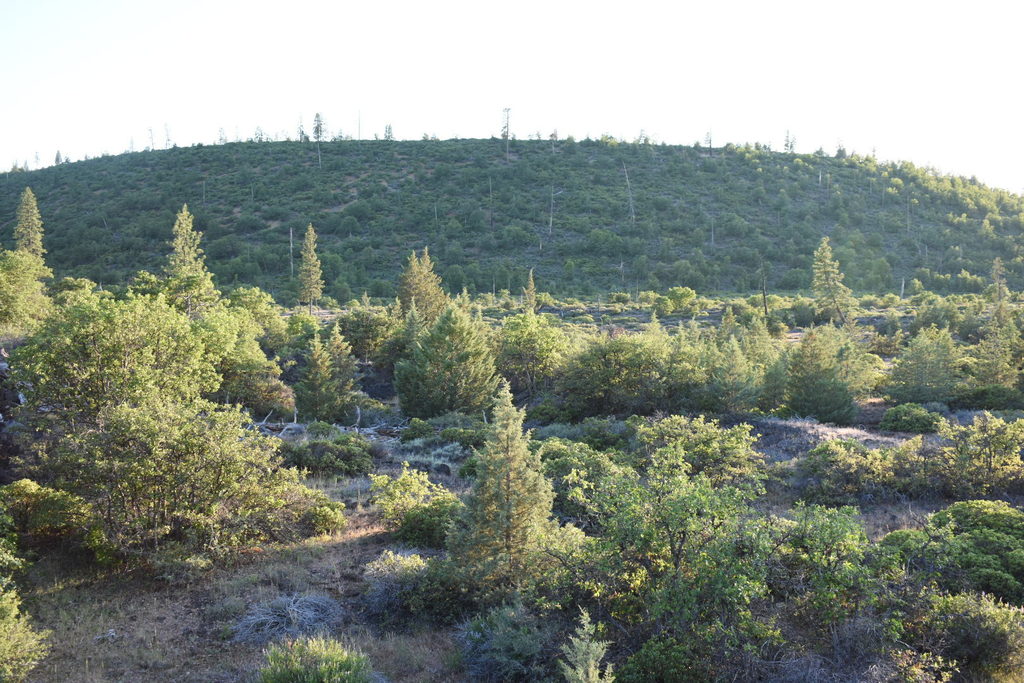
baker's cypress
Hesperocyparis bakeri
Cupressus bakeri, reclassified as Hesperocyparis bakeri, with the common names Baker cypress, Modoc cypress, or Siskiyou cypress, is a rare species of cypress tree endemic to a small area across far northern California and extreme southwestern Oregon, in the western United States.
From the article Hesperocyparis bakeri on Wikipedia (CC BY-SA), quoted section by section
Description
Hesperocyparis bakeri is a tree with a conical crown, growing to heights of 9–25 meters (30–82 ft), exceptionally to 39 m (130 ft), and a trunk diameter of up to 50 centimeters (20 inches), exceptionally to 1 m (40 in). The bark is thin, red when young, and gray in maturity. The foliage grows in sparse, very fragrant, usually pendulous sprays, varying from dull gray-green to glaucous blue-green in color. The leaves are scale-like, 2–5 millimeters long, and produced on rounded (not flattened) shoots. The seed cones are globose to oblong, covered in warty resin glands, 10–25 mm (3⁄8–1 in) long, with 6 or 8 (rarely 4 or 10) scales, green to brown at first, maturing gray or gray-brown about 20–24 months after pollination. The male cones are 3–5 mm long, and release pollen in February–March.
Range & habitat
The tree grows in limited populations in southwestern Oregon's Josephine and Jackson counties, and slightly more populously in a small section of Northern California within Siskiyou, Modoc, Shasta, Plumas and Tehama counties. It is probably the northernmost cypress. It is usually found in small, scattered populations, not in large forests, at altitudes of 900–2,000 m (3,000–6,600 ft). This includes locales in the Modoc Plateau, southern Cascade Range, Klamath Mountains, and northern Sierra Nevada. It is slow-growing in the wild, and is mostly restricted to sites difficult for plant growth, on serpentine soils and on old lava flows. Its tolerance of these sites enables it to avoid competition from much faster-growing trees. It is found in chaparral and yellow pine forest habitats.
Wikipedia: “Distribution and habitat”
What it does
The tree's thin bark makes it susceptible to wildfire, exposure to which is required to release the seeds; these then colonize the scorched earth left behind. Fire suppression policies of the past decades have severely limited reproduction of the species. It is listed as a vulnerable species on the IUCN Red List.
Wikipedia: “Ecology”
Where it lives
Recorded sightings
—
geo-referenced records in GBIF, from museums, herbaria and field observers.
Drag the globe to turn it. Dots are where records exist, not a range map; darker means more records.
In the stacks
Searching the stacks…
Every page naming Hesperocyparis bakeri in the Biodiversity Heritage Library →
This page is assembled live from iNaturalist, GBIF, Wikipedia, the Source Library and the Internet Archive. It is not yet part of the hand-edited codex. iNaturalist taxon 77374.