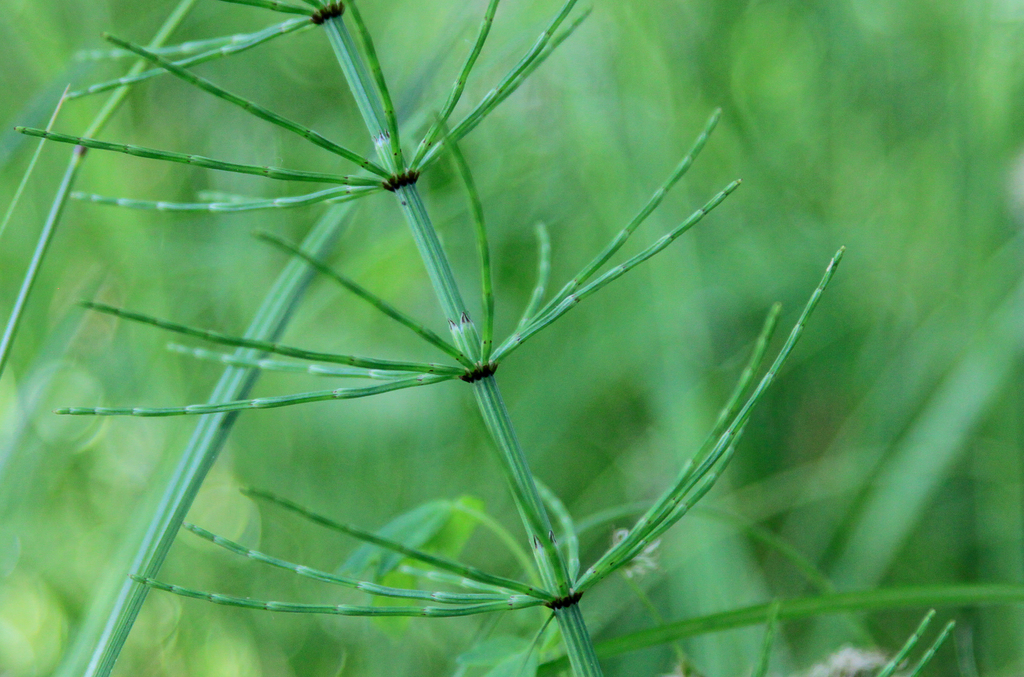
marsh horsetail
Equisetum palustre
Equisetum palustre, the marsh horsetail, is a perennial herbaceous pteridophyte belonging to the subclass of horsetails (Equisetidae). It is widespread in cooler regions of Eurasia and North America.
From the article Equisetum palustre on Wikipedia (CC BY-SA), quoted section by section
Description
Equisetum palustre has stems growing between 10-60 cm tall. The upright stems are usually scarcely branched with loose green leaf sheaths that have 5-10 narrow, dark teeth. The teeth are light at the edges. The lowest internode of the upright branches are much shorter than the leaf sheath of the stem. The rough, furrowed stem is 1–3 mm diameter, with usually 8–10 ribs, in rare cases, 4–12; it bears a variable number of whorled branches. The spores are spread by the wind (anemochory) and have four long ribbon-like structures attached to them. The spores sit on strobili which are rounded on the top. Marsh horsetails often form runners, with which they also can proliferate vegetatively.
What it does
Equisetum palustre is green from spring to autumn and grows spores from June to September. It grows primarily in nutrient-rich wet meadows. It is found in Europe and the circumpolar region up to mountainous heights. Its distribution is declining. In Finland, it has benefited from human action and grows often in road and track sides, ditches and especially peat based fields and pastures. A specific plant association in which E. palustre is found is the Juncus subnodulosus-Cirsium palustre fen-meadow.
Wikipedia: “Ecology”
Toxicity
Equisetum palustre is poisonous to mammals, most often reported as potentially fatal to horses, as it contains alkaloids palustrine and palustridiene, which destroy vitamin B1. According to Wink, Equisetum palustre also contains thiaminase enzymes. It is also known to contain lesser amounts of nicotine. Many thiaminases, however, are denatured by heat, and some sources refer Equisetum palustre safe to eat in moderate amounts when properly cooked. In Finland, it used to lower the production of dairy when cows would eat them in place of other preferable fodder.
Where it lives
Recorded sightings
—
geo-referenced records in GBIF, from museums, herbaria and field observers.
Drag the globe to turn it. Dots are where records exist, not a range map; darker means more records.
In the stacks
Searching the stacks…
Every page naming Equisetum palustre in the Biodiversity Heritage Library →
This page is assembled live from iNaturalist, GBIF, Wikipedia, the Source Library and the Internet Archive. It is not yet part of the hand-edited codex. iNaturalist taxon 76846.