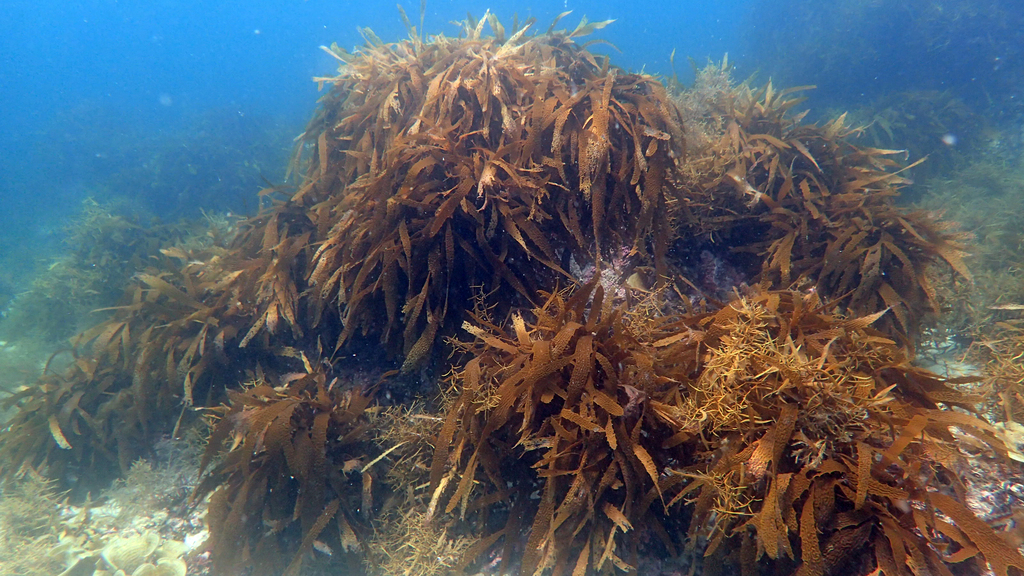
Eisenia bicyclis
Arame (荒布, Eisenia bicyclis, syn. Ecklonia bicyclis), sea oak is a species of kelp, of the brown algae, best known for its use in Japanese cuisine.
From the article Arame on Wikipedia (CC BY-SA), quoted section by section
Description
Eisenia bicyclis is indigenous to temperate Pacific Ocean waters centered near Japan, although it is deliberately cultured elsewhere, including South Korea. It grows and reproduces seasonally. Two flattened oval fronds rise from a stiff woody stipe which can be up to about 1 metre (3.3 ft) tall. The fronds are shed and new ones formed annually. The plant appears both branched and feathered. It may be harvested by divers manually or mechanically, and the dried form is available year-round.
At the table
It is one of many species of seaweed used in Asian cuisine. Usually purchased in a dried state, it is reconstituted quickly, taking about five minutes. Arame comes in dark brown strands, has a mild, semi-sweet flavor, and a firm texture. It is added to appetizers, casseroles, muffins, pilafs, soups, toasted dishes, and many other types of food. Its mild flavor makes it adaptable to many uses.
Wikipedia: “Cuisine”
Where it lives
Recorded sightings
—
geo-referenced records in GBIF, from museums, herbaria and field observers.
Drag the globe to turn it. Dots are where records exist, not a range map; darker means more records.
In the stacks
Searching the stacks…
Every page naming Eisenia bicyclis in the Biodiversity Heritage Library →
This page is assembled live from iNaturalist, GBIF, Wikipedia, the Source Library and the Internet Archive. It is not yet part of the hand-edited codex. iNaturalist taxon 768424.