- Plants
- ›Vascular Plants
- ›Ferns
- ›Leptosporangiate Ferns
- ›Polypod Ferns
- ›eupolypods I
- ›shieldfern family
- ›Dryopteridoideae
- ›Cyrtomium
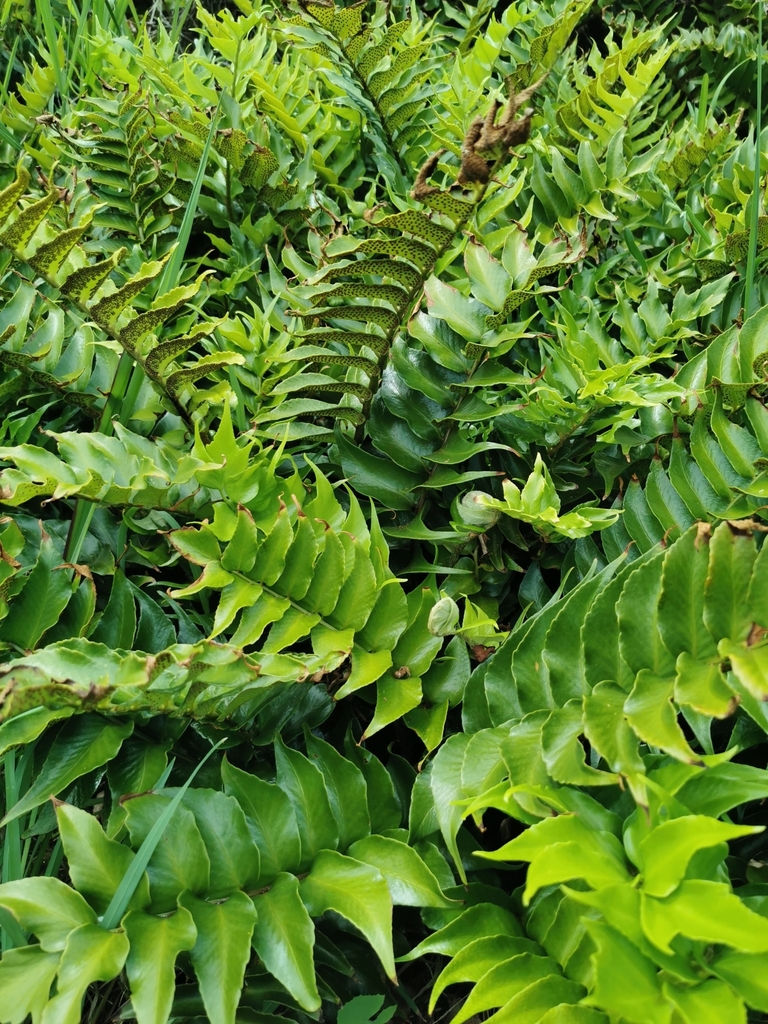
Japanese holly-fern
Cyrtomium falcatum
Cyrtomium falcatum is a species of fern, commonly known as house holly-fern and Japanese holly fern, in the wood fern family Dryopteridaceae. It is native to eastern Asia.
It grows from crevices in coastal cliffs, stream banks, rocky slopes, and other moist, stable areas.
From the article Cyrtomium falcatum on Wikipedia (CC BY-SA), quoted section by section
Description
This fern is a perennial plant with a large light brown rhizome. Cyrtomium falcatum has leaves exceeding 0.5 metres (1.6 ft) in length made up of six to ten pairs of shiny bright green leaflets. Each leathery leaflet has a flat to wavy to slightly toothed margin and a netlike pattern of veining. The underside of each leaflet has sori beneath brown or black indusia.
How it is grown
Cyrtomium falcatum is a fairly common outdoor ornamental plant in temperate climates (zones 6 to 10), such as in the coastal counties of California; it is more common as an indoor houseplant in areas with very cold or hot conditions. The holly fern is reliably hardy compared to many other, more tropical species of fern; outdoors, it thrives in locations of low indirect light to deep shade, such as underneath trees or bushes. It may be propagated by spores, but is more commonly multiplied via rhizome division, rooting the fresh cuttings in a substrate of coconut fiber, sphagnum moss, or another well-aerated substrate. The cuttings should be kept evenly moist and shaded but not sitting in a pool of water. Holly ferns planted either in containers or in the ground are not picky about soil composition or quality; like other ferns, they will even grow mounted or tied to driftwood, wooden boards, tree branches or rocks, provided there is some amount of sphagnum moss or other organic medium surrounding the rhizome and rootball and the plant receives adequate water. While soil quality is not of utmost importance, good drainage and aeration, combined with sufficient moisture retention, is a must. …
Wikipedia: “Cultivation”
Where it lives
Recorded sightings
—
geo-referenced records in GBIF, from museums, herbaria and field observers.
Drag the globe to turn it. Dots are where records exist, not a range map; darker means more records.
In the stacks
Searching the stacks…
Every page naming Cyrtomium falcatum in the Biodiversity Heritage Library →
This page is assembled live from iNaturalist, GBIF, Wikipedia, the Source Library and the Internet Archive. It is not yet part of the hand-edited codex. iNaturalist taxon 76595.