- Animals
- ›Chordates
- ›Vertebrates
- ›Mammals
- ›Therians
- ›Placental Mammals
- ›Ungulates, Carnivorans, and Allies
- ›Even-toed Ungulates and Cetaceans
- ›Ruminants
- ›Bovids
- ›Bovines
- ›Spiral-horned Antelopes
- ›Tragelaphus
- ›Taurotragus
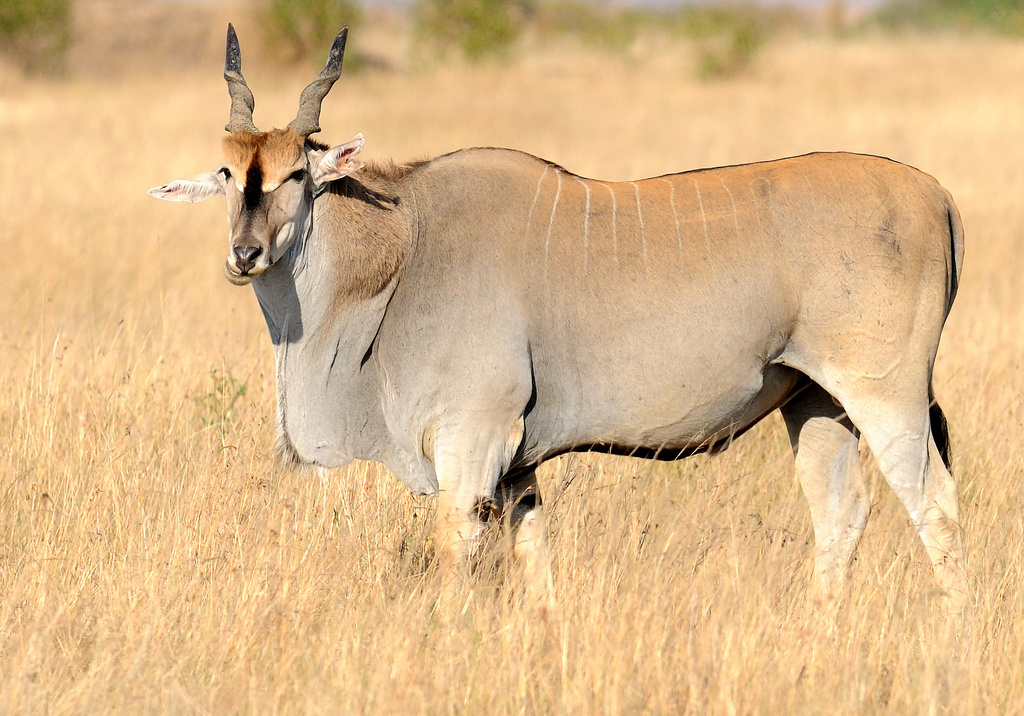
Common Eland
Tragelaphus oryx
The common eland (Tragelaphus oryx), also known as the southern eland or eland antelope, is a large savannah and plains antelope found in East and Southern Africa. An adult male is around 1.6 m (5.2 ft) tall at the shoulder and can weigh up to 942 kg (2,077 lb) with a typical range of 500–600 kg (1,100–1,300 lb). Females are around 1.4 m (4.6 ft) tall and weigh 340–445 kg (750–981 lb). It was scientifically described by Peter Simon Pallas in 1766.
Mainly a herbivore, its diet is primarily grasses and leaves. Common elands form herds of up to 500 animals, but are not territorial. The common eland prefers habitats with a wide variety of flowering plants such as savannah, woodlands, and open and montane grasslands; it avoids dense forests. It uses loud barks, visual and postural movements, and the flehmen response to communicate and warn others of danger. The common eland is used by humans for leather and meat, and has been domesticated in southern Africa. Eland milk contains more butterfat than cow's milk, and can be stored for up to eight months.
From the article Common eland on Wikipedia (CC BY-SA), quoted section by section
Range & habitat
Common elands live on the open plains of Southern Africa and along the foothills of the great southern African plateau. The species extends north into Ethiopia and most arid zones of South Sudan, west into eastern Angola and Namibia, and south to South Africa. However, a low density of elands exists in Africa due to poaching and human settlement. Elands prefer to live in semiarid areas that contain many shrub-like bushes, and often inhabit grasslands, woodlands, subdesert, bush, and mountaintops with altitudes of about 15,000 ft (4,600 m). Elands do, however, avoid forests, swamps and deserts. The places inhabited by elands generally contain Acacia, Combretum, Commiphora, Diospyros, Grewia, Rhus, and Ziziphus trees and shrubs; some of these also serve as their food. Eland can be found in many national parks and reserves today, including Nairobi National Park and Tsavo East National Park, Tsavo West National Park, Masai Mara National Reserve, (Kenya); Serengeti National Park, Ruaha National Park and Tarangire National Park, Ngorongoro Crater, (Tanzania); Kagera National Park (Rwanda); Nyika National Park (Malawi); Lake Mburo National Park (Uganda); Kidepo Valley National Park (Uganda); Luangwa Valley and Kafue National Park (Zambia); Hwange National Park, Matobo National Park, Tuli Safari Area and Chimanimani Eland Sanctuary (Zimbabwe); Kruger National Park, Kgalagadi Transfront …
Wikipedia: “Habitat and distribution”
What it does
Common elands are nomadic and crepuscular. They eat in the morning and evening, rest in shade when hot, and remain in sunlight when cold. They are commonly found in herds numbering up to 500, with individual members remaining in the herd from several hours to several months. Juveniles and mothers tend to form larger herds, while males may separate into smaller groups or wander individually. During estrus, mainly in the rainy season, groups tend to form more regularly. In Southern Africa, common elands will often associate with herds of zebras, roan antelopes and oryxes.
Common elands communicate via gestures, vocalizations, scent cues, and display behaviors. The flehmen response also occurs, primarily in males in response to contact with female urine or genitals. Females urinate to indicate fertility during the appropriate phase of their estrous cycle, as well as to indicate their lack of fertility when harassed by males. If eland bulls find any of their predators nearby, they bark and attempt to attract the attention of others by trotting back and forth until the entire herd is conscious of the danger. Some of their main predators include lions, African wild dogs, cheetahs, and spotted hyenas. Eland calves are more vulnerable than adults to their predators.
Diet. …
Wikipedia: “Ecology and behavior”
At the table
The common eland is sometimes farmed and hunted for its meat, and in some cases can be better used than cattle because it is more suited to African climates. This has led to some Southern African farmers switching from cattle to eland. Common elands are also pictured as supporters in the coat of arms of Grootfontein, Namibia.
Wikipedia: “Uses”
How it is grown
Common elands have a mild temperament and have been successfully domesticated for meat and milk production in South Africa and Russia. Their need for water is quite low because they produce urine with a high urea content, but they require a substantial grazing area, along with salt licks and large amounts of supplementary feed such as maize, sorghum, melons, and beans, which can be expensive. A female can produce up to 7 kg (15 lb) of milk per day that is richer in milkfat than cow milk. The pleasant-tasting milk has a butterfat content of 11-17% and can be stored for up to eight months if properly prepared, versus several days for cow milk. Housing common elands is difficult due to their ability to jump over fences as high as 3 m (9.8 ft) or simply break through using their substantial mass. Sometimes, wild elands break through enclosures to mix with domesticated ones. Common elands can reproduce in captivity, but calf survival is low and the young may need to be separated from their mothers to ensure health and adequate feeding. Husbandry requires care because the generally placid animals startle easily and require large amounts of space.
== References ==
Wikipedia: “Husbandry”
In human culture
The scientific name of the common eland is Tragelaphus oryx. The genus name is not of modern scientific invention, but comes from ancient Greek τραγέλαφος (tragélaphos), from τράγος (trágos), meaning a "male goat", and ἔλαφος (élaphos), meaning a "deer". Oryx is Latin and Greek (genitive: orygos) for pickaxe, referring to the pointed horns of North African antelopes like the common eland and scimitar-horned oryx. The name eland is Afrikaans for "elk" from Dutch eland of same meaning, from obsolete German Elend, probably from obsolete Lithuanian ellenis; eland itself is a direct English cognate (thus doublet) of "elk". When Dutch settlers came to the Cape of Good Hope, creating the Dutch Cape Colony, they named the animal after the large, herbivorous moose. In Dutch, the animal is called "eland antelope" to distinguish it from the moose found in northern boreal forests. Another term absorbed into Afrikaans to refer to elands in general is impofu from surrounding Bantu languages like Zulu and Swazi.
Wikipedia: “Etymology”
Listen
Looking for field recordings…
Where it lives
Recorded sightings
—
geo-referenced records in GBIF, from museums, herbaria and field observers.
Drag the globe to turn it. Dots are where records exist, not a range map; darker means more records.
In the stacks
Searching the stacks…
Every page naming Tragelaphus oryx in the Biodiversity Heritage Library →
This page is assembled live from iNaturalist, GBIF, Wikipedia, the Source Library and the Internet Archive. It is not yet part of the hand-edited codex. iNaturalist taxon 75192.