- Animals
- ›Chordates
- ›Vertebrates
- ›Mammals
- ›Therians
- ›Placental Mammals
- ›Ungulates, Carnivorans, and Allies
- ›Bats
- ›Yangochiroptera
- ›Vespertilionoid Bats
- ›Evening Bats
- ›Vesper Bats
- ›Eptesicini
- ›Scotorepens
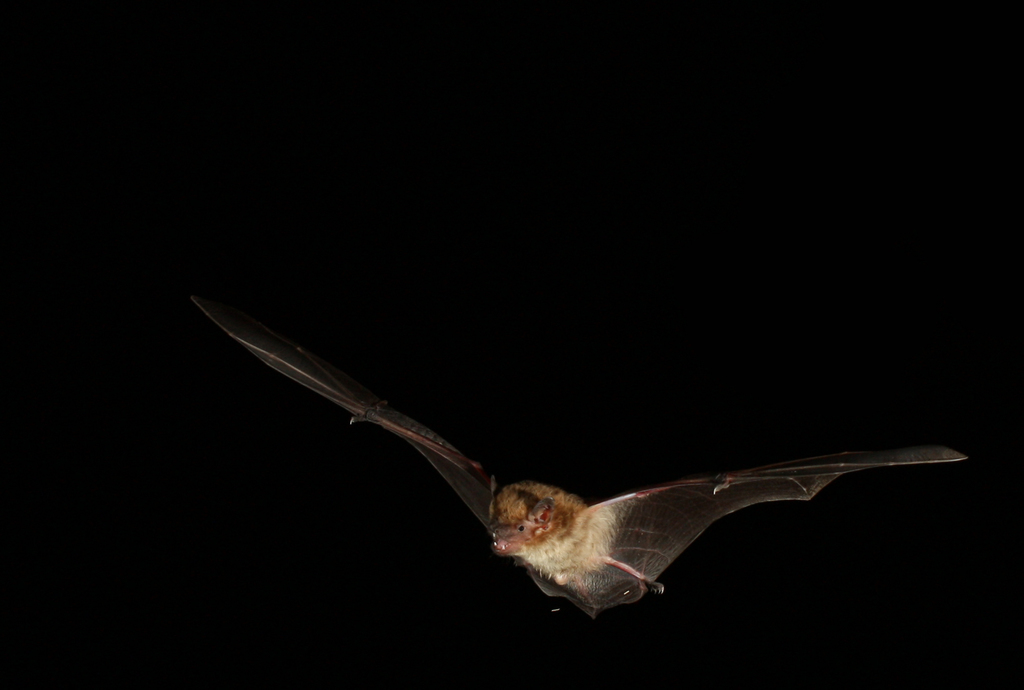
Northern Broad-nosed Bat
Scotorepens sanborni
The northern broad-nosed bat (Scotorepens sanborni) is a species of the vespertilionid family of microbats. It can be found in northern Australia, Timor-Leste, and Papua New Guinea.
From the article Northern broad-nosed bat on Wikipedia (CC BY-SA), quoted section by section
Description
A species of Scotorepens, closely resembling the widespread 'inland' or 'western' species S. balstoni excepting its slightly larger size. The muzzle is hairless and has prominent glands that are characteristic of the genus. The pelage colour is variable among individuals, the hair over the upper-parts is a uniform sandy to tawny olive and darker than the bi-coloured ventral fur, which is a pale greyish brown with whitish tips. The measurements of the geographical separated Australian populations are distinguished as those from the northwest and another from Queensland, as with S. balstoni the size of individuals becomes greater in the east and north of the range. The size and weight range of the Kimberley and Top End group is 28 to 34 millimetres for the forearm, an average of 31 mm; head and body combined is 37 to 48 mm; tail length is 27–36 mm; ear length is an average of 10 mm, ranging from 9–12 mmm; the average weight of the range 5.7 to 7.3 grams is 6.5 g. Those in Queensland are somewhat larger, a forearm length averaging 33 mm, for a range of 31–36 mm; head and body is 40–52 mm; tail ranges in length from 29 to 39 mm, ear length from 10 to 13 mm. The weight range of the eastern populous is 5.7 to 9.1 grams, an average of 7.3 g.
Range & habitat
A widely distributed species whose range extends across Timor-Leste, Papua New Guinea and the northern coast of Australia. There are two geographically separated populations in the northern parts of Australia. One is located from the western Top End to the Kimberley region in the northwest of the continent, occurring in coastal and sub-coastal wooded regions of mangrove forest and near waterways. Another population is located north of Rockhampton, inland from the coast to the Cape York Peninsula, occurring at heathlands, open woodland and monsoonal forest.
Wikipedia: “Distribution and habitat”
What it does
The daytimes roosts are usually sited in tree hollows, although buildings have also been used. They are often observed foraging for smaller flying insects such as midges and mosquitoes over open water. The species reproduces during September to November.
== References ==
Wikipedia: “Behaviour”
Listen
Looking for field recordings…
Where it lives
Recorded sightings
—
geo-referenced records in GBIF, from museums, herbaria and field observers.
Drag the globe to turn it. Dots are where records exist, not a range map; darker means more records.
In the stacks
Searching the stacks…
Every page naming Scotorepens sanborni in the Biodiversity Heritage Library →
This page is assembled live from iNaturalist, GBIF, Wikipedia, the Source Library and the Internet Archive. It is not yet part of the hand-edited codex. iNaturalist taxon 75076.