- Animals
- ›Chordates
- ›Vertebrates
- ›Mammals
- ›Therians
- ›Placental Mammals
- ›Primates, Rodents, and Allies
- ›Primates
- ›Lemurs, Lorises, and Allies
- ›Lorises, Pottos, and Galagos
- ›Lorises and Pottos
- ›Lorises
- ›Nycticebus
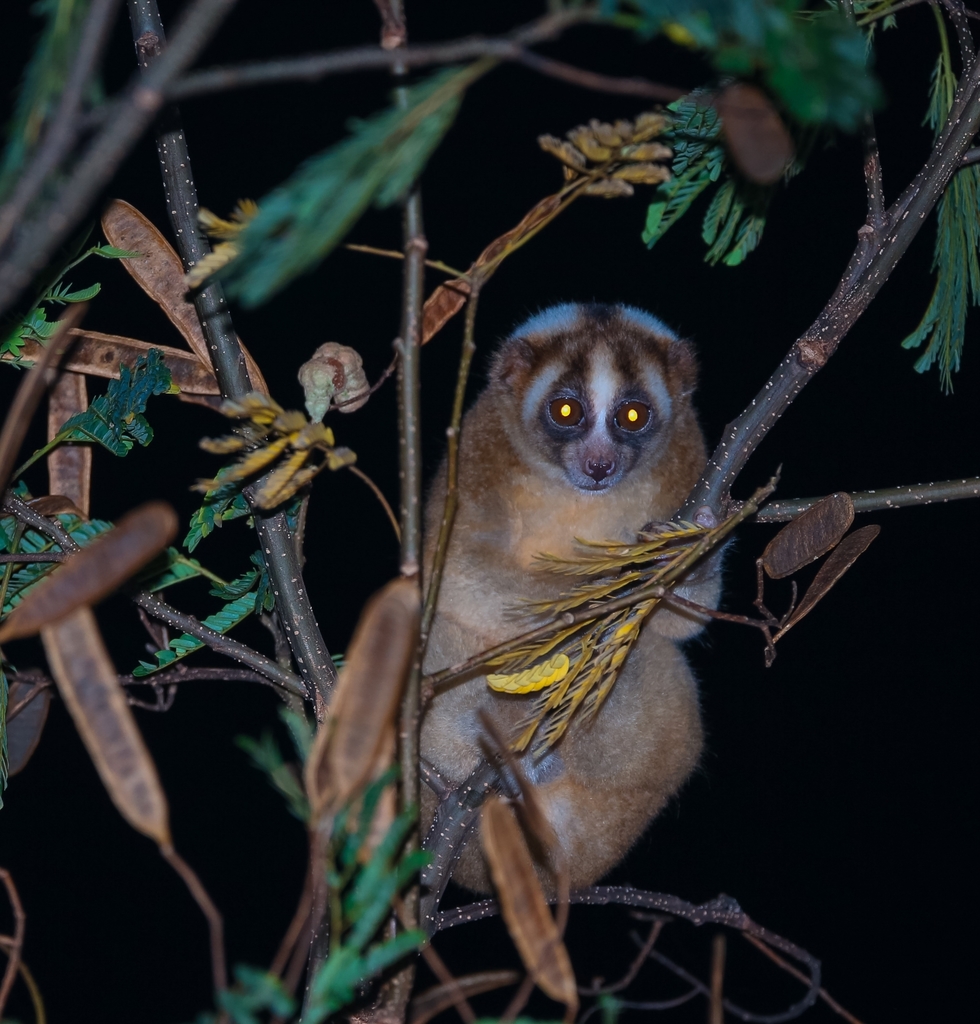
Javan Slow Loris
Nycticebus javanicus
The Javan slow loris (Nycticebus javanicus) is a strepsirrhine primate and a species of slow loris native to the western and central portions of the island of Java, in Indonesia. Although originally described as a separate species, it was considered a subspecies of the Sunda slow loris (N. coucang) for many years, until reassessments of its morphology and genetics in the 2000s resulted in its promotion to full species status. It is most closely related to the Sunda slow loris and the Bengal slow loris (N. bengalensis). The species has two forms, based on hair length and, to a lesser extent, coloration.
Its forehead has a prominent white diamond pattern, which consists of a distinct stripe that runs over its head and forks towards the eyes and ears. The Javan slow loris weighs between 565 and 687 g (1.25 and 1.51 lb) and has a head-body length of about 293 mm (11.5 in). Like all lorises, it is arboreal and moves slowly across vines and lianas instead of jumping from tree to tree. Its habitat includes primary and secondary forests, but it can also be found in bamboo and mangrove forests, and on chocolate plantations. Its diet typically consists of fruit, tree gum, lizards, and eggs. It sleeps on exposed branches, sometimes in groups, and is usually seen alone or in pairs.
From the article Javan slow loris on Wikipedia (CC BY-SA), quoted section by section
Description
The Javan slow loris weighs between 565 and 687 g (19.9 and 24.2 oz) and is similar in appearance to the largest slow loris, the Bengal slow loris. Its face and back are marked with a distinct stripe that runs over the crown and forks, leading to the eyes and ears, which leaves a white diamond pattern on the forehead. Its color is yellowish-gray. In contrast, its head, neck, and shoulders have cream hues. Like the Bornean slow loris (N. menagensis), it lacks the second incisor (I2) in its dentition. The Javan slow loris is larger than both of the other Indonesian slow lorises, the Sunda slow loris and the Bornean slow loris. Based on averages determined from six specimens obtained from the illegal wildlife trade in Java, other morphometric parameters are as follows: 59.2 mm (2.33 in) head length; 19.9 mm (0.78 in) snout length; 43.6 mm (1.72 in) head breadth; 250.8 mm (9.87 in) body breadth; 293.1 mm (11.54 in) head and body length; 190.8 mm (7.51 in) chest girth; 48.0 mm (1.89 in) dark percentage girth measured with dark dorsal hair, as a percent of girth circumference; 136.7 mm (5.38 in) neck circumference; 20.4 mm (0.80 in) long tail; 67.2 mm (2.65 in) long humerus; 71.8 mm (2.83 in) long radius bone; 83.2 mm (3.28 in) long femur; 85.9 mm (3.38 in) long tibia; hand span of 59.1 mm (2.33 in); foot span of 70.3 mm (2.77 in); and 16.8 mm (0.66 in) long ears. The ornatus mo …
Range & habitat
The species is found only on the western and central portion of the island of Java in Indonesia. Its presence has been confirmed in the Dieng Mountains, and it is known to be found in low densities at Gunung Gede Pangrango National Park (in montane cloud forests) and Mount Halimun Salak National Park, often only where human disturbance is minimal. It inhabits both primary and secondary disturbed forest, and can be found from sea level to 1,600 m (5,200 ft), although it is more commonly found at higher elevations since lower elevations tend to be deforested. A study in 2000 showed that in addition to primary and secondary forest, the Javan slow loris could be found in bamboo forests, mangrove forests, and on plantations—particularly chocolate plantations. In 2008, they were observed in West Java to occupy mixed-crop home gardens, tolerating high levels of human disturbance.
Wikipedia: “Distribution”
What it does
Like other lorises, the Javan slow loris is nocturnal and arboreal, relying on vines and lianas. However, the animal has been observed moving on the ground to cross open spaces in disturbed habitat. It moves through the canopy at heights between 3 and 22 m (10 and 72 ft) and is often encountered at heights between 1.5 and 9.5 m (5 and 31 ft). The Javan slow loris will eat fruit, lizards, eggs, and chocolate seeds. It is also known to eat the gum of trees of the genus Albizia, in the legume family, Fabaceae, as well as from the palm genus Arenga (family Arecaceae). Javan slow lorises are seen alone or in pairs and are sometimes found sleeping in groups. Instead of sleeping in nest holes, they sleep curled up on branches. Like other slow lorises, the Javan slow loris has a distinctive call that resembles a high-frequency whistle. The species is a host for the parasitic flatworm, Phaneropsolus oviforme.
Wikipedia: “Behavior and ecology”
Listen
Looking for field recordings…
Where it lives
Recorded sightings
—
geo-referenced records in GBIF, from museums, herbaria and field observers.
Drag the globe to turn it. Dots are where records exist, not a range map; darker means more records.
In the stacks
Searching the stacks…
Every page naming Nycticebus javanicus in the Biodiversity Heritage Library →
This page is assembled live from iNaturalist, GBIF, Wikipedia, the Source Library and the Internet Archive. It is not yet part of the hand-edited codex. iNaturalist taxon 74792.