- Animals
- ›Chordates
- ›Vertebrates
- ›Mammals
- ›Therians
- ›Placental Mammals
- ›Ungulates, Carnivorans, and Allies
- ›Carnivorans
- ›Felids
- ›Big Cats
- ›Neofelis
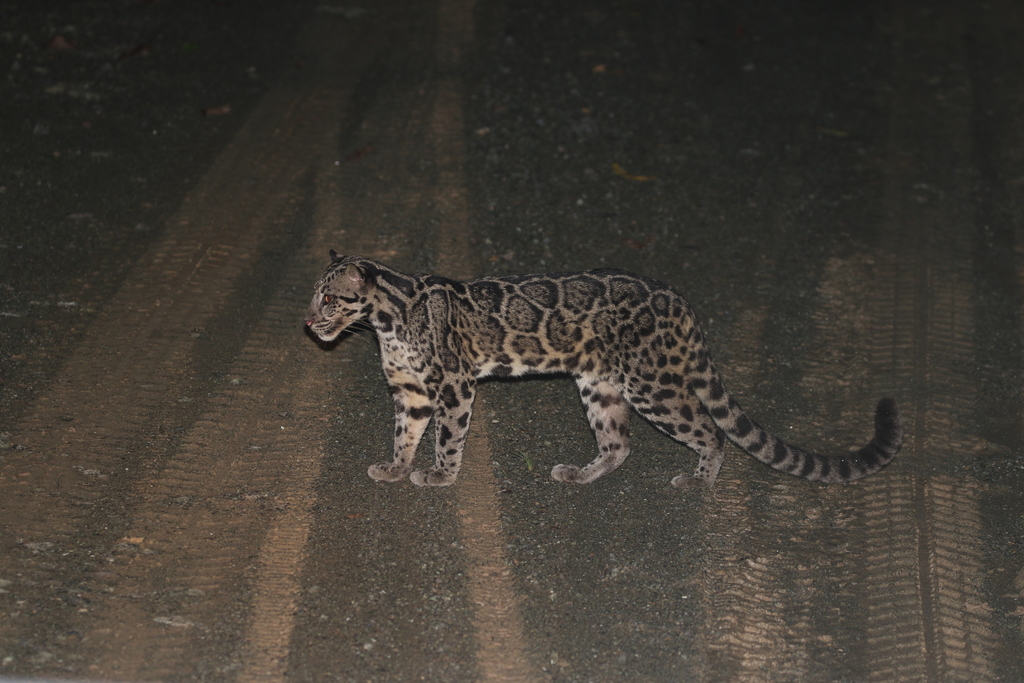
Sunda Clouded Leopard
Neofelis diardi
The Sunda clouded leopard (Neofelis diardi) is a medium-sized wild cat native to Borneo and Sumatra. It is listed as Vulnerable on the IUCN Red List since 2015, as the total effective population probably consists of fewer than 10,000 mature individuals, with a decreasing population trend. On both Sunda Islands, it is threatened by deforestation.
It was classified as a separate species, distinct from its close relative, the clouded leopard in mainland Southeast Asia based on a study in 2006. Its fur is darker with a smaller cloud pattern.
From the article Sunda clouded leopard on Wikipedia (CC BY-SA), quoted section by section
Description
The Sunda clouded leopard is overall grayish yellow or gray hue. It has a double midline on the back and is marked with small irregular cloud-like patterns on shoulders. These cloud markings have frequent spots inside and form two or more rows that are arranged vertically from the back on the flanks. It can purr as its hyoid bone is ossified. Its pupils contract to vertical slits. It has a stocky build and weighs around 12 to 26 kg (26 to 57 lb). Its canine teeth are 2 in (5.1 cm) long, which, in proportion to the skull length, are longer than those of any other living cat. Its tail can grow to be as long as its body, aiding balance.
Wikipedia: “Characteristics”
Range & habitat
The Sunda clouded leopard is restricted to the islands of Borneo and Sumatra. In Borneo, it occurs in lowland rainforest, and at lower density in logged forest below 1,500 m (4,900 ft). In Sumatra, it appears to be more abundant in hilly, montane areas. It is unknown if it still occurs on the Batu Islands close to Sumatra. Between March and August 2005, tracks of clouded leopards were recorded during field research in the Tabin Wildlife Reserve in Sabah. The population size in the 56 km2 (22 sq mi) research area was estimated to be five individuals, based on a capture-recapture analysis of four confirmed animals differentiated by their tracks. The density was estimated at eight to 17 individuals per 100 km2 (39 sq mi). The population in Sabah is roughly estimated at 1,500–3,200 individuals, with only 275–585 of them living in totally protected reserves that are large enough to hold a long-term viable population of more than 50 individuals. Density outside protected areas in Sabah is probably much lower, estimated at one individual per 100 km2 (39 sq mi). In Sumatra, it was recorded in Kerinci Seblat, Gunung Leuser and Bukit Barisan Selatan National Parks. It occurs most probably in much lower densities than on Borneo. …
Wikipedia: “Distribution and habitat”
What it does
The habits of the Sunda clouded leopard are largely unknown because of the animal's secretive nature. It is assumed that it is generally solitary. It hunts mainly on the ground and uses its climbing skills to hide from dangers.
Diet. The Sunda clouded leopard has been observed feeding on sambar deer, muntjacs, Bornean bearded pigs, mouse deer, porcupines and primates.
Wikipedia: “Ecology and behaviour”
Listen
Looking for field recordings…
Where it lives
Recorded sightings
—
geo-referenced records in GBIF, from museums, herbaria and field observers.
Drag the globe to turn it. Dots are where records exist, not a range map; darker means more records.
In the stacks
Searching the stacks…
Every page naming Neofelis diardi in the Biodiversity Heritage Library →
This page is assembled live from iNaturalist, GBIF, Wikipedia, the Source Library and the Internet Archive. It is not yet part of the hand-edited codex. iNaturalist taxon 74753.