- Animals
- ›Chordates
- ›Vertebrates
- ›Mammals
- ›Therians
- ›Placental Mammals
- ›Ungulates, Carnivorans, and Allies
- ›Even-toed Ungulates and Cetaceans
- ›Ruminants
- ›Bovids
- ›Antelopes, Goats, and Sheep
- ›Typical Antelopes
- ›Nanger
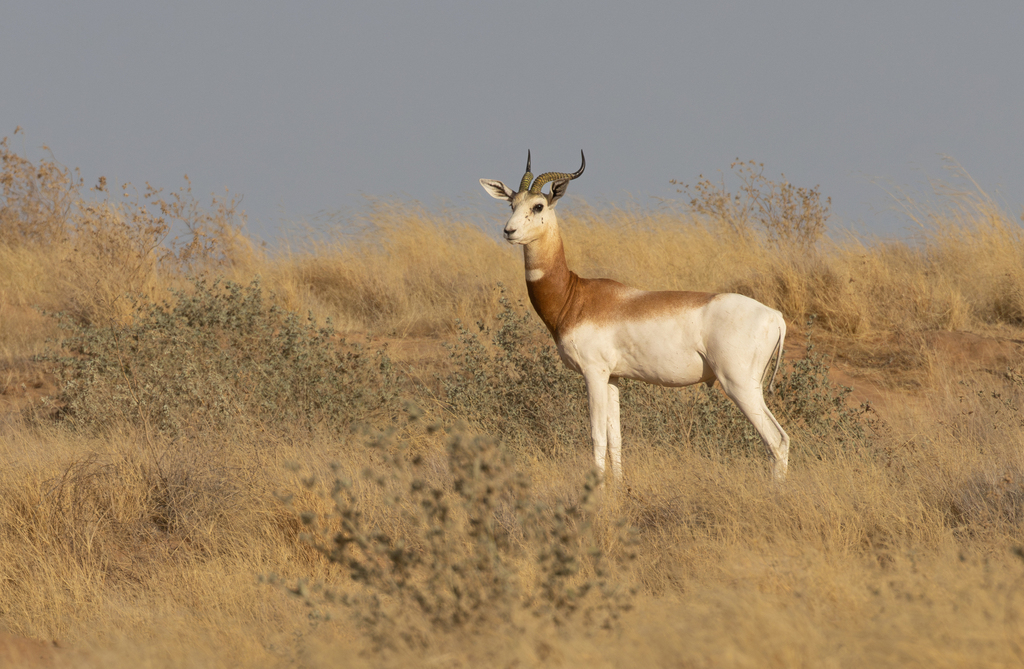
Dama Gazelle
Nanger dama
The dama gazelle (Nanger dama), also known as the addra gazelle or mhorr gazelle, is a species of gazelle. It lives in Africa, in the Sahara desert and the Sahel. A critically endangered species, it has disappeared from most of its former range due to overhunting and habitat loss, and natural populations only remain in Chad, Mali, and Niger. Its habitat includes grassland, shrubland, semi-deserts, open savanna and mountain plateaus. Its diet includes shrubs, herbs, grasses, leaves (especially Acacia leaves), shoots, and fruit.
In Niger, the dama gazelle has become a national symbol. Under the Hausa name meyna or ménas, the dama gazelle appears on the badge of the Niger national football team, who are popularly called the Ménas.
From the article Dama gazelle on Wikipedia (CC BY-SA), quoted section by section
Description
The dama gazelle is white with a reddish-brown head and neck. Both sexes usually have medium-length ringed horns curved like an "S". Males' horns are about 35 cm (14 in) long, while females' horns are much shorter. The head is small with a narrow muzzle, and the eyes are relatively large. It has a longer neck and longer legs than most gazelles. It is between 90 and 95 cm (35 and 37 in) tall at the shoulder, weighs between 35 and 75 kg (77 and 165 lb), and has a lifespan up to 12 years in the wild or 18 in captivity. A few days following birth, dama young are strong enough to follow the herd, and after a week, they are able to run as fast as the adults. The dama gazelle is considered the largest species of gazelle, with incredibly long legs, which provide extra surface area to dissipate heat, one of the many ways it stays cool in its hot desert environment. It also tends to need more water than some of its desert relatives, but it can withstand fairly long periods of drought. Unlike many other desert mammals, the dama gazelle is a diurnal species, meaning it is active during the day. Always on the alert, the dama gazelle uses a behavior called pronking to warn herd members of danger. Pronking involves the animal hopping up and down with all four of its legs stiff, so that its limbs all leave and touch the ground at the same time. …
Listen
Looking for field recordings…
Where it lives
Recorded sightings
—
geo-referenced records in GBIF, from museums, herbaria and field observers.
Drag the globe to turn it. Dots are where records exist, not a range map; darker means more records.
In the stacks
Searching the stacks…
Every page naming Nanger dama in the Biodiversity Heritage Library →
This page is assembled live from iNaturalist, GBIF, Wikipedia, the Source Library and the Internet Archive. It is not yet part of the hand-edited codex. iNaturalist taxon 74723.