- Animals
- ›Chordates
- ›Vertebrates
- ›Mammals
- ›Therians
- ›Placental Mammals
- ›Primates, Rodents, and Allies
- ›Rodents
- ›Mice, Rats, and Hamsters
- ›Muroids
- ›Hamsters, Voles, Lemmings, and Allies
- ›South American Mice and Rats
- ›Rice Rats
- ›Mindomys
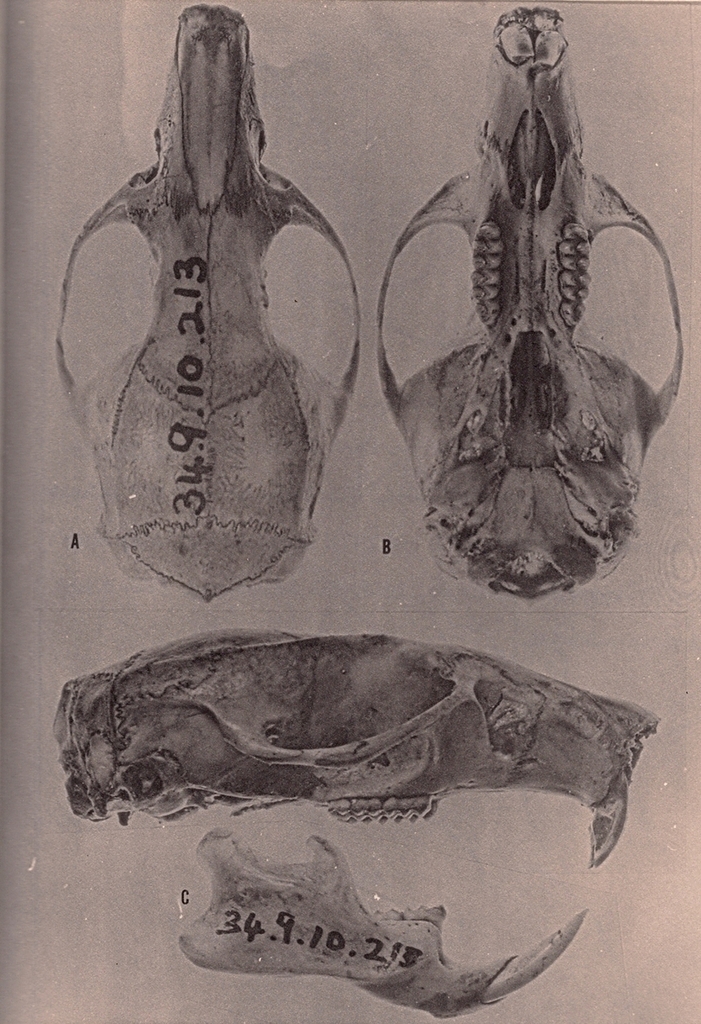
Hammond's rice rat
Mindomys hammondi
Mindomys hammondi, also known as Hammond's rice rat or Hammond's oryzomys, is an endangered species of rodent in the tribe Oryzomyini of family Cricetidae. Formerly considered to be related with Nectomys, Sigmodontomys, Megalomys, or Oryzomys, it is now placed in then genus Mindomys, but its relationships remain obscure; some evidence supports a placement near Oecomys or as a basal member of Oryzomyini.
Mindomys hammondi is known only from Ecuador, where it occurs in montane forest; a record from the Amazon basin lowlands is dubious. Reportedly, it lives on the ground and is associated with water; others suggest it lives in trees. A large, long-tailed, and long-whiskered rat, its fur is buff above and abruptly lighter below. The front part of the skull (rostrum) is heavily built.
From the article Hammond's rice rat on Wikipedia (CC BY-SA), quoted section by section
Description
Mindomys hammondi is a large rice rat; all other rats known within its range are smaller. The fur is relatively short and woolly and is buffy with a grayish tone above and much paler—yellow or white—below, with the bases of the hairs grey. It has a long snout and small, dark ears that appear hairless. The vibrissae (whiskers) are long. The very long tail is dark both above and below and has rectangular scales. The hindfeet are broad, with long, narrow digits. They have poorly developed ungual tufts, patches of hair between the digits and along the plantar margins. The squamae, small structures resembling scales that cover the soles of the hindfeet in many oryzomyines, are indistinct. The fifth digit reaches to about half the length of the second phalange of the fourth. As in most oryzomyines, females have eight mammae. In specimens with published measurements, head and body length is 173 to 203 mm (6.8 to 8.0 in), tail length is 251 mm (9.9 in), hindfoot length is 41 to 42 mm (1.6 to 1.7 in), ear length is 18 mm (0.71 in), and greatest length of skull is 39.4 to 43.9 mm (1.55 to 1.73 in).
Skull. In the skull, the rostrum (front part) is large and robust. The nasal bones are short, not extending further back than the lacrimals, and the premaxillaries extend about as far back as the nasals. …
Range & habitat
A rare species, Mindomys hammondi is known only from Ecuador. Between 1913 and 1980, eight specimens were collected at Mindo, a "tiny agricultural community" at 1,264 m (4,147 ft) elevation in Pichincha Province, northwestern Ecuador. Another specimen is labeled as having been collected on July 27, 1929, by the Olalla family of professional collectors in Concepción, a locality in the Amazon basin lowlands of Napo Province, around 300 to 500 m (980 to 1,640 ft) above sea level. If this record is correct, Mindomys would be unique among small, non-flying mammals native to Ecuador in occurring at relatively low elevations on both sides of the Andes. Furthermore, other collectors working in the same area in Napo have failed to find Mindomys, and the date the specimen was reportedly collected does not accord with the dates reported for the visit of the Olallas to Concepción, rendering its provenance dubious. There are two other locations named "Concepción" in northwestern Ecuador, and Diego Tirira suggested in 2007 that the specimen may instead be from one of these. …
Wikipedia: “Distribution and ecology”
Listen
Looking for field recordings…
Where it lives
Recorded sightings
—
geo-referenced records in GBIF, from museums, herbaria and field observers.
Drag the globe to turn it. Dots are where records exist, not a range map; darker means more records.
In the stacks
Searching the stacks…
Every page naming Mindomys hammondi in the Biodiversity Heritage Library →
This page is assembled live from iNaturalist, GBIF, Wikipedia, the Source Library and the Internet Archive. It is not yet part of the hand-edited codex. iNaturalist taxon 74619.