- Animals
- ›Chordates
- ›Vertebrates
- ›Mammals
- ›Therians
- ›Placental Mammals
- ›Ungulates, Carnivorans, and Allies
- ›Carnivorans
- ›Mustelids
- ›Eurasian and Hog Badgers
- ›Meles
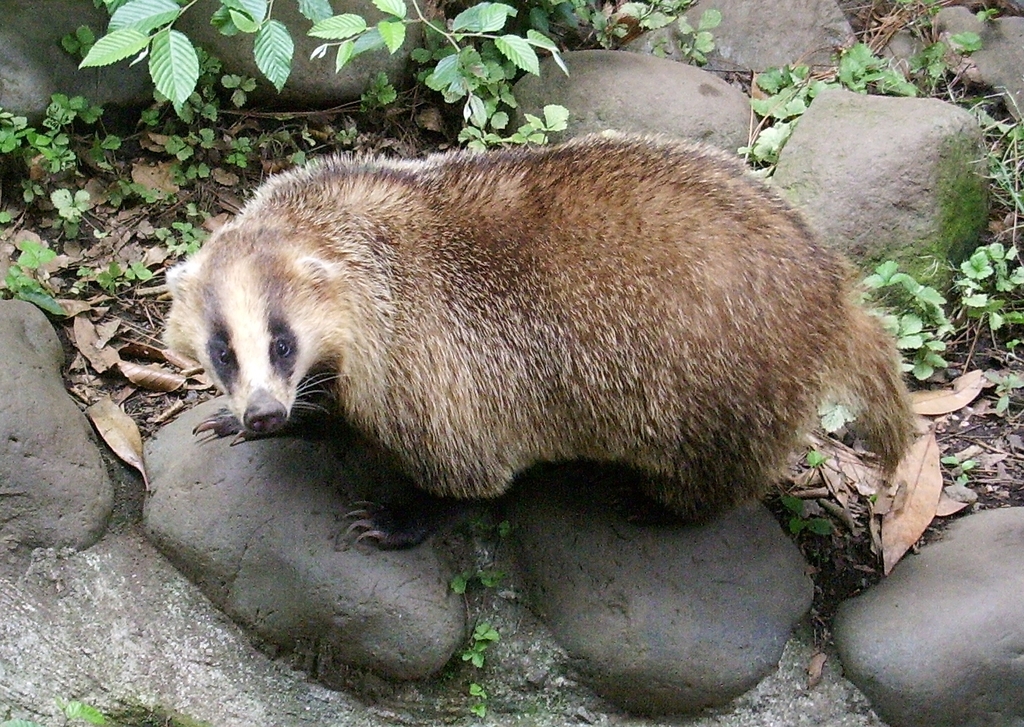
Japanese Badger
Meles anakuma
The Japanese badger (Meles anakuma) is a species of carnivoran of the family Mustelidae, the weasels and their kin. Endemic to Japan, it is found on Honshu, Kyushu, Shikoku, and Shōdoshima. It is assigned to the genus Meles with its close relatives, the European (M. meles), Caucasian (M. canescens) and Asian (M. leucurus) badgers. In Japan, it is called by the name anaguma (穴熊, 貛) meaning "hole-bear", or mujina (むじな, 狢, 貉).
From the article Japanese badger on Wikipedia (CC BY-SA), quoted section by section
Description
At an average length of 79 cm (31 in) in males and 72 cm (28 in) in females, the Japanese badger is generally smaller and less sexually dimorphic (except in the size of the canine teeth) than its European counterparts. Tail length is between 14 and 20 cm (5.5 and 7.9 in). This species is similar or mildly larger than the Asian badger. Adults usually weigh from 3.8 to 11 kg (8.4 to 24.3 lb). The average weight of female Japanese badgers in one study from the Tokyo area was found to be 6.6 kg (15 lb) while that of males was 7.76 kg (17.1 lb). In Yamaguchi Prefecture, the average spring weight of female and male Japanese badgers was 4.4 kg (9.7 lb) and 5.7 kg (13 lb) respectively. The torso is blunt and limbs are short. The front feet are equipped with powerful digging claws. The claws on the hind feet are smaller. The outer coat has long gray-brown hair. Ventral hair is short and black. The face has characteristic black-white stripes that are not as distinct as in the European badger. The dark color is concentrated around the eyes. The skull is smaller than the European badger.
What it does
Similar to other badgers, the Japanese badger's diet is omnivorous; it includes earthworms, beetles, berries and persimmons. The Japanese badger's diet varies depending on seasonal availability. Based on fecal analysis, studies have shown that earthworm consumption is highest in the warmer seasons, coupled with berries, persimmons, and small insects in the summer months. When earthworms are less abundant in cooler months, the Japanese badger consumes more wild berries, like Rubus palmatus and Rubus hirsutus, while consuming the most persimmons during the fruit's peak availability in the fall season.
Wikipedia: “Diet”
In human culture
In Japanese mythology, badgers are shapeshifters known as mujina. In the Nihon Shoki, mujina were known to sing and shapeshift into other humans.
Wikipedia: “Folklore”
Listen
Looking for field recordings…
Where it lives
Recorded sightings
—
geo-referenced records in GBIF, from museums, herbaria and field observers.
Drag the globe to turn it. Dots are where records exist, not a range map; darker means more records.
In the stacks
Searching the stacks…
Every page naming Meles anakuma in the Biodiversity Heritage Library →
This page is assembled live from iNaturalist, GBIF, Wikipedia, the Source Library and the Internet Archive. It is not yet part of the hand-edited codex. iNaturalist taxon 74557.