- Animals
- ›Chordates
- ›Vertebrates
- ›Mammals
- ›Therians
- ›Placental Mammals
- ›Primates, Rodents, and Allies
- ›Rodents
- ›Mice, Rats, and Hamsters
- ›Muroids
- ›Hamsters, Voles, Lemmings, and Allies
- ›South American Mice and Rats
- ›Rice Rats
- ›Lundomys
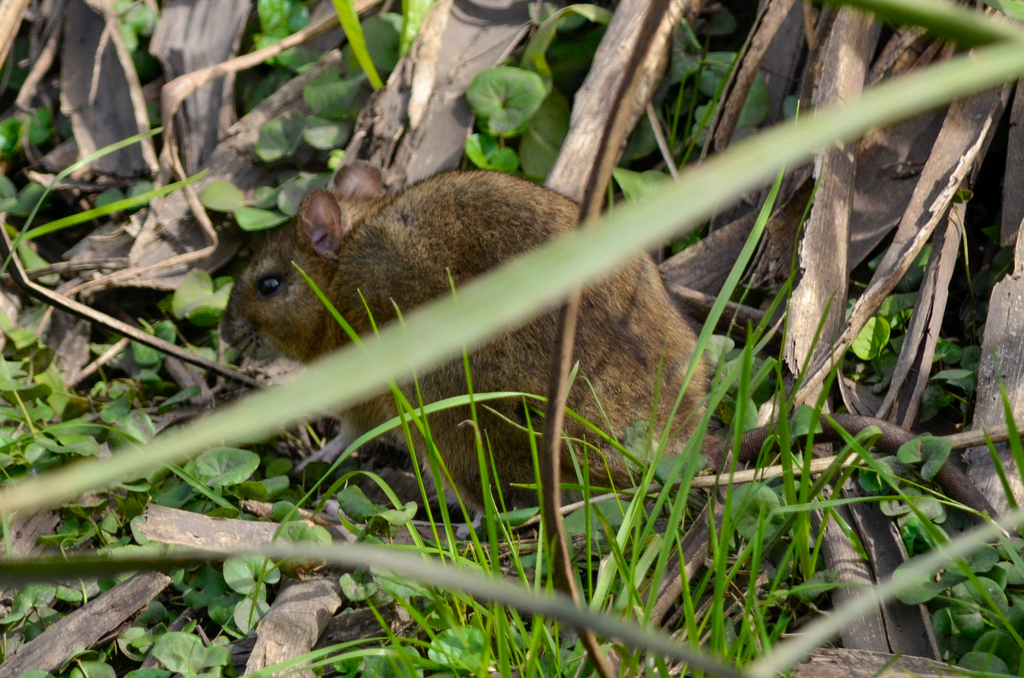
Lund’s Amphibious Rat
Lundomys molitor
Lundomys molitor, also known as Lund's amphibious rat or the greater marsh rat, is a semiaquatic rat species from southeastern South America.
Its distribution is now restricted to Uruguay and nearby Rio Grande do Sul, Brazil, but it previously ranged northward into Minas Gerais, Brazil, and southward into eastern Argentina. The Argentine form may have been distinct from the living form from Brazil and Uruguay. L. molitor is a large rodent, with the head and body length averaging 193 mm (7.6 in), characterized by a long tail, large hindfeet, and long and dense fur. It builds nests above the water, supported by reeds, and it is not currently threatened.
From the article Lundomys on Wikipedia (CC BY-SA), quoted section by section
Description
Lundomys molitor is among the largest living oryzomyines, rivaled only by some large forms of Holochilus and Nectomys, but it is substantially smaller than some of the recently extinct Antillean species, such as "Ekbletomys hypenemus" and Megalomys desmarestii. Unlike in Holochilus brasiliensis, which occurs in the same area, the tail is longer than the head and body. It is sparsely haired and dark, and there is no difference in color between the upper and lower side. The coat, which is long, dense, and soft, is yellow–brown at the sides, but becomes darker on the upperparts and lighter on the underparts. The large hindfeet are characterized by conspicuous interdigital webbing, but they lack tufts of hair on the digits and several of the pads are reduced. As in some other semiaquatic oryzomyines, fringes of hair are present along the plantar margins and between some of the digits. The forefeet also lack tufts on the digits and show very long claws, a character unique among oryzomyines. The female has four pairs of teats, and the gall bladder is absent, both important characters of oryzomyines. …
Range & habitat
Lundomys molitor has been found as a living animal only in Uruguay and nearby Rio Grande do Sul; records of live specimens from eastern Argentina and Lagoa Santa, Minas Gerais, have not been confirmed. It is rarely encountered, and has been collected in only one location in Rio Grande do Sul, but this may be due to insufficient efforts to locate it, rather than genuine rarity. Its distribution is generally limited to areas with mean winter temperatures over 12 °C (54 °F), mean annual temperatures over 18 °C (64 °F), annual rainfall over 1,100 mm (43 in), and a long rainy season averaging over 200 days. It is usually found in swamps or near streams. Pleistocene fossils have been found throughout its current range and beyond it. In Uruguay and Rio Grande do Sul, the Lujanian (Late Pleistocene to Early Holocene) Sopas Formation has yielded remains of L. molitor, in addition to such other mammals as the extinct saber-toothed cat Smilodon populator and species of Glyptodon, Macrauchenia, and Toxodon. The type locality, Lagoa Santa, lies far northeast of the nearest record of live L. molitor; there, it is known only from three skull fragments from a cave known as Laga da Escrivania Nr. 5. …
Wikipedia: “Distribution and ecology”
In human culture
Lundomys molitor is semiaquatic in habits, spending much of its time in the water, and is active during the night. An excellent swimmer, it is even more specialized for swimming than is Holochilus. It builds a spherical nest among reeds in up to 1.5 m (4.9 ft) deep water, usually about 20 cm (8 in) above the water. The material for the nest, which is 25 to 30 cm (10 to 12 in) in diameter and 9 to 11 cm (about 4 in) in height, comes from the surrounding reeds. Its wall consists of three layers, surrounding a central chamber, which is connected to the water by a ramp, also composed of reeds. Nests built by members of the related genus Holochilus are similar in many details. Several dissected stomachs contained green plant material, suggesting that it is herbivorous, like Holochilus. A female caught in April was pregnant with three embryos, which were about 12 mm (0.47 in) long. The mites Gigantolaelaps wolffsohni and Amblyomma dubitatum have been found on specimens of L. molitor in Uruguay. Other rodents found in association with it include Scapteromys tumidus, Oligoryzomys nigripes, Reithrodon auritus, Akodon azarae, Oxymycterus nasutus, and Holochilus brasiliensis.
Wikipedia: “Natural history”
Listen
Looking for field recordings…
Where it lives
Recorded sightings
—
geo-referenced records in GBIF, from museums, herbaria and field observers.
Drag the globe to turn it. Dots are where records exist, not a range map; darker means more records.
In the stacks
Searching the stacks…
Every page naming Lundomys molitor in the Biodiversity Heritage Library →
This page is assembled live from iNaturalist, GBIF, Wikipedia, the Source Library and the Internet Archive. It is not yet part of the hand-edited codex. iNaturalist taxon 74529.