- Animals
- ›Chordates
- ›Vertebrates
- ›Mammals
- ›Therians
- ›Placental Mammals
- ›Primates, Rodents, and Allies
- ›Rodents
- ›Mice, Rats, and Hamsters
- ›Muroids
- ›Hamsters, Voles, Lemmings, and Allies
- ›South American Mice and Rats
- ›Red-nosed Mice
- ›Juliomys
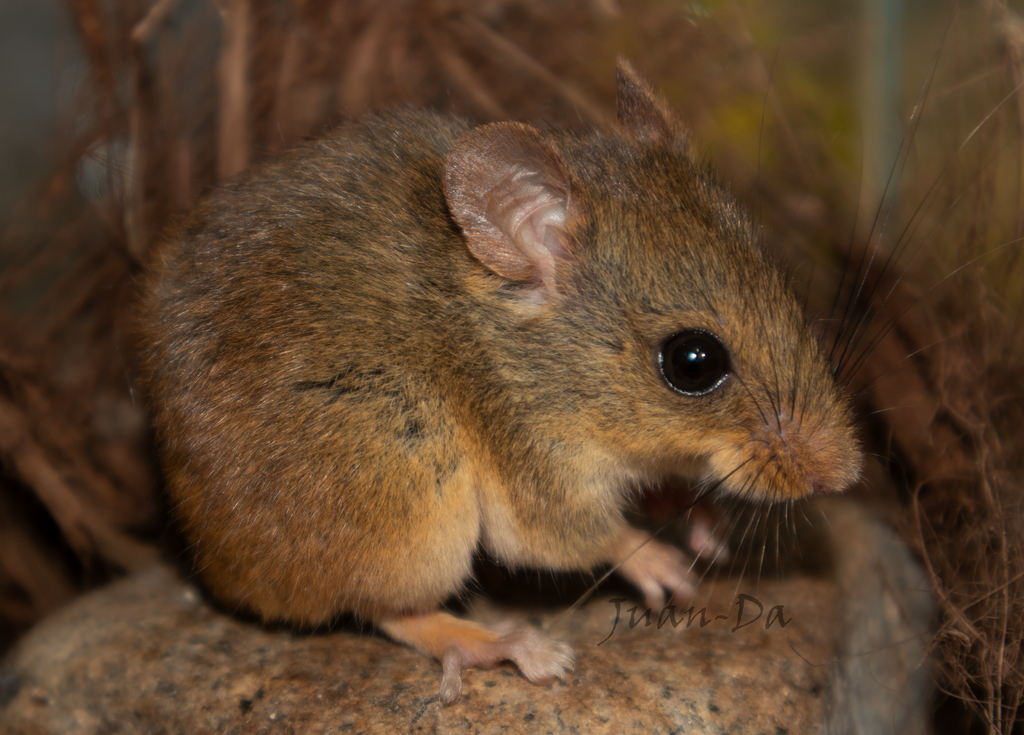
Lesser Wilfred's Mouse
Juliomys pictipes
The lesser Wilfred's mouse (Juliomys pictipes) is a species of South American rodents of the family Cricetidae. It was first described by Wilfred H. Osgood under the name Thomasomys pictipes, then into the genus Wilfredomys, and now known as Juliomys pictipes. The lesser Wilfred's mouse is endemic to northeastern Argentina, southeastern Brazil and eastern Paraguay. Its physical appearance ranges from dark brown to light orange coloration and the typical size is small to medium. This species is arboreal, spending most of its time trees and living in the local forests at altitudes from sea level to 2,000 m (6,560 ft). Currently, this species is listed as Least Concern by the IUCN, but, threats include livestock farming, ranching, and wood harvesting.
From the article Lesser Wilfred's mouse on Wikipedia (CC BY-SA), quoted section by section
Description
This animal is considered to be small to medium sized Sigmodontinae rodents. They are dark-brown to light-orange brown. Other characteristics include having long soft fur with a brownish ochraceous dorsum. This small-bodied animal is a pentalophodont with a tail longer than its head and body. Juliomys pictipes have short, broad feet with 6 plantar pads. In addition, the skull has identifying features including having a short rostrum and rounded braincase. Another diagnostic characteristic is the presence of an open slit in the suture between the frontal bones. Lastly, its karyotype has 2n = 36, FN = 34.
Range & habitat
It is found in northeastern Argentina and southeastern Brazil and limited to the tropical and subtropical moist forests of those countries. The type locality was first discovered in Misiones, Argentina and occurs in the Atlantic forest.
Wikipedia: “Distribution and habitat”
What it does
The species is arboreal. A baby of this species is often called a pinkie, kitten or pup. The females are called doe and males are called buck. Groups of this species are called a nest, colony, harvest, horde or mischief.
Wikipedia: “Ecology”
Listen
Looking for field recordings…
Where it lives
Recorded sightings
—
geo-referenced records in GBIF, from museums, herbaria and field observers.
Drag the globe to turn it. Dots are where records exist, not a range map; darker means more records.
In the stacks
Searching the stacks…
Every page naming Juliomys pictipes in the Biodiversity Heritage Library →
This page is assembled live from iNaturalist, GBIF, Wikipedia, the Source Library and the Internet Archive. It is not yet part of the hand-edited codex. iNaturalist taxon 74458.