On eBird ↗
Taiwan Partridge
Live sightings near you, the range map, bar charts of when it is seen, and Macaulay Library photos and recordings.
Taiwan Partridge
Arborophila crudigularis
The Taiwan partridge (Arborophila crudigularis), also called the Taiwan hill partridge, is a species of bird in the family Phasianidae. It is found only in Taiwan, and its natural habitat is broadleaf forests. It is threatened by habitat loss, but at present is categorised by the International Union for Conservation of Nature (IUCN) as of least concern.
From the article Taiwan partridge on Wikipedia (CC BY-SA), quoted section by section
Description
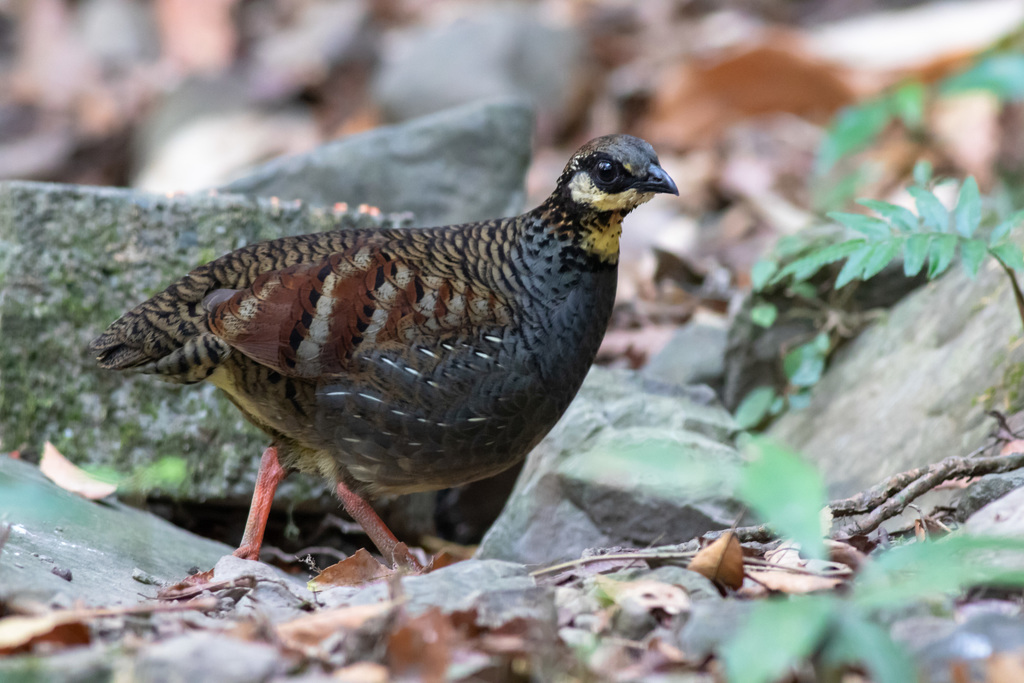
The Taiwan partridge is about 28 cm (11 in) long. The male weighs about 311 g (11.0 oz), and the female weighs about 212 g (7.5 oz). The crown is grey. The head has black sides, and a white eyebrow, chin and patch below the eye. The throat is white, and there is a black half collar. The upperparts are olive-grey with black bars, and there are three grey bars on the rounded, rufous wings. The tail is short and rounded. The underparts are blue-grey, with white streaks on the flanks. The eye is black, with a narrow red ring around it. The beak is blue-grey, and the feet are orange-red. The female bird is similar to the male, but it has fewer streaks on its throat and more streaks on its flanks.
Range & habitat
This partridge is endemic to Taiwan, found in the central and eastern mountains. It lives in broadleaf forests, preferring thickets and undergrowth. It is found at elevations of 700–3,000 m (2,300–9,800 ft) above sea level, mainly at 1,500–2,000 m (4,900–6,600 ft).
Wikipedia: “Distribution and habitat”
What it does
The Taiwan partridge's voice is a rising and falling series of gurru calls. Duets and choruses are often heard. Single calls are similar to those of the black-necklaced scimitar babbler. It forages in groups of two or three birds, eating earthworms, berries, seeds, seedlings and insects. It breeds from March to August, depending on the elevation, and it nests in a crevice or under a tree. There are three to four white eggs in a clutch, incubated for about 24 days.
Wikipedia: “Behaviour”
Listen
Looking for field recordings…
Where it lives
Recorded sightings
—
geo-referenced records in GBIF, from museums, herbaria and field observers.
Drag the globe to turn it. Dots are where records exist, not a range map; darker means more records.
In the stacks
Searching the stacks…
Every page naming Arborophila crudigularis in the Biodiversity Heritage Library →
This page is assembled live from iNaturalist, GBIF, Wikipedia, the Source Library and the Internet Archive. It is not yet part of the hand-edited codex. iNaturalist taxon 742.