- Animals
- ›Chordates
- ›Vertebrates
- ›Mammals
- ›Therians
- ›Placental Mammals
- ›Ungulates, Carnivorans, and Allies
- ›Even-toed Ungulates and Cetaceans
- ›Ruminants
- ›Bovids
- ›Antelopes, Goats, and Sheep
- ›Alcelaphines
- ›Beatragus
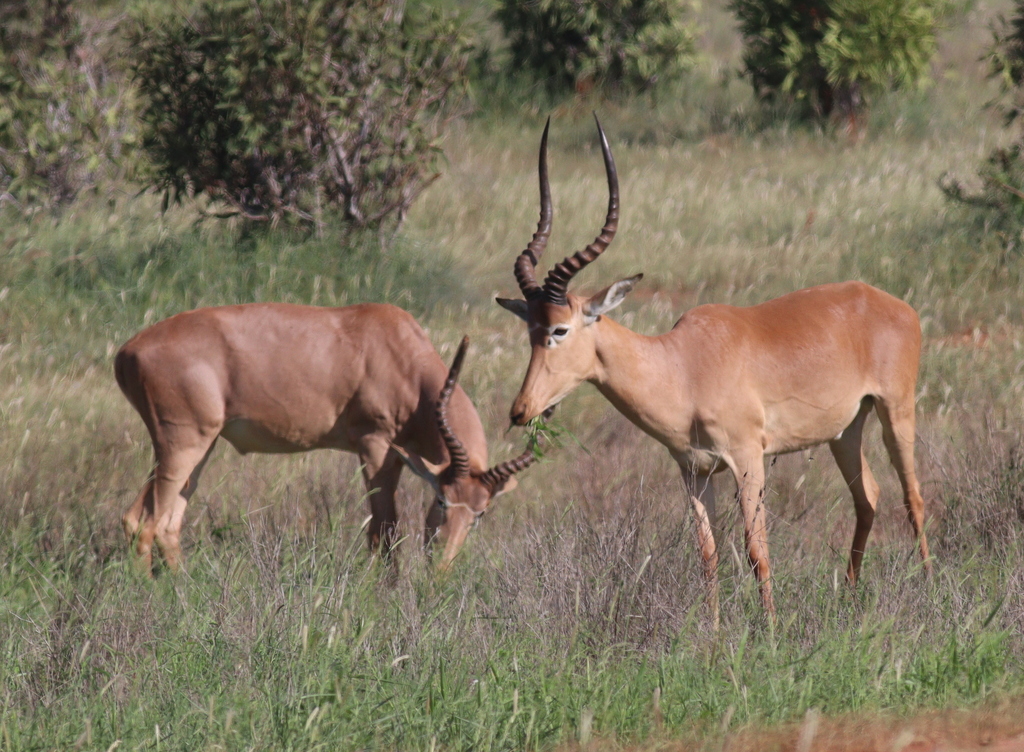
Hirola
Beatragus hunteri
The hirola (Beatragus hunteri), also called Hunter's hartebeest or Hunter's antelope, is a critically endangered antelope species found as of now, only in Kenya along the border of Somalia. It was first described by the big game hunter and zoologist H.C.V. Hunter in 1888. It is the only living member of the genus Beatragus, though other species are known from the fossil record. The global hirola population is estimated at 300–500 animals and there are none in captivity. According to a document produced by the International Union for Conservation of Nature "the loss of the hirola would be the first extinction of a mammalian genus on mainland Africa in modern human history".
From the article Hirola on Wikipedia (CC BY-SA), quoted section by section
Description
The hirola is a medium-sized antelope, tan to rufous-tawny in colour with slightly lighter under parts, predominantly white inner ears and a white tail which extends down to the hocks. It has very sharp, lyrate horns which lack a basal pedicle and are ridged along three quarters of their length. As hirola age their coat darkens towards a slate grey and the number of ridges along their horns increases. Hirola have large, dark sub-orbital glands used for marking their territories and give them the name "four-eyed antelope". They have white spectacles around their eyes and an inverted white chevron running between the eyes. The horns, hooves, udders, nostrils, lips and ear tips are black. Males and females look similar although males are slightly larger with thicker horns and darker coats. Several sources have recorded precise measurements from both captive and wild hirola. The following are maximum and minimum values taken from all sources: height at the shoulder: 99–125 cm (39–49 in; 3.25–4.10 ft), body weight: 73–118 kg (161–260 lb), head and body length: 1.2–2 m (3 ft 11 in – 6 ft 7 in), horn length: 44–72 cm (17–28 in; 1.44–2.36 ft), horn spread (greatest outside width): 15–32 cm (5.9–12.6 in), tail length: 30–45 cm (12–18 in), ear length: 19 cm (7.5 in). It is not stated whether horn length was measured direct from base to tip or along the curve of the horn. …
Range & habitat
The hirola's natural range is an area of no more than 1,500 km2 (580 sq mi) on the Kenyan-Somali border, but there is also a translocated population in Tsavo East National Park. The natural population in the 1970s was likely to number 10,000–15,000 individuals but there was an 85–90% decline between 1983 and 1985. A survey in 1995 and 1996 estimated the population to number between 500 and 2,000 individuals with 1,300 as the most reasonable estimate. A 2010 survey estimated a population of 402–466 hirola. A translocated population was established in Kenya's Tsavo East National Park with translocations in 1963 and 1996 (Hofmann, 1996; Andanje & Ottichilo, 1999; Butynski, 1999; East, 1999). The 1963 translocation released 30 animals and the first survey in December 1995 concluded that there were at least 76 hirola present in Tsavo at the time. Eight months later a further 29 translocated hirola were released in to Tsavo, at least six of which were pregnant at the time (Andanje, 1997). By December 2000 the hirola population in Tsavo had returned to 77 individuals (Andanje, 2002) and by 2011 the population was estimated at 76 individuals. In 2013, 9 individuals from 7 different herds were fitted with GPS-collars, scheduled to drop-off in June 2014, in north-eastern Kenya. This marked the first time that the species was GPS-collared in the wild. …
Wikipedia: “Population size and distribution”
What it does
The hirola is adapted to arid environments with annual rainfall averaging 300 to 600 millimetres (12 to 24 in). Their habitats range from open grassland with light bush to wooded savannahs with low shrubs and scattered trees, most often on sandy soils. Despite the arid environments they inhabit, hirola appear to be able to survive independently of surface water. Andanje observed hirola drinking on only 10 occasions in 674 observations (1.5%) and all 10 observations of drinking occurred at the height of the dry season. Hirola do however favour short green grass and in 392 of 674 observations (58%) hirola were grazing on growths of short green grass around waterholes. This association with waterholes may have led to reports that hirola are dependent on surface water. Hirola are primarily grazers but browse may be important in the dry season. They favour grasses with a high leaf to stem ratio and Chloris and Digitaria species are believed to be important in their diet. Kingdon does not consider the ecological requirements of the hirola unusual and in fact considers them to be more generalist than either Connochaetes spp. or Damaliscus. A vet who examined the digestive tract of several hirola concluded that they were well adapted to eating dry region grasses and roughage. …
Wikipedia: “Ecology”
Listen
Looking for field recordings…
Where it lives
Recorded sightings
—
geo-referenced records in GBIF, from museums, herbaria and field observers.
Drag the globe to turn it. Dots are where records exist, not a range map; darker means more records.
In the stacks
Searching the stacks…
Every page naming Beatragus hunteri in the Biodiversity Heritage Library →
This page is assembled live from iNaturalist, GBIF, Wikipedia, the Source Library and the Internet Archive. It is not yet part of the hand-edited codex. iNaturalist taxon 74108.