- Animals
- ›Chordates
- ›Vertebrates
- ›Mammals
- ›Therians
- ›Placental Mammals
- ›Primates, Rodents, and Allies
- ›Rodents
- ›Mice, Rats, and Hamsters
- ›Muroids
- ›Old World Mice and Rats
- ›Murines
- ›Canariomys
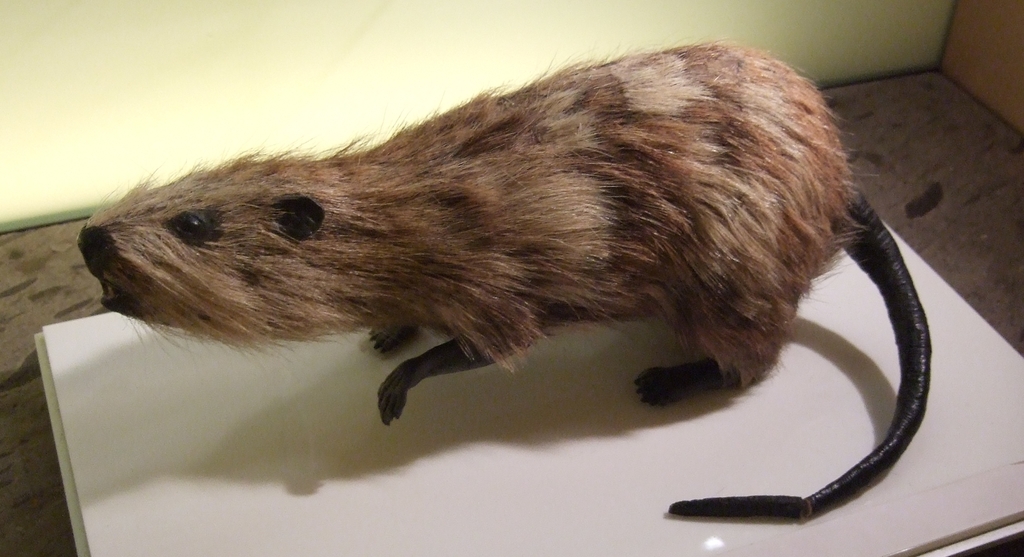
Tenerife Giant Rat
Canariomys bravoi
The Tenerife giant rat (Canariomys bravoi) is an extinct species of rodent endemic to the island of Tenerife, the largest of the Canary Islands, Spain. Many remains have been found during archeological digs. Most remains are from the Pleistocene. Radiocarbon dating has placed some of the finds in the late Pleistocene.
From the article Tenerife giant rat on Wikipedia (CC BY-SA), quoted section by section
Description
This species was a big rat of about 1 kg (2.2 lb) or more. It had a cranium that reached up to seven centimetres in length. Including the tail, the rat was over 1.14 m (3 ft 9 in), making it the largest of its family (at least in the Canaries). A scientific study published in 2012 compared the Canariomys bravoi species to present-day arboreal rodents such as Phloeomys cumingi, the giant rat of the island of Luzon in the Philippines. The study revealed that among the distinctive features of C. bravoi are claws that develop almost similarly in the anterior and posterior limbs. Also the hind legs longer than the front ones evoke an intermediate form between rats and arboreal murids like Phloeomys. Canariomys bravoi was a strong and powerfully muscled rodent able to move on different substrates from the ground to the trees, and probably had digging skills.
What it does
Paired δ13C and δ15N analysis shows that the Tenerife giant rat was omnivorous and relied predominantly on energy derived from C3 plants. Elevated δ13C values in the inland Icod municipality suggest that it foraged in forest canopies in this region. Additionally, in regions where the Tenerife giant rat coexisted with the Tenerife giant lizard, the δ13C and δ15N of both species differ slightly, indicating niche partitioning between the two of them. The dental microwear of the Tenerife giant rat indicates that it was a highly generalist herbivore that consumed a variety of plants, the one exception being grass. Genetic evidence indicates that the genus is nested within Arvicanthis, specifically within the African grass rat (A. niloticus) species complex, with an estimated divergence from its mainland relatives around 650,000 years ago.
Wikipedia: “Palaeoecology”
Listen
Looking for field recordings…
Where it lives
Recorded sightings
—
geo-referenced records in GBIF, from museums, herbaria and field observers.
Drag the globe to turn it. Dots are where records exist, not a range map; darker means more records.
In the stacks
Searching the stacks…
Every page naming Canariomys bravoi in the Biodiversity Heritage Library →
This page is assembled live from iNaturalist, GBIF, Wikipedia, the Source Library and the Internet Archive. It is not yet part of the hand-edited codex. iNaturalist taxon 741032.