- Animals
- ›Chordates
- ›Vertebrates
- ›Reptiles
- ›Snakes and Lizards
- ›Lizards
- ›Skinks and allies
- ›Skinks
- ›Typical skinks
- ›Plestiodon
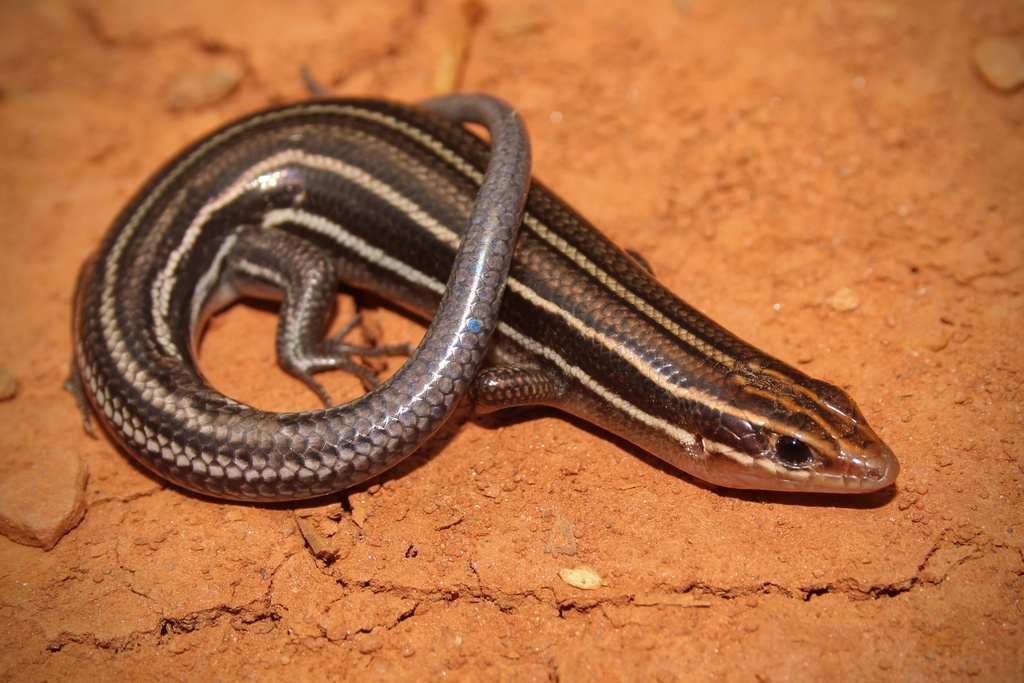
Southeastern Five-lined Skink
Plestiodon inexpectatus
Plestiodon inexpectatus, the southeastern five-lined skink is a common skink in the southeastern United States.
From the article Plestiodon inexpectatus on Wikipedia (CC BY-SA), quoted section by section
Description
As their common name suggests, southeastern five-lined skinks have five characteristic narrow stripes along their bodies that become lighter with age. The middle stripe tends to be narrower than the others, and the dark areas between stripes are black in young skinks but become brown with age. A similar lizard, the common five-lined skink (Plestiodon fasciatus), is slightly smaller than the southeastern five-lined skink and has broader stripes. However, it is difficult to discriminate between these two species on the basis of physical appearance. Young southeastern five-lined skinks have a bright blue or purplish tail, especially towards the tip. Also, stripes become a bright reddish orange towards the head. Juvenile coloration may persist into adulthood, giving the head of the animal an altogether orange-brown appearance.
Range & habitat
Southeastern five-lined skinks are common inhabitants of wooded areas of the southeastern United States. They are commonly found on small islands off the southeastern coast even in the absence of fresh water and vegetation.
Wikipedia: “Habitat”
What it does
Like other skinks of the genus Plestiodon, they feed primarily on insects, preferring larger prey such as grasshoppers.
Wikipedia: “Diet”
In human culture
The specific name, inexpectatus ("the unexpected"), is possibly a reference to the unexpected discovery of this species in 1932, almost 175 years after Linnaeus described Plestiodon fasciatus, commonly known as the American five-lined skink.
Wikipedia: “Etymology”
Where it lives
Recorded sightings
—
geo-referenced records in GBIF, from museums, herbaria and field observers.
Drag the globe to turn it. Dots are where records exist, not a range map; darker means more records.
In the stacks
Searching the stacks…
Every page naming Plestiodon inexpectatus in the Biodiversity Heritage Library →
This page is assembled live from iNaturalist, GBIF, Wikipedia, the Source Library and the Internet Archive. It is not yet part of the hand-edited codex. iNaturalist taxon 73790.