- Animals
- ›Chordates
- ›Vertebrates
- ›Reptiles
- ›Turtles and Tortoises
- ›Eurasian Pond, River, and Neotropical Wood Turtles
- ›Geoemydinae
- ›Batagur
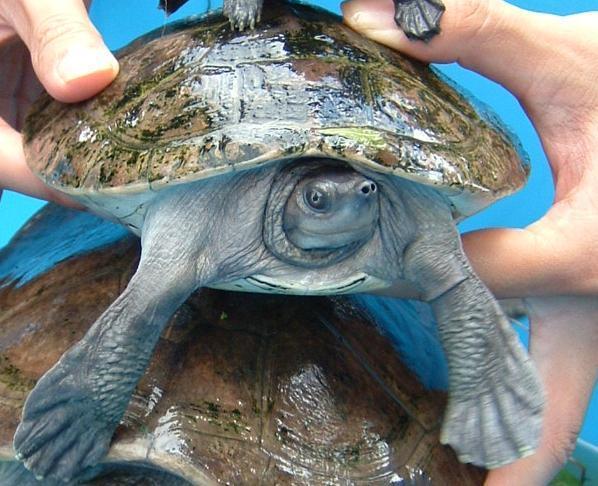
Northern River Terrapin
Batagur baska
The northern river terrapin (Batagur baska) is a species of riverine turtle native to Southeast Asia. It has been classified as Critically Endangered on the IUCN Red List and considered extinct in much of its former range; as of 2018, the population in the wild was estimated at 100 mature individuals.
From the article Northern river terrapin on Wikipedia (CC BY-SA), quoted section by section
Description
The northern river terrapin is one of Asia's largest freshwater and brackwater turtles, reaching a carapace length of up to 60 cm and a maximum weight of 18 kg. Its carapace is moderately depressed, with a vertebral keel in juveniles. The plastron is large, strongly angulate laterally in the young, convex in the adult. The head is rather small, with a pointed and upwards-tending snout. The legs have band-like scales. The upper surface of the carapace and the soft parts are generally olive-brown, while the plastron is yellowish. Head and neck are brown with reddish bases. Males in breeding coloration have a black head and neck with a crimson or orange dorsal surface and red or orange forelegs. The colour of the pupils also changes during this period, to brown in females and yellow-white in males. During the breeding season, the color of the pupils of a female brown whereas the pupils in the males become yellowish-white.
Range & habitat
The northern river terrapin is distributed in the Sunderbans of India and Bangladesh. It is regionally extinct in Myanmar and Thailand. It is strongly aquatic but uses terrestrial nesting sites, frequenting the tidal areas of estuaries, large rivers, and mangrove forests.
Wikipedia: “Distribution and habitat”
What it does
The northern river terrapin is omnivorous, taking waterside plants and small animals such as clams. The species prefers freshwater habitats and moves to brackish river mouths or estuaries in the breeding season (December–March), returning after laying their eggs. Individuals have been known to undertake long seasonal migrations of 50 to 60 miles to the sand banks where they were hatched. Females usually lay three clutches of 10–34 eggs each.
Wikipedia: “Ecology”
Where it lives
Recorded sightings
—
geo-referenced records in GBIF, from museums, herbaria and field observers.
Drag the globe to turn it. Dots are where records exist, not a range map; darker means more records.
In the stacks
Searching the stacks…
Every page naming Batagur baska in the Biodiversity Heritage Library →
This page is assembled live from iNaturalist, GBIF, Wikipedia, the Source Library and the Internet Archive. It is not yet part of the hand-edited codex. iNaturalist taxon 73698.