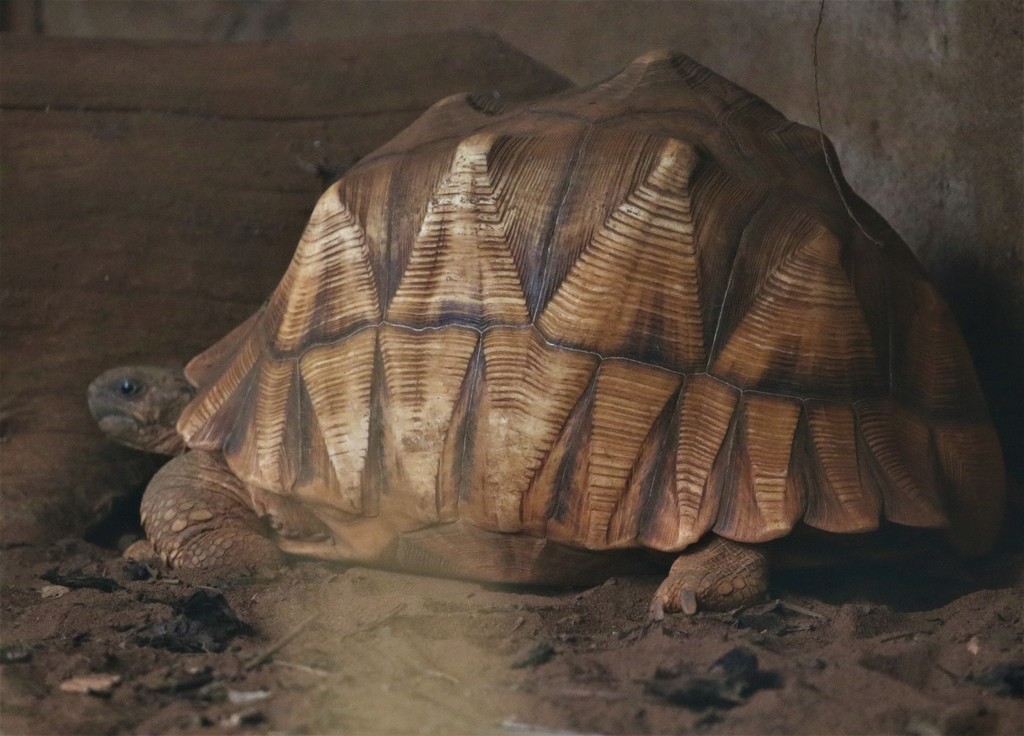
Ploughshare Tortoise
Astrochelys yniphora
The angonoka tortoise (Astrochelys yniphora) is a critically endangered species of tortoise severely threatened by poaching for the illegal pet trade. It is endemic to Madagascar. It is also known as the angonoka, ploughshare tortoise, Madagascar tortoise, or Madagascar angulated tortoise. There may be fewer than 400 of these tortoises left in the wild. It is found only in the dry forests of the Baly Bay area of northwestern Madagascar, near the town of Soalala (including Baie de Baly National Park). A captive-breeding facility was established in 1986 by the Jersey Wildlife Preservation Trust (now the Durrell Trust) in collaboration with the Water and Forests Department. In 1996, 75 tortoises were stolen, which later appeared for sale in the Netherlands. The project was ultimately successful, achieving 224 captive-bred juveniles out of 17 adults in 2004. Project Angonoka developed conservation plans that involved local communities making firebreaks, along with the creation of a park to protect the tortoise and the forests. Monitoring of the angonoka tortoise in the global pet trade has also continued to be advocated.
From the article Angonoka tortoise on Wikipedia (CC BY-SA), quoted section by section
Description
The carapace is highly domed and light brown in colour with prominent growth rings on each scute. The outer parts of the vertebral are a darker brown. The gular scute of the plastron projects forward between the front legs and curves upward toward the neck. Males are larger than females, reaching a carapace length up to 17 in (43 cm). The average length of an adult male angonoka tortoise is 414.8 mm (16.33 in) and the average weight is 10.3 kg (23 lb). Females measure at a 370.1 mm (14.57 in) average and weigh 8.8 kg (19 lb) on average.
Range & habitat
In the wild, this species is only found in Madagascar, where it is endemic to the dry forests in the Baly Bay area of northwestern Madagascar, near the town of Soalala (including Baie de Baly National Park). The distribution is 25 to 60 km2 (9.7 to 23.2 sq mi) in range around Baly Bay.
The Baly Bay region is made up of savanna, mangrove swamps, and dry deciduous forest. They make use of bamboo-scrub habitat which is made up of different types of shrubs, savanna grasses, bamboo, and open areas with no vegetation. The flora includes shrubbery usually under 2 m (6 ft 7 in) in height, such as Bauhinia and Terminalia species, and Perrierbambus madagascariensis bamboo, which forms dense thickets. The elevation of this area is under 50 m (160 ft) above sea level.
Population. The first population surveys of this species were performed by Juvik & Blanc in 1974 and Juvik et al. in 1981, in which they estimated the total wild population to be a few hundred, based on a population density of around five tortoises per km2 and a potential range of approximately 100 km2 (39 sq mi) in suitable habitat. In 1983 (published 1985) Curl et al. estimated a total population of 100–400 individuals in a range of 40–80 km2 (15–31 sq mi), found in five subpopulations, two east and three west of the Andranomavo River. …
Wikipedia: “Distribution and habitat”
What it does
The angonoka tortoise has been observed feeding on grasses found in open rocky areas of bamboo scrub. It is also known to eat shrubs, forbs, and herbs. While it has been seen eating dead bamboo leaves, it has never been observed eating living bamboo. As well as these plants, the tortoise has also been seen eating the dried feces of bushpigs and carnivores. The introduced bush pig is the main predator of the angonoka tortoise; it eats the tortoises' eggs and young. In captivity, males must be separated due to aggression towards each other, including ramming, pushing, and overturning with the enlarged gular scute. The aggression is used to establish dominance.
Reproduction. It is expected to become sexually mature once reaching 15 years old. The tortoise can produce one to six eggs per clutch and up to four clutches every season. The reproductive season is from 15 January to 30 May. The angonoka tortoise's reproductive patterns coincide with the seasonal rainfall patterns of the region, with both mating and hatching occurring at the onset of the rainy seasons. With a 71.9% fertility rate and a 54.6% hatching success rate, about 4.3 hatchlings are produced per female tortoise.
Wikipedia: “Ecology and behaviour”
Where it lives
Recorded sightings
—
geo-referenced records in GBIF, from museums, herbaria and field observers.
Drag the globe to turn it. Dots are where records exist, not a range map; darker means more records.
In the stacks
Searching the stacks…
Every page naming Astrochelys yniphora in the Biodiversity Heritage Library →
This page is assembled live from iNaturalist, GBIF, Wikipedia, the Source Library and the Internet Archive. It is not yet part of the hand-edited codex. iNaturalist taxon 73696.