- Animals
- ›Chordates
- ›Vertebrates
- ›Reptiles
- ›Turtles and Tortoises
- ›Softshell and Flapshell Turtles
- ›Softshell Turtles
- ›Amyda
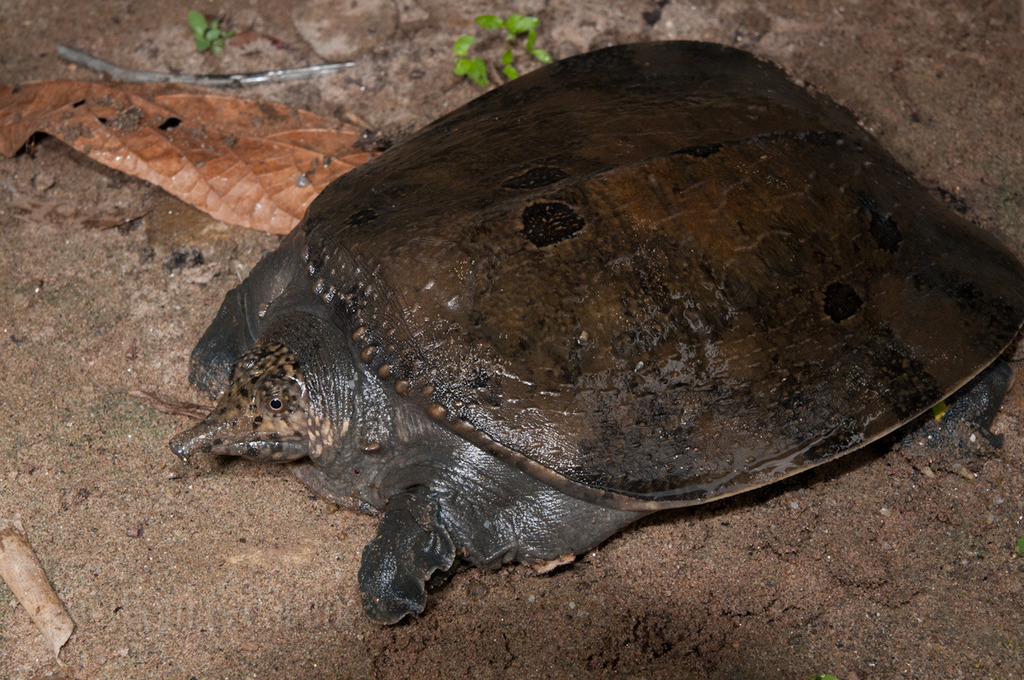
Southeast Asian Softshell Turtle
Amyda cartilaginea
The Asiatic softshell turtle or black-rayed softshell turtle (Amyda cartilaginea) is a species of softshell turtle in the Trionychidae family. Despite its name, it is not the only softshell turtle in Asia (most trionychines are Asian).
From the article Asiatic softshell turtle on Wikipedia (CC BY-SA), quoted section by section
Range & habitat
Amyda cartilaginea is found in Brunei, Indonesia (Bali, Java, Sumatra, and Kalimantan), Malaysia (Sabah, Sarawak), Singapore, and southern Thailand. It ranges from the Thai portion of the Malay Peninsula south throughout Island Southeast Asia. Populations in the Lesser Sundas, Moluccas, and Sulawesi are thought to be introduced or traded individuals.
Wikipedia: “Geographic range”
What it does
The Asiatic soft-shell is an omnivore, meaning it will feed off of plants and animals when given the chance. It has the ability to stay under water for long periods of time because of the gill like structure it possesses. This gives Amyda cartilaginea the ability to sneak up on prey. The Asiatic soft-shell likes to eat a variety of foods, including crabs, fish, insects, worms, eggs, amphibians, crustaceans and even at times bird carcasses. When the Asiatic soft-shell can't find meat, it will choose to eat berries, nuts, and plant seeds. Amyda cartilaginea specifically prefers the seeds of marsh plants. It also sometimes chooses to munch on rubber tree seeds. As with most animals, as the specific habitat of each turtle changes, its specific diet also slightly changes. The Asiatic soft-shell turtle does most of its hunting and foraging during the night hours.
Wikipedia: “Diet”
Toxicity
As the trade for this species grows, the number of turtles remaining drops. The Asiatic softshell turtle is now on the IUCN Red List as "Vulnerable", meaning it is not yet extinct, but is at the risk of becoming so. Laws have been put in place to help slow down the trading of these turtles or even stop it completely to protect this species from extinction. However, there aren't any against harvesting Amyda cartilaginea for food. Since selling for human consumption is one of biggest markets these turtles are sold in, the laws put in place have made only a slight difference in the Asiatic soft-shell's population drop. Harvesting is done mostly locally, since it allows the turtle's meat to be made freshly, and is quickly available to residents. Trading to other countries is done to provide food, however Amyda cartilaginea is also used for medicinal purposes.
Wikipedia: “Endangerment”
Where it lives
Recorded sightings
—
geo-referenced records in GBIF, from museums, herbaria and field observers.
Drag the globe to turn it. Dots are where records exist, not a range map; darker means more records.
In the stacks
Searching the stacks…
Every page naming Amyda cartilaginea in the Biodiversity Heritage Library →
This page is assembled live from iNaturalist, GBIF, Wikipedia, the Source Library and the Internet Archive. It is not yet part of the hand-edited codex. iNaturalist taxon 73600.