- Animals
- ›Cnidarians
- ›Sea Anemones and Corals
- ›Hexacorallians
- ›Sea Anemones
- ›Enthemonae
- ›Actinioidea
- ›Actiniid Sea Anemones
- ›Actinia
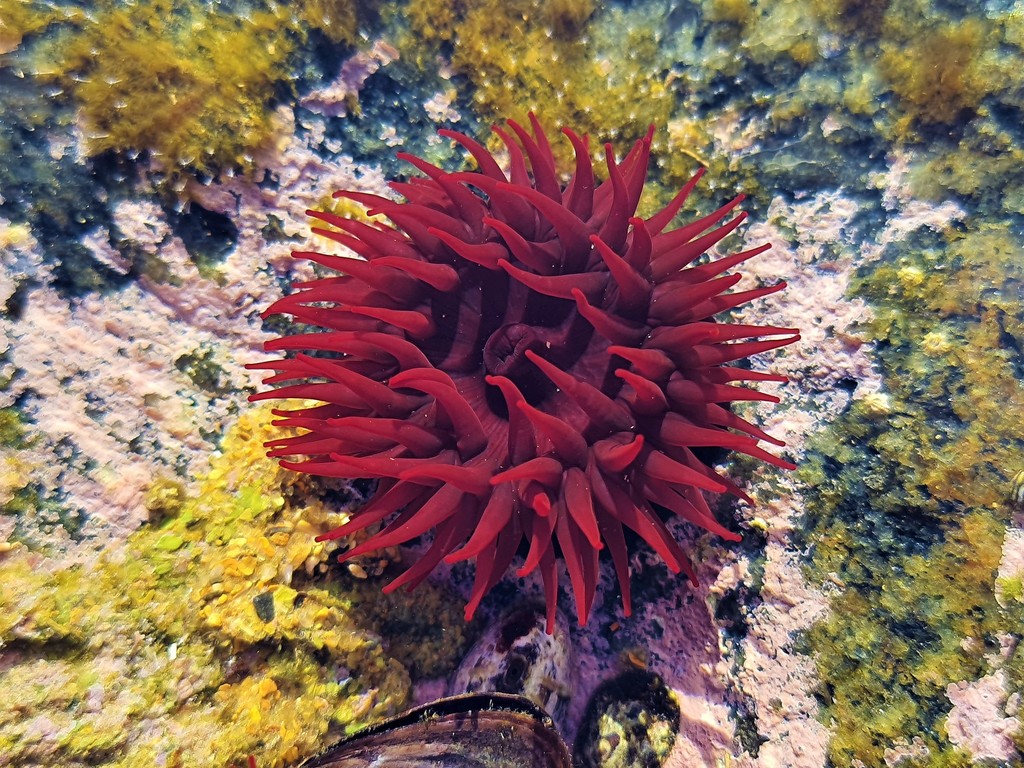
Maroon Anemone
Actinia bermudensis
Actinia bermudensis, the red, maroon or stinging anemone, is a species of sea anemone in the family Actiniidae.
From the article Actinia bermudensis on Wikipedia (CC BY-SA), quoted section by section
Description
Actinia bermudensis attaches itself to a rock surface by its pedal disc, which can reach 4 centimetres in width. The column is narrower at the top than the base and can reach 5 centimetres in height. Near the top is a ring of bulges called acrorhagi which contain many cnidocytes. The oral disc has a central mouth and two irregular whorls of 96 to 140 short, retractable, tapering tentacles which are armed with cnidocytes. The general colour of the anemone is dark red or maroon.
Range & habitat
Actinia bermudensis occurs in the West Indies, Bermuda and northern Florida, Greece, Caribbean pool, West Atlantica and there is a further, isolated population off Brazil. It is found in the intertidal and the sublittoral zone. It is usually found near the base of rock walls, under overhangs, in caves, in crevices and under boulders.
Wikipedia: “Distribution and habitat”
Where it lives
Recorded sightings
—
geo-referenced records in GBIF, from museums, herbaria and field observers.
Drag the globe to turn it. Dots are where records exist, not a range map; darker means more records.
In the stacks
Searching the stacks…
Every page naming Actinia bermudensis in the Biodiversity Heritage Library →
This page is assembled live from iNaturalist, GBIF, Wikipedia, the Source Library and the Internet Archive. It is not yet part of the hand-edited codex. iNaturalist taxon 735020.