On eBird ↗
Salvin's Albatross
Live sightings near you, the range map, bar charts of when it is seen, and Macaulay Library photos and recordings.
Salvin's Albatross
Thalassarche salvini
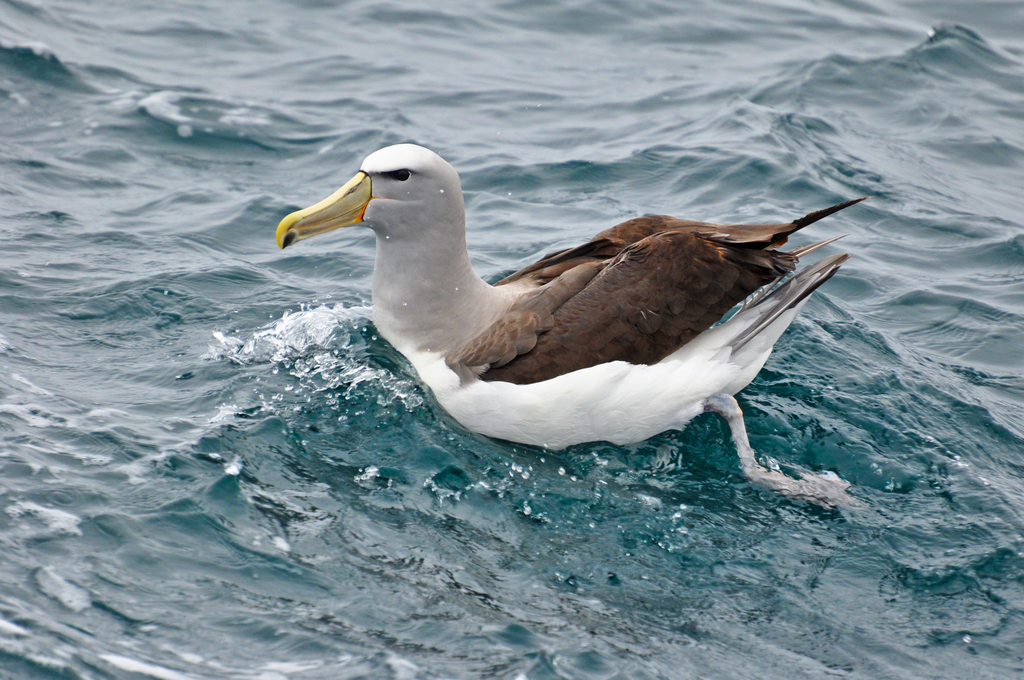
Salvin's albatross (Thalassarche salvini) or Salvin's mollymawk, is a large seabird that breeds only in islands in New Zealand's realm. A medium-sized mollymawk in the albatross family, it was long considered to be a subspecies of the shy albatross. It is a medium-sized black and white albatross.
From the article Salvin's albatross on Wikipedia (CC BY-SA), quoted section by section
Description
Salvin's albatross is about 90 cm (35 in) and 2.56 m (8.4 ft) across the wings. It weighs 3.3–4.9 kg (7.3–10.8 lb) and is, alongside the shy albatross, the largest of the mollymawk or small albatross group. The adult bird has a silver-grey crown. Its face, upper throat, and upper mantle are grey, and its back, upperwing, and tail are grey-black. It has a white rump and underparts with a black thumbmark on underwing and black narrow leading and trailing edges on the wing and black wing tips. Its bill is pale grey-green with a pale yellow upper ridge, and a bright yellow tip on the upper mandible, and a dark spot on the tip of the lower mandible. The juveniles have more extensive grey areas and a blue-grey bill with black tips on both mandibles. It can be distinguished from the Chatham albatross by its larger size and grey bill, and from the shy albatross by the greyer head. Such differences can be difficult to pick out at sea, however, and this explains the under-representation of this species in at-sea surveys.
Range & habitat
Salvin's albatross breed colonially on three disparate island groups in the Southern Ocean, Île des Pingouins in the Crozet Islands in the Indian Ocean and the Bounty Islands and The Snares to the south of New Zealand, as well as The Pyramid and Forty-Fours Island of the Chatham Islands. At sea they range from South Africa across to Australia and as far east as the coast of South America. In the early 2000s, an adult Salvin's albatross was seen by a fisheries observer 700–800mi north of the Hawaiian islands. This sighting was supported by a photograph.
Wikipedia: “Range and habitat”
What it does
It breeds mainly on small rocky islands with little vegetation, and the nest is a pedestal made of mud, feathers, and bird bones. A single egg is laid in September, and incubated by both parents until early November. The chicks fledge after about 4 months.
Wikipedia: “Reproduction”
In human culture
The species was named by Lord Lionel Walter Rothschild for the distinguished ornithologist Osbert Salvin.
Wikipedia: “Etymology”
Listen
Looking for field recordings…
Where it lives
Recorded sightings
—
geo-referenced records in GBIF, from museums, herbaria and field observers.
Drag the globe to turn it. Dots are where records exist, not a range map; darker means more records.
In the stacks
Searching the stacks…
Every page naming Thalassarche salvini in the Biodiversity Heritage Library →
This page is assembled live from iNaturalist, GBIF, Wikipedia, the Source Library and the Internet Archive. It is not yet part of the hand-edited codex. iNaturalist taxon 73481.