On eBird ↗
Pfrimer's Parakeet
Live sightings near you, the range map, bar charts of when it is seen, and Macaulay Library photos and recordings.
Pfrimer's Parakeet
Pyrrhura pfrimeri
Pfrimer's parakeet (Pyrrhura pfrimeri) is a non-migratory species within the parrot family Psittacidae. It also is known as Pfrimer's conure, Goias parakeet, and maroon-faced conure. The Pfrimer's parakeet has been qualified as endangered by the IUCN and BirdLife International since 2007. It is endemic to the Goiás and Tocantins regions of Brazil. It is mainly found within a belt of dry deciduous and semi-deciduous areas of the Caatinga forest.
It was considered a subspecies of the white-eared parakeet, as Pyrrhura leucotis pfrimeri. The split was based on range, differences in habitat and distinctive differences in plumage (it is the only member of the P. leucotis complex where the pale patch on the ear-coverts is greatly reduced). A recent study based on mtDNA has confirmed its status as a distinct species.
From the article Pfrimer's parakeet on Wikipedia (CC BY-SA), quoted section by section
Description
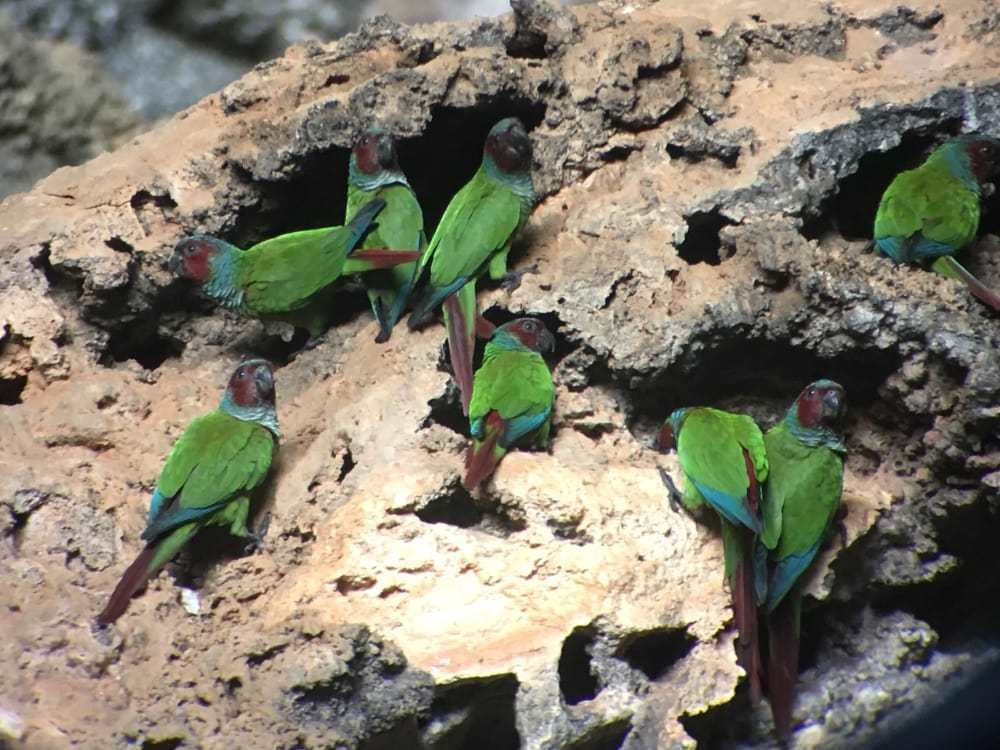
Adult and juvenile Pfrimer's parakeet look similar in plumage. They have brown and red faces and ear coverts, with a blue crown. They have white or grey eye rings surround their brown or orange eyes above their gray or black beaks. Their necks are covered in green or blue feathers. The breasts are colored blue or green with hints of white and brown, while their abdomen is brown/red. The wings have a blend of red, green, and blue. Their tails are typically seen to be maroon with a green base. Adult Pfrimer's parakeets grow up to a size of around 22–23 cm (8.5–9 ins) including the tail.
Wikipedia: “Morphology”
Range & habitat
Pfrimer's parakeet is endemic to Caatinga forest of the Goiás and Tocantins states of Brazil. These birds are known to be found up to 600 m up in deciduous or semi-deciduous forests. According to the BirdLife International and the IUCN they have an estimated extent of occurrence up to 20,300 km2. The range of this bird is severely fragmented due to habitat loss and ecosystem degradation. This is partly why BirdLife International has listed this species as Endangered.
Wikipedia: “Range”
What it does
These social birds can usually be found in flocks that can consist of up to 10 birds. These flocks are typically noisy when in flight but will be quiet when resting or feeding in the canopy.
Wikipedia: “Behavior”
Listen
Looking for field recordings…
Where it lives
Recorded sightings
—
geo-referenced records in GBIF, from museums, herbaria and field observers.
Drag the globe to turn it. Dots are where records exist, not a range map; darker means more records.
In the stacks
Searching the stacks…
Every page naming Pyrrhura pfrimeri in the Biodiversity Heritage Library →
This page is assembled live from iNaturalist, GBIF, Wikipedia, the Source Library and the Internet Archive. It is not yet part of the hand-edited codex. iNaturalist taxon 73332.