On eBird ↗
Bald Parrot
Live sightings near you, the range map, bar charts of when it is seen, and Macaulay Library photos and recordings.
Bald Parrot
Pyrilia aurantiocephala
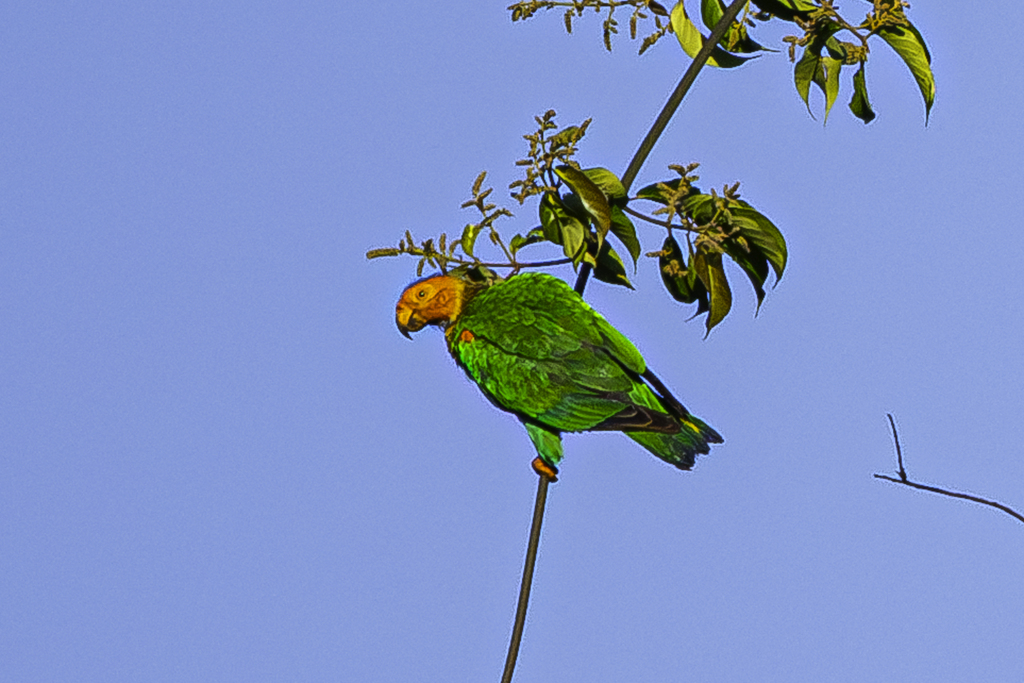
The bald parrot (Pyrilia aurantiocephala) or orange-headed parrot is a species of parrot in the family Psittacidae. It was formerly placed in the genus Pionopsitta, which is now monotypic. It is endemic to the east-central Amazon of Brazil. Its natural habitat is tropical moist lowland forests. It is considered near threatened by BirdLife International (and consequently IUCN) due to the widespread deforestation of the Amazon.
From the article Bald parrot on Wikipedia (CC BY-SA), quoted section by section
Description
The bald parrot is a medium-small, overall green parrot with a bald, brownish-orange head. As several other members of the genus Pyrilia, it has red underwing coverts that barely are visible when perched, but highly conspicuous in flight. The bald parrot communicates with sounds that consist of a high pitched "skee-skee-skee" and a rolling slightly nasal of a "chow-chow-chow". Their diet includes flowers, seeds, fruits, and insects. This medium-sized bird is known for its bare skin and orange head. It has the complexion of intensely orange skin, a paler and more yellow color around the eye, black(ish) coloring around the neck, a mostly green lower neck, light yellow tint to the green wings, and tinged with blue on the lower belly. The unique coloring and baldness of this parrot's head give it its name.
Range & habitat
Bald parrots can be found in the humid tropical lowlands spreading throughout the Lower River Madeira and Upper River Tapajós and River Teles Pires, in central Brazil.
Wikipedia: “Distribution and habitat”
Listen
Looking for field recordings…
Where it lives
Recorded sightings
—
geo-referenced records in GBIF, from museums, herbaria and field observers.
Drag the globe to turn it. Dots are where records exist, not a range map; darker means more records.
In the stacks
Searching the stacks…
Every page naming Pyrilia aurantiocephala in the Biodiversity Heritage Library →
This page is assembled live from iNaturalist, GBIF, Wikipedia, the Source Library and the Internet Archive. It is not yet part of the hand-edited codex. iNaturalist taxon 73320.