- Animals
- ›Chordates
- ›Vertebrates
- ›Birds
- ›Woodpeckers and Allies
- ›Woodpeckers
- ›Typical woodpeckers
- ›Green Woodpeckers, Flickers, and Allies
- ›Piculus
On eBird ↗
Lita Woodpecker
Live sightings near you, the range map, bar charts of when it is seen, and Macaulay Library photos and recordings.
Lita Woodpecker
Piculus litae
The Lita woodpecker (Piculus litae) is a species of bird in subfamily Picinae of the woodpecker family Picidae. It is found in Colombia and Ecuador.
From the article Lita woodpecker on Wikipedia (CC BY-SA), quoted section by section
Description
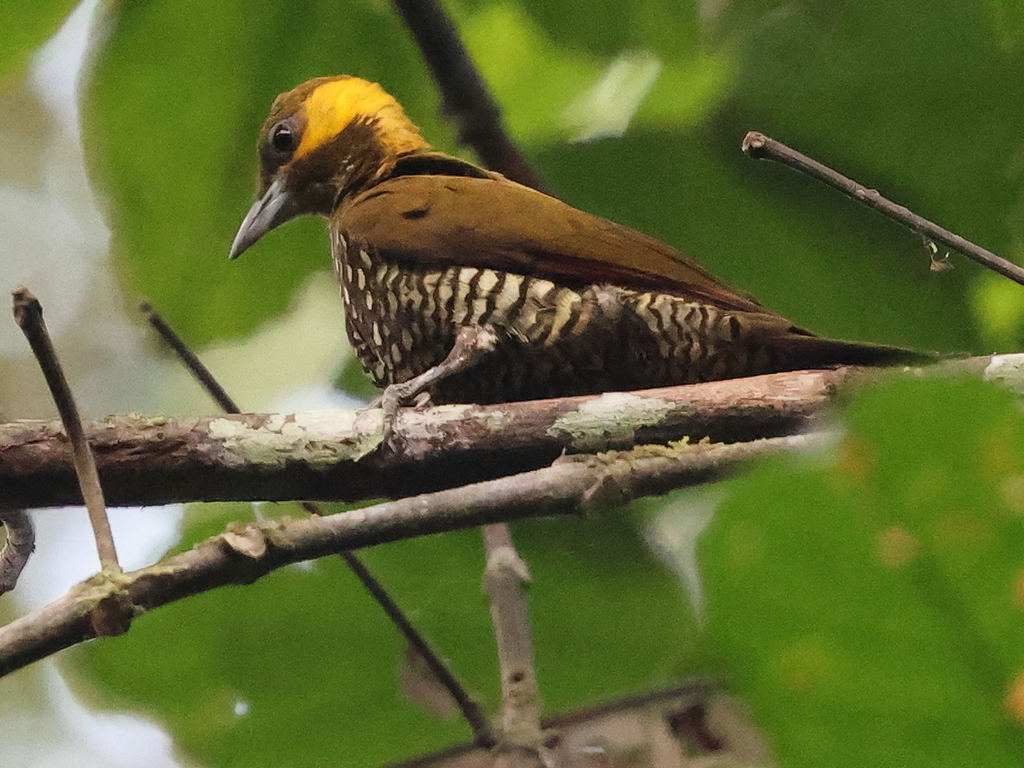
The Lita woodpecker is about 17 to 18 cm (6.7 to 7.1 in) long. Males and females have the same plumage except on their heads. Males are red from forehead to hindneck and very widely on the malar (cheek); the rest of the face is golden-yellow. The female has red only on the nape and malar but is otherwise the same as the male. Adults of both sexes have a dusky olive chin and throat that appear blackish at a distance. Their upperparts are olive-yellow to bronze-green with a slightly darker rump. Their flight feathers are mostly dark brown with olive on the outer webs, pale cinnamon-rufous on the inner webs, and black tips. Their tail is blackish with greenish edges on the feathers. Their underparts are whitish with black wedge-shaped bars. Their shortish beak is light bluish with a black tip, their iris dark brown, and the legs dark slate blue. Juveniles are duller and greener than adults, have red only on the nape, and have a streaked throat.
Range & habitat
The Lita woodpecker is found in Colombia in the middle Magdalena River Valley and the Pacific slope of the western Andes, and south into northwestern Ecuador to Pichincha Province. It inhabits the interior and edges of humid and wet primary forest and also secondary forest. In elevation it ranges from about sea level to 800 m (2,600 ft).
Wikipedia: “Distribution and habitat”
What it does
The Lita woodpecker forages from the forest's middle levels to the sub-canopy, usually by itself and sometimes in pairs. Its diet has not been studied but is assumed to be adult and larval insects.
Wikipedia: “Feeding”
Listen
Looking for field recordings…
Where it lives
Recorded sightings
—
geo-referenced records in GBIF, from museums, herbaria and field observers.
Drag the globe to turn it. Dots are where records exist, not a range map; darker means more records.
In the stacks
Searching the stacks…
Every page naming Piculus litae in the Biodiversity Heritage Library →
This page is assembled live from iNaturalist, GBIF, Wikipedia, the Source Library and the Internet Archive. It is not yet part of the hand-edited codex. iNaturalist taxon 73247.