- Animals
- ›Chordates
- ›Vertebrates
- ›Birds
- ›Parrots
- ›Old World Parrots
- ›Broad-tailed Parrots and Allies
- ›Neopsephotus
On eBird ↗
Bourke's Parrot
Live sightings near you, the range map, bar charts of when it is seen, and Macaulay Library photos and recordings.
Bourke's Parrot
Neopsephotus bourkii
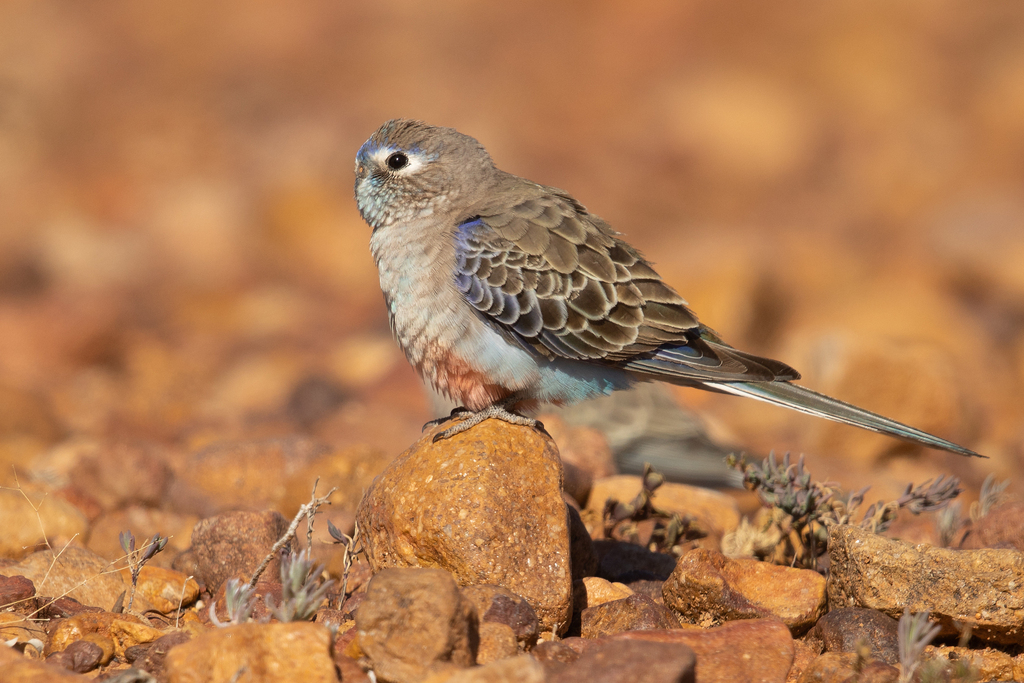
The Bourke's parrot (Neopsephotus bourkii, formerly known as Neophema bourkii), also known as the blue-vented parrot, sundown parrot, pink-bellied parrot, Bourke's parakeet, Bourke or "Bourkie", is a small parrot originating in Australia and the only species in its genus Neopsephotus. This species is sometimes placed in the genus Neophema and there is an ongoing discussion about the proper taxonomic placement of this species. It is a grass parrot approximately 19 cm long and weighing around 45 grams. It...
From the article Bourke's parrot on Wikipedia (CC BY-SA), quoted section by section
Description
Bourke's parrot is a relatively small species. They tend to vary between 18 cm and 23 cm in length with a tail length of approximately 9 cm. The females of the species tend to be slightly smaller than the males: males of the species weigh between 47 g and 49 g whilst females weigh between 41 g and 49 g. Both sexes look very similar until the age of nine months, after which they come into full plumage colour. In the wild, Bourke's parakeets display an overall brown colouration with a pink abdomen, pinkish breast and a blue rump. The legs are dark-brown, with zygodactyl toes. The bill is yellowish-brown. The adult male has a blue forehead while the adult female has a little or no blue on the forehead. Bourke's parrot's feathers help it blend in with the reddish soil of its arid home. The bird's call has been described as a "soft twitter". Other sounds made by Bourke's parrot go "chu-vee", "chirrup chirrup", or when alarmed, "kik-kik-kik".
Range & habitat
Bourke's parrot is native to Australia. As a nomadic species, following water and food sources, it has a vast range. The Bourke's parrot is mainly found in sparsely populated areas; however they have been known to dwell in urban areas as well. These parrots can be found from the South-western parts of Queensland deep into western New South Wales, throughout Central Australia to the far northern parts of South Australia and parts of Western Australia. Bourke's parrot's main habitat consists of areas dominated by Acacia species, particularly mulga, and spinifex plains. The species can also be found in native cypress and open eucalypt woodlands.
Wikipedia: “Distribution and habitat”
What it does
Bourke's parrot has been described as both arboreal and terrestrial; it perches and nests in trees, but also frequently lives on the ground where it can easily camouflage. The flight pattern of Bourke's parakeet is short but swift, interspersed with gliding motions. It usually flies close to the ground in quick bursts, as it travels between trees. The bird's wing beat is minimal and produces an audible whirring sound. In the wild it tends to live in pairs or small groups, ranging from approximately four to six. Larger flocks ranging in the hundreds are also made by the species, particularly during times of drought.
Breeding. During the nesting season, males are highly territorial, chasing away any potential intruders or threats. Breeding season for Bourke's parrot usually occurs between the months of August and October, but can also draw out into December, depending on the season and availability of resources. Bourke's parrots are monogamous, staying with a single partner. Their nests tend to be situated from 1 metre to 3 metres above ground level in hollow limbs of the mulga tree or other acacia species. Eggs are generally laid on a bed of decayed wood at the bottom of the tree hollow. Bourke's parrot has a clutch of 3 to 6 eggs, which are incubated by the female for 18–19 days. …
Wikipedia: “Ecology and behaviour”
In human culture
Bourke's parrot is a relatively popular aviary bird. It is particularly common among new bird owners, as it is known for its quiet and passive temperament. Due to their peaceful nature, Bourke's parrots may be kept in captivity with a number of other species including finches, doves and other small parakeets. Bourke's parrots rarely learn to talk. Unlike many other species of parrots, the Bourke's parrot does not climb and instead relies on hopping or flying to reach higher perches. This species typically lives for 10-15 years when kept in captivity, but some individuals do surpass this lifespan. There are few documented mutations found in captive Bourke's parrots; such as yellow, Isabel, fallow and pink or rosa. The rosa mutation is particularly common in aviculture, lending to the popular name "Rosy Bourke". Additionally, while Bourke's parakeets lacking a color mutation can often be sexed visually, males and females with a color mutation cannot. There have been recorded instances of Bourke's parrot producing hybrids with the scarlet-chested parrot (Neophema splendida).
Wikipedia: “Aviculture”
Listen
Looking for field recordings…
Where it lives
Recorded sightings
—
geo-referenced records in GBIF, from museums, herbaria and field observers.
Drag the globe to turn it. Dots are where records exist, not a range map; darker means more records.
In the stacks
Searching the stacks…
Every page naming Neopsephotus bourkii in the Biodiversity Heritage Library →
This page is assembled live from iNaturalist, GBIF, Wikipedia, the Source Library and the Internet Archive. It is not yet part of the hand-edited codex. iNaturalist taxon 73087.