- Animals
- ›Chordates
- ›Vertebrates
- ›Birds
- ›Parrots
- ›Old World Parrots
- ›Broad-tailed Parrots and Allies
- ›Cyanoramphus
On eBird ↗
Chatham Islands Parakeet
Live sightings near you, the range map, bar charts of when it is seen, and Macaulay Library photos and recordings.
Chatham Parakeet
Cyanoramphus forbesi
The Chatham Islands parakeet (Cyanoramphus forbesi), also known as Forbes' parakeet, is a rare parakeet endemic to the Chatham Islands group, New Zealand. This parakeet is one of New Zealand's rarest birds and is classified as Vulnerable on the IUCN Red List, as a result of a range of threats to the species survival, including habitat loss, predation, and hybridization. A number of conservation methods have been employed to assist the recovery of this species, and currently the population trend is considered stable.
From the article Chatham Islands parakeet on Wikipedia (CC BY-SA), quoted section by section
Description
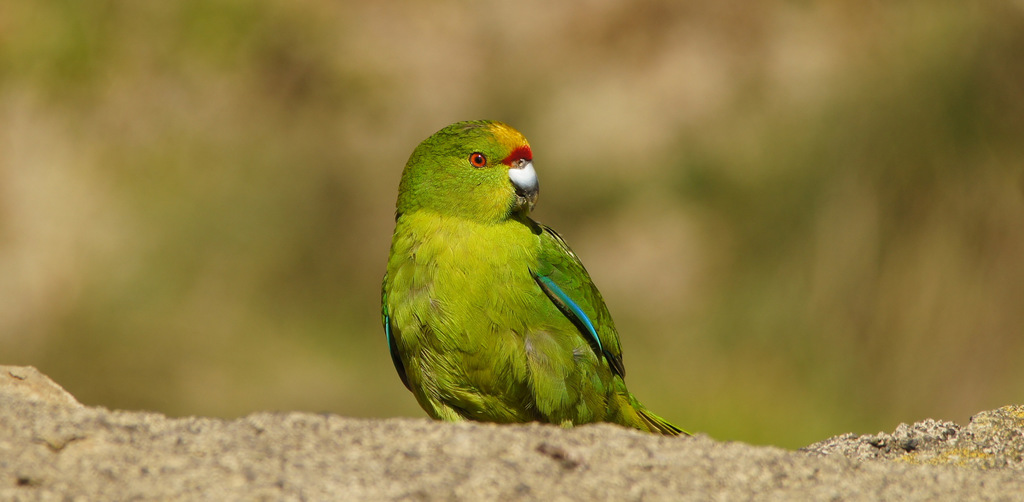
Forbes' parakeets are medium-sized parakeets, with long tails and orange-red eyes. Plumage is bright green, with a red band across the forehead (but not reaching the eyes) and a yellow forecrown. The lores are also green, and the bird has some red plumage on the sides of the rump, and violet-blue outer primaries and wing coverts. The female parakeet is slightly smaller than the male, which is also reflected in her smaller bill size. Forbes' parakeet is easily distinguished from the Chatham Island Red-crowned Parakeet by its golden-yellow forecrown, as like its name suggests the Chatham Island Red-crowned parakeet has a red forecrown. It is also distinguishable from the Yellow-crowned parakeet (Cyanoramphus auriceps) despite looking quite similar, as C. auriceps is not found in the Chatham Islands.
Range & habitat
Forbes' parakeet is found only on Mangere and Little Mangere (Tapuaenuku) Islands in the Chatham Islands group. The Chatham Islands are sovereign land of New Zealand, and lay to the South-east of Wellington. Historically, Forbes' parakeet was documented in the 1800s to have travelled to nearby Pitt Island and southern Chatham Island. The species was extinct on Mangere Island by 1930 as a result of significant deforestation. However, the species persisted on Little Mangere Island, until recolonizing Mangere Island in the 1960s after the removal of introduced species (such as cats, rabbits and grazing livestock) and after the native vegetation had a chance to grow back. The parakeet is found in dense forest and scrub, and utilizes tree hollows and rock crevices to nest.
Wikipedia: “Distribution and habitat”
What it does
Forbes' parakeet are typically seen singly or in pairs, but rarely in groups. The birds are considered sedentary, and remain at a single nesting site throughout the year.
Diet. The diet of Forbes' parakeets consists of invertebrates, flowers, seeds, leaves, fruit, shoots and bark. They have been noted feeding in the forest canopy and on the forest floor, as well as in trees, shrubs or other plants when fruiting, seeding or flowering. Forbes' parakeet feeds both individually and in groups with conspecifics, as well as with Chatham Island Red-crowned Parakeets and hybrids of the two species.
Reproduction. Forbes' parakeet nest in hollows of dead or living trees, and breed between October and March. The birds become quite territorial of boundaries when breeding, chasing other birds away from the area and making loud vocalisations. The female bird will stay in the nest during incubation, and the male will bring her food. Clutch size is between 2-9 eggs, and once the eggs hatch both the male and the female adult birds will share parental care of the offspring. When provided with nest boxes, the species has a high rate of chick mortality, though it is unclear why this may be the case.
Wikipedia: “Behaviour”
Listen
Looking for field recordings…
Where it lives
Recorded sightings
—
geo-referenced records in GBIF, from museums, herbaria and field observers.
Drag the globe to turn it. Dots are where records exist, not a range map; darker means more records.
In the stacks
Searching the stacks…
Every page naming Cyanoramphus forbesi in the Biodiversity Heritage Library →
This page is assembled live from iNaturalist, GBIF, Wikipedia, the Source Library and the Internet Archive. It is not yet part of the hand-edited codex. iNaturalist taxon 72786.