On eBird ↗
Ringed Teal
Live sightings near you, the range map, bar charts of when it is seen, and Macaulay Library photos and recordings.
Ringed Teal
Callonetta leucophrys
The ringed teal (Callonetta leucophrys) is a small duck of marshes, pools, and forest wetlands native to south-central South America. It is the only species of the genus Callonetta. Formerly often placed with the perching ducks in the tribe Cairinini, this species is now known to be closer to shelducks and belongs in the subfamily Tadorninae.
From the article Ringed teal on Wikipedia (CC BY-SA), quoted section by section
Description
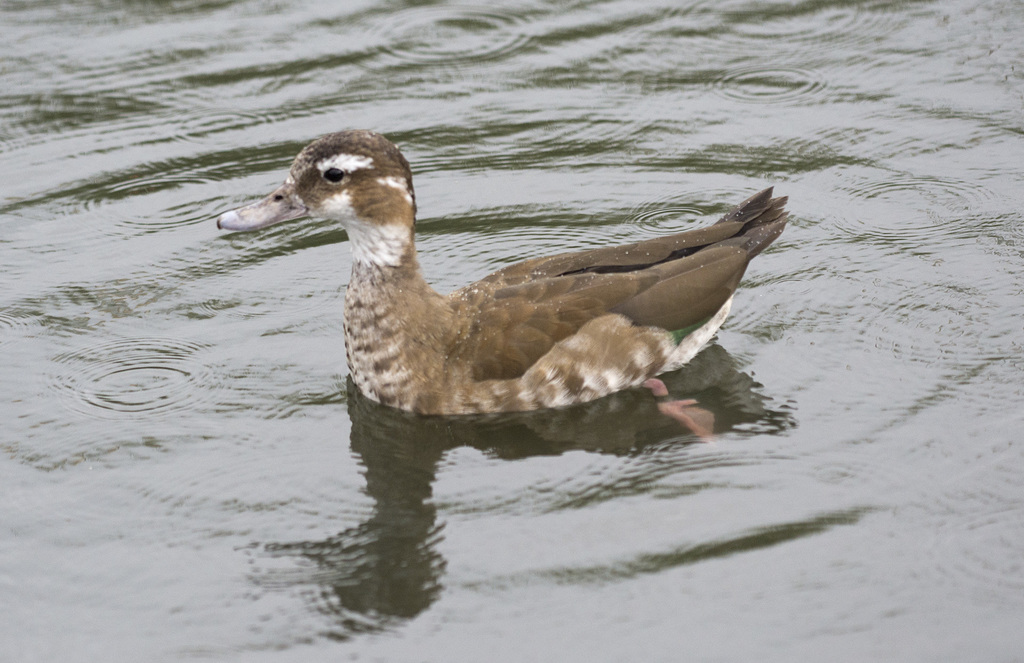
The ringed teal is 35–38 cm (14–15 in) long, with a 70 cm (28 in) wingspan, and a weight of 190–360 g (6.7–12.7 oz). The drake has a rich chestnut back, pale grey flanks, and a salmon-coloured breast speckled in black. A black band runs from the top of its head down to the nape. Females have an olive-brownish back, a head blotched and striated in white, and pencilled barring on a pale chest and belly. Both males and females have a dark tail, a contrasting pale rump, and a distinctive white patch on the wing. The bill is grey and legs and feet are pink in both sexes. Pairs easily bond. Their contact calls are a cat-like mee-oowing in ducks and a lingering peewoo in drakes. The male and female retain similar plumage throughout the year, lacking an eclipse plumage. Ringed teals also have webbed toes with long, pointed claws that allow the birds to sit on tree branches.
Range & habitat
Their habitats include tropical, swampy forests and marshy clearings in well-wooded lowlands, as well as secluded pools and small streams. As a predominantly aquatic species, ringed teals eat a variety of aquatic plants and invertebrates, as well as any seeds that can be found. Ringed teals are classified as "dabblers" as opposed to "divers". Dabblers tend to feed on plant and insect material near the surface of the water, whereas divers feed on plants, invertebrates, and fish deeper under the water's surface. Although dabblers may submerge their heads and upper torso while putting their tails up in the air, also known as "up-ending", they rarely completely submerge themselves and stay under for periods of time, such as the diving ducks do.
Wikipedia: “Habitat”
Listen
Looking for field recordings…
Where it lives
Recorded sightings
—
geo-referenced records in GBIF, from museums, herbaria and field observers.
Drag the globe to turn it. Dots are where records exist, not a range map; darker means more records.
In the stacks
Searching the stacks…
Every page naming Callonetta leucophrys in the Biodiversity Heritage Library →
This page is assembled live from iNaturalist, GBIF, Wikipedia, the Source Library and the Internet Archive. It is not yet part of the hand-edited codex. iNaturalist taxon 7188.