On eBird ↗
Hartlaub's Duck
Live sightings near you, the range map, bar charts of when it is seen, and Macaulay Library photos and recordings.
Hartlaub's Duck
Pteronetta hartlaubii
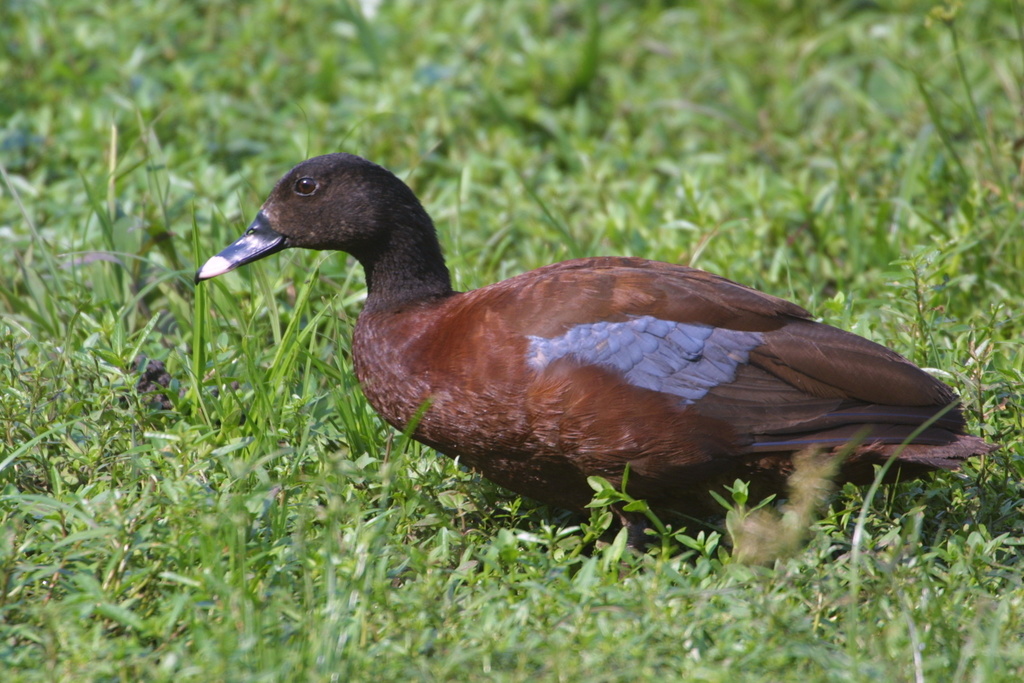
Hartlaub's duck (Pteronetta hartlaubii) is a dark chestnut-coloured duck of African forests. Formerly included in the paraphyletic "perching duck" assemblage, it was later moved to the dabbling duck assemblage. However, it is distinct from the "typical" dabbling ducks, and is placed in the monotypic genus Pteronetta. It is named after the German naturalist Gustav Hartlaub.
From the article Hartlaub's duck on Wikipedia (CC BY-SA), quoted section by section
Description
On average, Hartlaub's ducks range from 56–58 centimetres (22–23 in) long. It is monotypic, with no subspecies accepted. Juveniles have feathers with pale tips on their breast and abdomen. The adult plumage is red-brown overall with a black head with or without white marks on the crown; adult plumage is fully developed after six months. The amount of white on each duck's head varies. Adult males weigh between 925–1,140 grams (32.6–40.2 oz), and have reddish-brown eyes; they are more likely to have extensive white on the crown. The females weigh between 770 and 805 grams (27.2 and 28.4 oz), and rarely have any white on their heads; they have dark red eyes. Both sexes have a blue patch on their wing that distinguishes them from most other waterfowl. During mating season, the base of the male's bill will enlarge.
Range & habitat
Hartlaub's duck is resident in equatorial West and Central Africa, from Guinea and Sierra Leone east through Nigeria to South Sudan, and south to Gabon, Congo and Zaire. Hartlaub's ducks reside in swampy marshes, tropical forests, savanna areas, rivers, and streams. In Liberia, they live in mangroves. However, they will only gather in flocks in Liberia from January to May. Year-round, they will live in parts of central western Africa, including the Democratic Republic of Congo and Cameroon.
Wikipedia: “Distribution”
What it does
In flight, Hartlaub's ducks will quack "ko-ko-ko-ko" or "kakakakarr". Their conversational sounds are "whit-whit-whit". When threatened, the males will quack a fast "wheezy whistle". When juveniles are in distress, they will give three calls in evenly spaced quick descending notes. Their diet consists of aquatic invertebrates, such as insects and crustaceans. The Republic of Congo's Nouabalé-Ndoki National Park reports that the ducks regularly feed on the insects found in elephant dung. They also eat seeds and insect larvae. To remove ectoparasites, these ducks have been observed jumping onto the backs of bongo and forest buffalo. They are most active in the early morning and evening.
Wikipedia: “Behaviour”
Listen
Looking for field recordings…
Where it lives
Recorded sightings
—
geo-referenced records in GBIF, from museums, herbaria and field observers.
Drag the globe to turn it. Dots are where records exist, not a range map; darker means more records.
In the stacks
Searching the stacks…
Every page naming Pteronetta hartlaubii in the Biodiversity Heritage Library →
This page is assembled live from iNaturalist, GBIF, Wikipedia, the Source Library and the Internet Archive. It is not yet part of the hand-edited codex. iNaturalist taxon 7137.