On eBird ↗
Green Pygmy-Goose
Live sightings near you, the range map, bar charts of when it is seen, and Macaulay Library photos and recordings.
Green Pygmy-Goose
Nettapus pulchellus
The green pygmy goose (Nettapus pulchellus) is a small perching duck which breeds in southern New Guinea and northern Australia.
From the article Green pygmy goose on Wikipedia (CC BY-SA), quoted section by section
Description
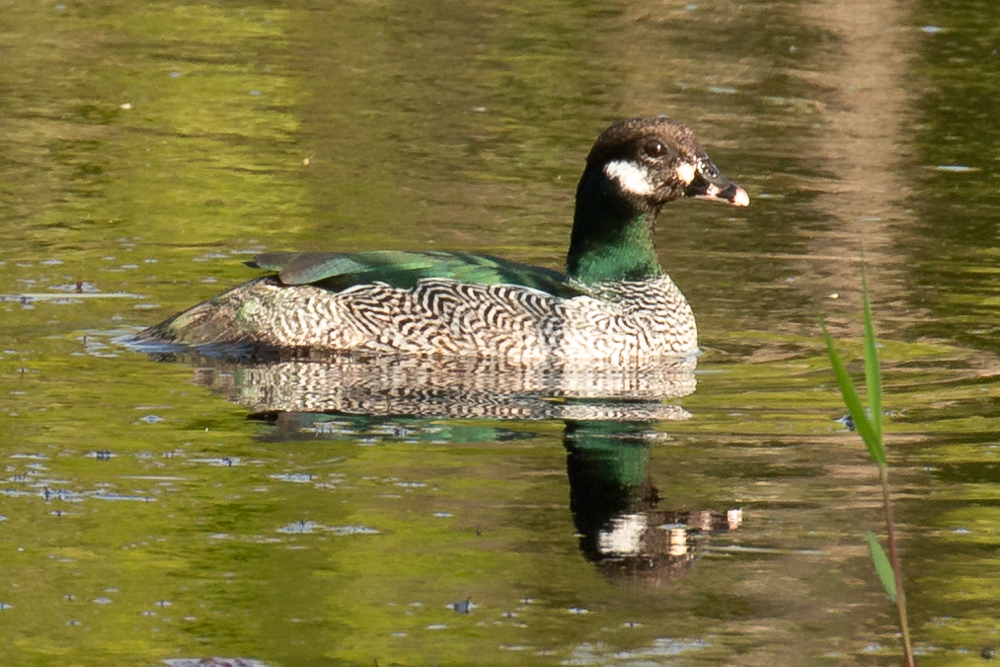
Ranging from 30 to 36 cm (12 to 14 in) in length, the green pygmy goose is one of the smallest species of duck. It has a 48 to 60 cm (19 to 23.5 in) wingspan. It has a small bill and a compact form. The breeding male has a predominantly dark green back and neck, and a dark gray crown. The cheeks are white, and the underparts are pale grey and white scalloped. The tail, primary flight feathers and primary coverts are black, while the secondary flight feathers are white. The secondary coverts are a dark iridescent green. This iridescence is lost outside of the breeding season and the plumage becomes duller. The species exhibits a degree of sexual dimorphism — the female has a barred rather than green neck but otherwise resembles the non-breeding male. Immature birds are less brightly coloured, and have mottled dark brown heads. The male has a high-pitched whistle and the female a lower-pitched call.
Range & habitat
The green pygmy goose is found in southern New Guinea and across northern Australia (from Western Australia, through Northern Territory and into Queensland). To the west, it commonly reaches Timor-Leste, where it possibly breeds at Lake Iralalara. It is largely resident, apart from dispersion in the wet season. The habitat is well-vegetated lowland lagoons and other permanent fresh waters.
Wikipedia: “Distribution”
Listen
Looking for field recordings…
Where it lives
Recorded sightings
—
geo-referenced records in GBIF, from museums, herbaria and field observers.
Drag the globe to turn it. Dots are where records exist, not a range map; darker means more records.
In the stacks
Searching the stacks…
Every page naming Nettapus pulchellus in the Biodiversity Heritage Library →
This page is assembled live from iNaturalist, GBIF, Wikipedia, the Source Library and the Internet Archive. It is not yet part of the hand-edited codex. iNaturalist taxon 7126.