On eBird ↗
Brant
Live sightings near you, the range map, bar charts of when it is seen, and Macaulay Library photos and recordings.
Brant
Branta bernicla
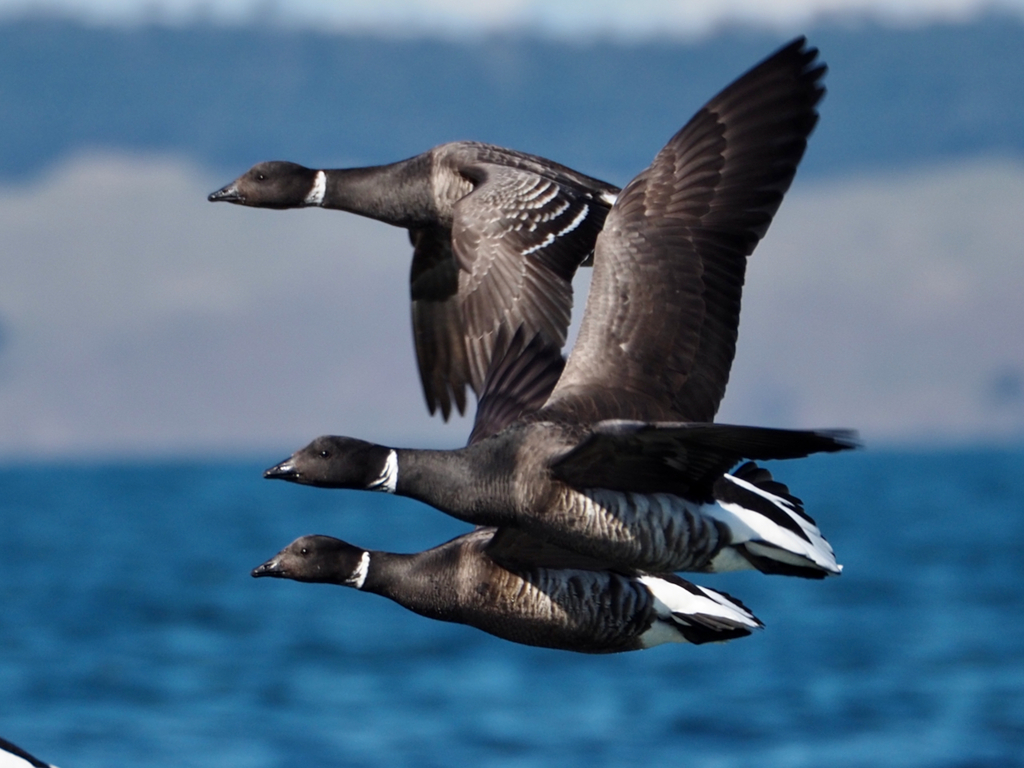
The brant or brent goose (Branta bernicla) is a small goose in the genus Branta. There are three subspecies, all of which winter along temperate-zone sea-coasts and breed on the high-Arctic tundra.
The Brent oilfield was named after the species.
From the article Brant (goose) on Wikipedia (CC BY-SA), quoted section by section
Description
The brant is a small goose with a short, stubby bill. It measures 55–66 cm (22–26 in) long, 106–121 cm (42–48 in) across the wings and weighs 0.88–2.2 kg (1.9–4.9 lb). The under-tail is pure white, and the tail black and very short (the shortest of any goose). The body of the dark-bellied nominate subspecies B. b. bernicla is fairly uniformly dark grey-brown all over, the flanks and belly not significantly paler than the back. The head and neck are black, with a small white patch on either side of the neck. With a population of about 250,000, it breeds on the Arctic coasts of central and western Siberia and winters in coastal areas of western Europe, with over half the population in southern England, the rest between northern Germany and south-western France. The pale-bellied form B. b. hrota appears blackish-brown and light grey in colour. The body is different shades of grey-brown all over, the flanks and belly are significantly paler than the back and present a marked contrast. The head and neck are black, with a small white patch on either side of the neck. The total population is about 250,000, with the main population breeding in northeastern Canada and wintering along the Atlantic coast of the U.S. …
Range & habitat
The brant goose was once a strictly coastal bird in winter, rarely leaving tidal estuaries, where it primarily favours eelgrass (Zostera marina) and the seaweed, sea lettuce (Ulva), among other aquatic plants. On the east coast of North America, the inclusion of sea lettuce is a recent change to their diet, brought about by a blight on eelgrass in 1931 which had resulted in the near-extirpation of the brant. The few that survived changed their diet to include sea lettuce until the eelgrass eventually began to return. Brants have since maintained this diet as a survival strategy. A similar collapse in eelgrass in Ireland in the 1930s also negatively impacted the population. In recent decades, the brant has started using agricultural land a short distance inland, feeding extensively on grass and winter-sown cereals. It has been suggested that they learned this behaviour by following other species of geese. Food resource pressure may also be important in forcing this change, as the world population increased over ten-fold to 400,000 to 500,000 by the mid-1980s, possibly reaching the carrying capacity of the estuaries. In the breeding season, it uses low-lying wet coastal tundra for both breeding and feeding. The nest is bowl-shaped, lined with grass and down, in an elevated location, often near a small pond.
Wikipedia: “Habitat”
What it does
The brant goose is almost exclusively herbivorous. Major food sources in the non-breeding season include salt marsh plants, green algae, and eelgrass. During breeding season, it feeds on graminoids, forbs, and mosses.
Wikipedia: “Diet”
Listen
Looking for field recordings…
Where it lives
Recorded sightings
—
geo-referenced records in GBIF, from museums, herbaria and field observers.
Drag the globe to turn it. Dots are where records exist, not a range map; darker means more records.
In the old herbals & bestiaries

Bestiary
Anonymous · 1240 · p.59

Jan Moninckx; Maria Moninckx — Moninckx Atlas, vol. 2 (1686)
Jan Moninckx; Maria Moninckx · 1686 · p.29

Constantinople Painted by Warwick Goble
Alexander Van Millingen · 1906 · p.139

Jan Moninckx; Maria Moninckx — Moninckx Atlas, vol. 9 (1686)
Jan Moninckx; Maria Moninckx · 1686 · p.6

Histoire Naturelle des Indes (The Drake Manuscript)
Anonymous (French) · 1586 · p.75

The Natural History of Carolina Florida and Bahama Islands Vol. 2
Mark Catesby · 1743 · p.274

Louis Renard — Poissons, ecrevisses et crabes (1754)
Louis Renard · 1754 · p.127

Georg Wolfgang Knorr — Deliciae naturae selectae (1771)
Georg Wolfgang Knorr · 1771 · p.131

François Le Vaillant — Histoire naturelle des promerops et des guêpiers (1807)
François Le Vaillant · 1807 · p.520

François Le Vaillant — Histoire naturelle des promerops et des guêpiers (1807)
François Le Vaillant · 1807 · p.548

François Le Vaillant — Histoire naturelle des promerops et des guêpiers (1807)
François Le Vaillant · 1807 · p.596

François Le Vaillant — Histoire naturelle des promerops et des guêpiers (1807)
François Le Vaillant · 1807 · p.622
In the stacks
Searching the stacks…
Every page naming Branta bernicla in the Biodiversity Heritage Library →
This page is assembled live from iNaturalist, GBIF, Wikipedia, the Source Library and the Internet Archive. It is not yet part of the hand-edited codex. iNaturalist taxon 7087.