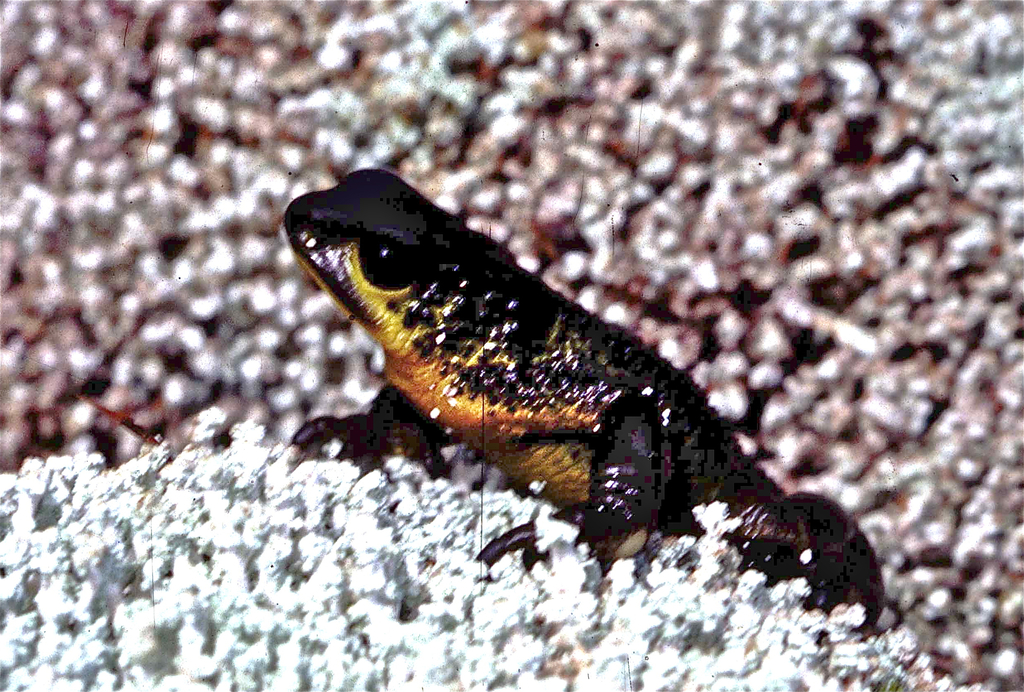
Pastuso Harlequin frog
Atelopus pastuso
Atelopus pastuso, commonly known as the Pastuso Harlequin Frog, is a species of frog in the family Bufonidae. It has not been seen since 1993, and is possibly extinct.
From the article Atelopus pastuso on Wikipedia (CC BY-SA), quoted section by section
Description
Atelopus pastuso is a medium-sized member of its genus, with males being an average of 31.82 millimetres (1.253 in) long and females being larger at an average of 38.68 millimetres (1.523 in). Males and females also differ in that females have long, slender limbs, while males have much shorter and stouter ones. The color of their dorsal side ranges from a bright green, to a grayish color, to nearly black.
Range & habitat
The range of Atelopus pastuso extends from Nariño Department in southern Colombia and Imbabura Province in northern Ecuador. They inhabit the páramo, and are terrestrial.
Wikipedia: “Habitat and Distribution”
In human culture
Atelopus pastuso was once a common species in its locality, but it experienced a dramatic decline in the past several decades. The last individuals in Colombia were seen on November 16, 1982. The last living individuals in Ecuador were seen on June 29, 1993. Extensive searches since then have failed to turn up any individuals. In 2010, Atelopus pastuso was classed as a new species, and was declared Critically Endangered and possibly extinct by the IUCN. Disease may have played a role in the species' decline. In Ecuador, several unhealthy and deceased individuals were seen before the disappearance of Atelopus pastuso. In 2001, three specimens were examined, and all tested positive for chytridiomycosis. It's believed that climate change and habitat loss could have also led to Atelopus pastuso's decline.
== References ==
Wikipedia: “History”
Listen
Looking for field recordings…
Where it lives
Recorded sightings
—
geo-referenced records in GBIF, from museums, herbaria and field observers.
Drag the globe to turn it. Dots are where records exist, not a range map; darker means more records.
In the stacks
Searching the stacks…
Every page naming Atelopus pastuso in the Biodiversity Heritage Library →
This page is assembled live from iNaturalist, GBIF, Wikipedia, the Source Library and the Internet Archive. It is not yet part of the hand-edited codex. iNaturalist taxon 70469.