- Fungi Including Lichens
- ›Basidiomycete Fungi
- ›Higher Basidiomycetes
- ›Mushrooms, Bracket Fungi, Puffballs, and Allies
- ›Agaricomycetidae
- ›Common Gilled Mushrooms and Allies
- ›Agaricineae
- ›Hymenogastraceae
- ›Gymnopilus
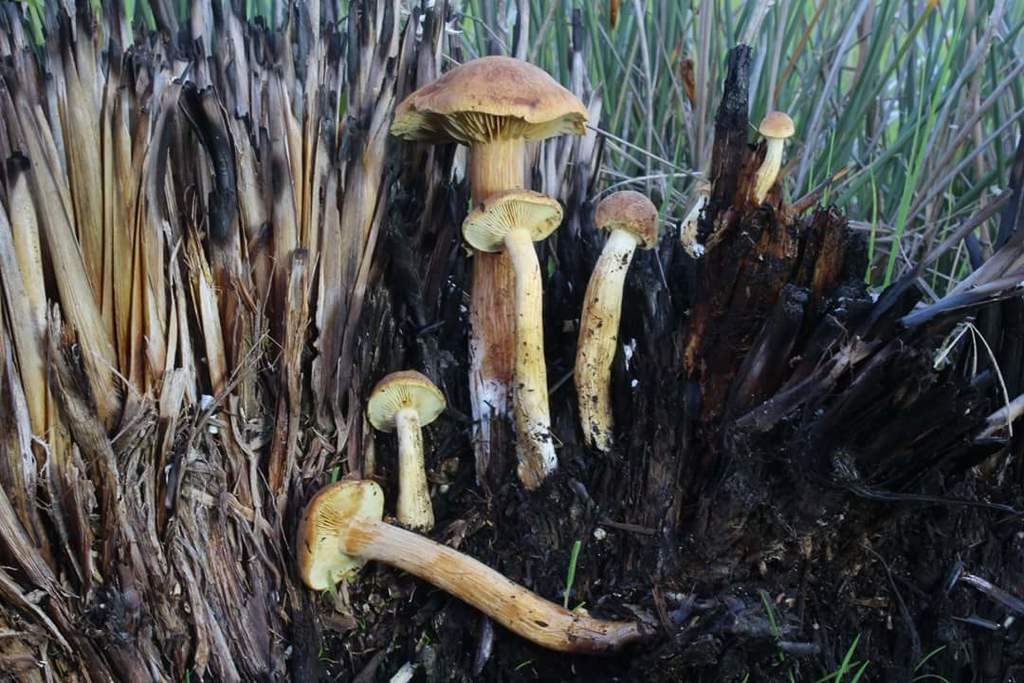
Gymnopilus maritimus
Gymnopilus maritimus is a fungus species of the family Hymenogastraceae first collected in northern Sardinia, Italy, in 2006. The species produces moderately sized, sturdy mushrooms of a reddish-orange colour. The cap, which can measure up to 70 millimetres (3 in) across, is covered in orange fibrils, and sometimes has small scales. The yellowish stem measures up to 110 mm (4 in) in length by 8 mm (0.3 in) in width, and sometimes shows remnants of the partial veil. The mushrooms have thick gills of a variable colour, ranging from yellow to rust but staining darker, and the yellow flesh has a mild taste. The mushrooms leave a rusty-brown spore print, while the spores themselves measure from 7.5–11.5 micrometres (0.00030–0.00045 in) in length. The species is most similar in appearance to G. arenophilus and G. fulgens, but can be differentiated from both morphologically. Despite the similarities, it is not closely related to either, suggesting convergent evolution. Instead, within the genus Gymnopilus, it is most closely related to the spectabilis–imperialis clade. However, it is not particularly similar to any of its closest relatives.
The species has been found only on coastal sand dunes near Olbia, in Sardinia, where it was observed growing at the base of Juncus maritimus (the sea rush), between the winter months of October and January. However, there is speculation that it may also grow elsewhere in Europe.
From the article Gymnopilus maritimus on Wikipedia (CC BY-SA), quoted section by section
Description
Gymnopilus maritimus mushrooms have a cap of between 15 and 70 millimetres (0.6 and 3 in) in width that is convex to flattened-convex in shape. There is sometimes a broad umbo, and in older specimens, the cap is depressed in the centre. The margin of the cap is somewhat wavey. The cap surface is dry and dull, coloured red to red-orange, and yellow towards the margin. It is covered in fibrils of an orange colour, and sometimes has minute scales. The dried cap turns blackish-red when potassium hydroxide is applied. The stem is 35 to 110 mm (1 to 4 in) in length by 4 to 8 mm (0.2 to 0.3 in) in width. It is attached centrally to the cap, and is either completely cylindrical, with equal thickness throughout its length, or slightly narrower towards the base, where whitish or cream mycelia are sometimes visible. It is dry, with fibres and furrows. It is a yellowish colour, bruising reddish brown. Traces of the partial veil are sometimes visible on the stem, though it does not form a ring. The yellow (brown at the bottom of the stem) flesh can be up to 15 mm (0.6 in) thick in the cap and does not bruise. It dries dark brown. There is no distinctive odour, and the taste is mild or slightly bitter. The thick gills can be adnate (connected to the stem by the entire depth of the gill) or sinuate (wavy, with the gills becoming shallower than deeper). …
Range & habitat
Gymnopilus maritimus is known only from a single site in Pittulongu, an area of Olbia, in Sardinia, Italy, which is the type locality. There, mushrooms were found growing in close groups and tufts on coastal sand dunes around 10 metres (33 ft) from the high tide line. They were observed at the base of live Juncus maritimus (sea rush) plants, growing on sandy soil or decaying plants, where they were feeding as saprotrophs. As such, it is possible that the species would be able to grow on other substrates. They were observed growing from autumn to winter, between the end of October and January. In addition to the collections in Sardinia, Contu and Vizzini speculate that reports of G. fulgens growing in "sand-dune heaths" on Great Britain, an unusual habitat for that species, may in fact show the presence of G. maritimus on the island.
Wikipedia: “Habitat and distribution”
Where it lives
Recorded sightings
—
geo-referenced records in GBIF, from museums, herbaria and field observers.
Drag the globe to turn it. Dots are where records exist, not a range map; darker means more records.
In the stacks
Searching the stacks…
Every page naming Gymnopilus maritimus in the Biodiversity Heritage Library →
This page is assembled live from iNaturalist, GBIF, Wikipedia, the Source Library and the Internet Archive. It is not yet part of the hand-edited codex. iNaturalist taxon 702043.