On eBird ↗
Swan Goose
Live sightings near you, the range map, bar charts of when it is seen, and Macaulay Library photos and recordings.
Swan Goose
Anser cygnoides
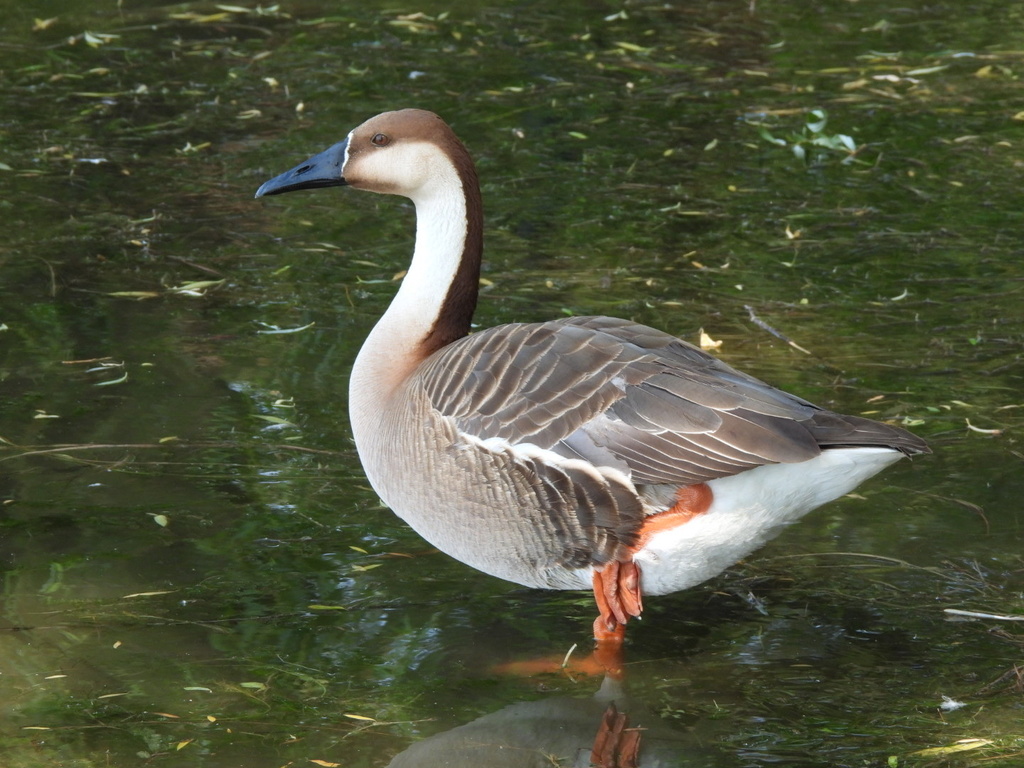
The swan goose (Anser cygnoides) is a large goose with a natural breeding range in inland Mongolia, Northeast China, and the Russian Far East. It is migratory and winters mainly in central and eastern China. Vagrant birds are encountered in Japan and Korea (where it used to winter in numbers when it was more common), and more rarely in Kazakhstan, Laos, coastal Siberia, Taiwan, Thailand and Uzbekistan.
While uncommon in the wild, this species has been extensively domesticated, when it is known as Chinese goose. Introduced and feral populations of its domestic breeds occur in many places outside its natural range. The wild form is also kept in collections, and escapes are not unusual amongst feral flocks of other Anser and Branta geese.
From the article Swan goose on Wikipedia (CC BY-SA), quoted section by section
What it does
It inhabits steppe to taiga and mountain valleys near freshwater, grazing on plants such as sedges (Cyperaceae), grasses (Poaceae) and water plants, and rarely swimming. It forms small flocks outside the breeding season. In the winter, it grazes on plains and stubble fields, sometimes far from water. Birds return from the winter quarters around April, and the breeding season starts soon thereafter. It breeds as single pairs or loose groups near marshes and other wetlands, with nesting activity starting about May. The clutch is usually 5–6 but sometimes up to 8 eggs, which are laid in a shallow nest made from plants, placed directly on the ground, often on a small knoll to keep it dry. The precocial young hatch after about 28 days and become sexually mature at 2–3 years of age. Around late August/early September, the birds leave for winter quarters, where they gather in small groups to moult their worn plumage. The swan goose was uplisted from Near Threatened to Vulnerable on the IUCN Red List in 1992 and further to Endangered in 2000, as its population is declining due to habitat loss and excessive hunting and (particularly on the Sanjiang Plain in China) egg collecting. But new research has shown it to be not as rare as it was believed, and consequently, it was downlisted to Vulnerable status again in 2008. …
Wikipedia: “Ecology”
Listen
Looking for field recordings…
Where it lives
Recorded sightings
—
geo-referenced records in GBIF, from museums, herbaria and field observers.
Drag the globe to turn it. Dots are where records exist, not a range map; darker means more records.
In the stacks
Searching the stacks…
Every page naming Anser cygnoides in the Biodiversity Heritage Library →
This page is assembled live from iNaturalist, GBIF, Wikipedia, the Source Library and the Internet Archive. It is not yet part of the hand-edited codex. iNaturalist taxon 7014.