On eBird ↗
Common Merganser
Live sightings near you, the range map, bar charts of when it is seen, and Macaulay Library photos and recordings.
Common Merganser
Mergus merganser
The common merganser or goosander (Mergus merganser) is a large sea duck of rivers and lakes in forested areas of Europe, Asia, and North America. The common merganser eats mainly fish. It nests in holes in trees. The name "common merganser" is used in North America, while "goosander" is used in Eurasia.
From the article Common merganser on Wikipedia (CC BY-SA), quoted section by section
Description
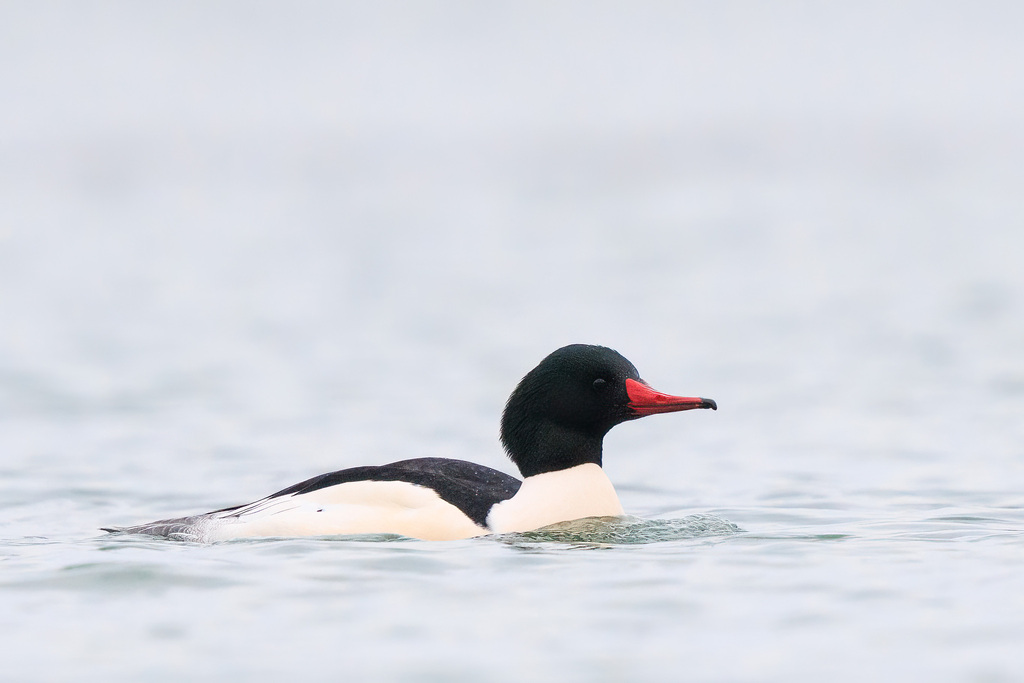
It is 58–72 cm (23–28+1⁄2 in) long with a 78–97 cm (30+1⁄2–38 in) wingspan and a weight of 0.9–2.1 kg (2 lb 0 oz – 4 lb 10 oz); males are on average slightly larger than females, but with some overlap. Like other species in the genus Mergus, it has a crest of longer head feathers, but these usually lie smoothly rounded behind the head and do not normally form an erect crest. Adult males in breeding plumage are easily distinguished, the body white with a variable salmon-pink tinge, the head black with an iridescent green sheen, the rump and tail grey, and the wings largely white on the inner half, black on the outer half. Females and males in "eclipse" (non-breeding plumage, July to October) are largely grey, with a reddish-brown head, white chin, and white secondary feathers on the wing. Juveniles (both sexes) are similar to adult females but also show a short black-edged white stripe between the eye and bill. The bill and legs are red to brownish-red, brightest on adult males, dullest on juveniles.
What it does
As with other mergansers, these piscivorous ducks have serrated edges to their bills to help them grip their prey, so they are often known as "sawbills". In addition to fish, they take a wide range of other aquatic prey, such as molluscs, crustaceans, worms, insect larvae, and amphibians; more rarely, small mammals and birds may be taken. As in other birds with this trait, the salmon-pink colouration shown variably by males is probably dietary-derived from the carotenoid pigments found in some crustaceans and fish. When not diving for food, they are usually observed swimming on the surface of the water or resting on rocks in the middle of rivers or hidden in the vegetation along riverbanks, or (in winter) on the edge of floating ice.
Wikipedia: “Feeding”
Listen
Looking for field recordings…
Where it lives
Recorded sightings
—
geo-referenced records in GBIF, from museums, herbaria and field observers.
Drag the globe to turn it. Dots are where records exist, not a range map; darker means more records.
In the stacks
Searching the stacks…
Every page naming Mergus merganser in the Biodiversity Heritage Library →
This page is assembled live from iNaturalist, GBIF, Wikipedia, the Source Library and the Internet Archive. It is not yet part of the hand-edited codex. iNaturalist taxon 7004.