On eBird ↗
Scaly-sided Merganser
Live sightings near you, the range map, bar charts of when it is seen, and Macaulay Library photos and recordings.
Scaly-sided Merganser
Mergus squamatus
The scaly-sided merganser or Chinese merganser (Mergus squamatus) is an endangered typical merganser (genus Mergus). It lives in Manchuria and extreme Southeast Siberia, breeding in the north and wintering in the south.
From the article Scaly-sided merganser on Wikipedia (CC BY-SA), quoted section by section
Description
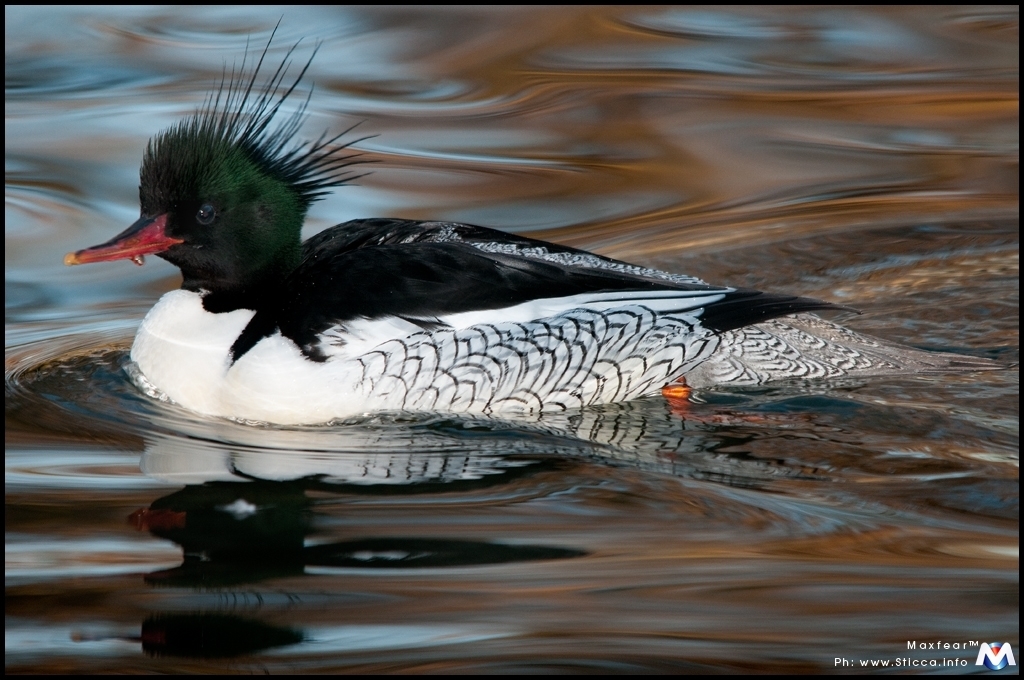
This striking sea duck has a thin red bill and a scaled dark pattern on the flanks and rump. Both sexes have a crest of wispy elongated feathers, reaching almost to the shoulders in adult males and being fairly short in females and immatures. The adult male has a black head and neck, white breast and underparts, and blackish mantle and wings, except for the white innerwings. The scaling is also black, while the tail is medium grey. The female has a buffish head and otherwise replaces the male's black with grey colour. The legs are orange-red and the irides dark brown in both sexes.
What it does
Their breeding habitat is rivers in primary forest in the southeastern Russian Far East, perhaps in North Korea, and in two locations Changbai Mountains and small isolated location in Lesser Xingan Mtns. in northeastern China. The bulk of the species' population breed in Russian Far East (85%) and Changbaishan both in China and DPRK M. squamatus are migratory, wintering in central and southern China, with small numbers in Japan, South Korea, Taiwan, northern Vietnam, Myanmar and Thailand. They arrive on the breeding grounds as soon as winter is over, in March, and leave when the first cold nights come in mid November. This shy and easily startled bird favors mid-sized rivers which meander through wide expanses of mixed forest in the mountains, up to 1,000 meters (3,300 ft) ASL or less. Birds tend to move upriver during the day, both when startled and when foraging; the latter is probably because stirred-up sediments will alert and hide prey downstream. Food is caught with the serrated beak from among the riverbed gravel. Often the birds dive for prey, repeatedly submerging for a quarter-to half-minute with only a few seconds pause between dives. In shallow water, the birds submerge only the head; they do not upend. The birds are not very social during breeding period and they gather in small groups in autumn and winter. …
Wikipedia: “Ecology”
Listen
Looking for field recordings…
Where it lives
Recorded sightings
—
geo-referenced records in GBIF, from museums, herbaria and field observers.
Drag the globe to turn it. Dots are where records exist, not a range map; darker means more records.
In the stacks
Searching the stacks…
Every page naming Mergus squamatus in the Biodiversity Heritage Library →
This page is assembled live from iNaturalist, GBIF, Wikipedia, the Source Library and the Internet Archive. It is not yet part of the hand-edited codex. iNaturalist taxon 7002.