On eBird ↗
Pacific Black Duck
Live sightings near you, the range map, bar charts of when it is seen, and Macaulay Library photos and recordings.
Pacific Black Duck
Anas superciliosa
The Pacific black duck (Anas superciliosa), commonly known as the PBD, is a dabbling duck found in much of Indonesia, New Guinea, Australia, New Zealand, and many islands in the southwestern Pacific, reaching to the Caroline Islands in the north and French Polynesia in the east. It is usually called the grey duck in New Zealand, where it is also known by its Māori name, pārera.
From the article Pacific black duck on Wikipedia (CC BY-SA), quoted section by section
Description
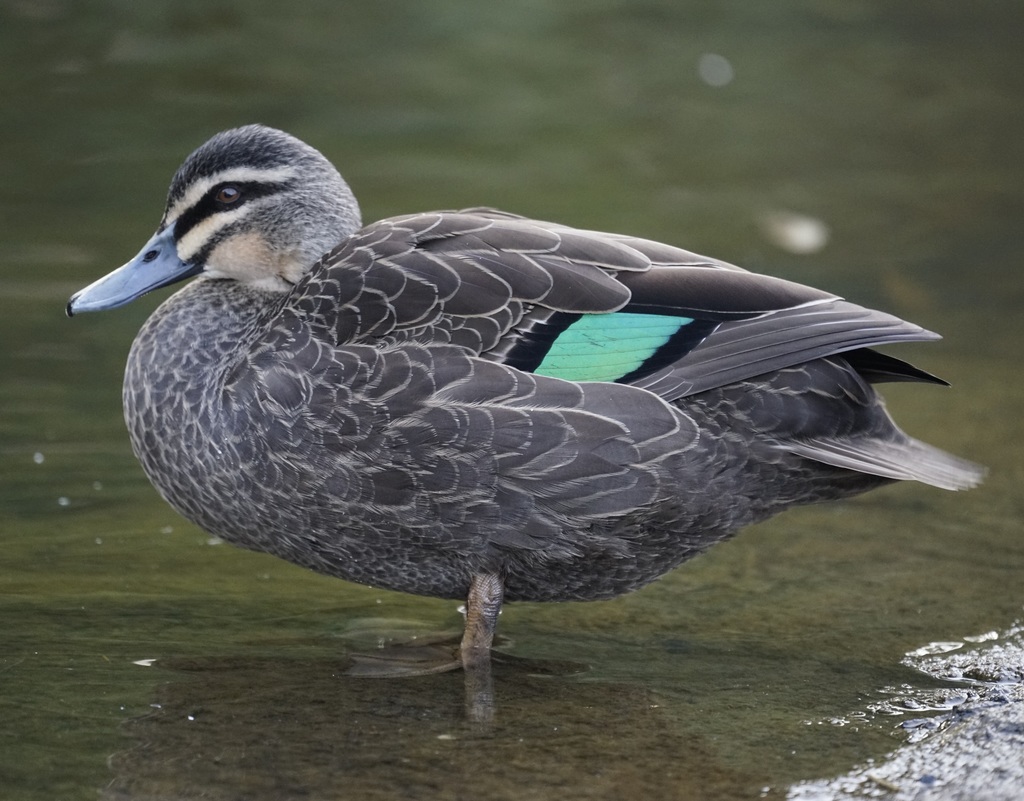
This sociable duck is found in a variety of wetland habitats, and its nesting habits are much like those of the mallard, which is encroaching on its range in New Zealand. It feeds by upending, like other Anas ducks. It has a dark body, and a paler head with a dark crown and facial stripes. In flight, it shows a green speculum and pale underwing. All plumages are similar. The size range is 54–61 cm (21–24 in); males tend to be larger than females, and some island forms are smaller and darker than the main populations. It is not resident on the Marianas islands, but sometimes occurs there during migration. The now-extinct Mariana mallard was probably originally derived from hybrids between this species and the mallard, which came to the islands during migration and settled there. Like its relatives the mallard and American black duck, the Pacific black duck is one of a number of duck species that can quack, with the female producing a sequence of raucous, rapid quacking which decreases in volume.
What it does
The Pacific black duck is mainly vegetarian, feeding on seeds of aquatic plants. This diet is supplemented with small crustaceans, molluscs and aquatic insects. Food is obtained by 'dabbling', where the bird plunges its head and neck underwater and upends, raising its rear end vertically out of the water. Occasionally, food is sought on land in damp grassy areas.
Wikipedia: “Diet”
Listen
Looking for field recordings…
Where it lives
Recorded sightings
—
geo-referenced records in GBIF, from museums, herbaria and field observers.
Drag the globe to turn it. Dots are where records exist, not a range map; darker means more records.
In the stacks
Searching the stacks…
Every page naming Anas superciliosa in the Biodiversity Heritage Library →
This page is assembled live from iNaturalist, GBIF, Wikipedia, the Source Library and the Internet Archive. It is not yet part of the hand-edited codex. iNaturalist taxon 6987.