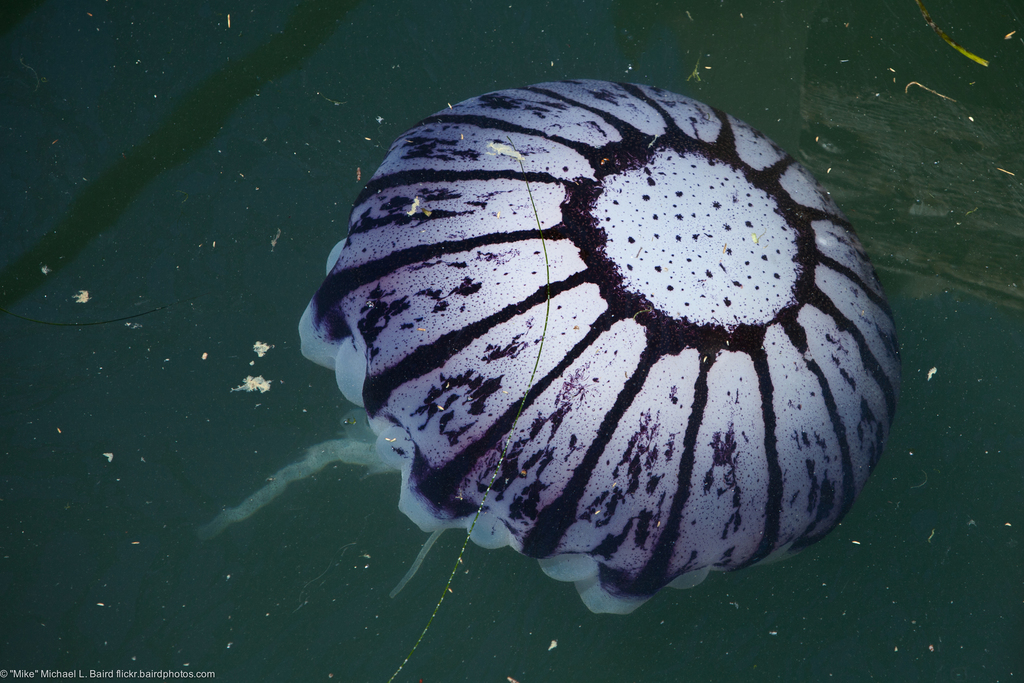
Purple-striped Sea Nettle
Chrysaora colorata
Chrysaora colorata (Russell), commonly known as the purple-striped jelly or purple-striped sea nettle, is a species of jellyfish that exists primarily off the coast of California from Bodega Bay to San Diego. The bell (body) of the jellyfish is up to 70 cm (2.3 ft) in diameter, typically with a radial pattern of stripes. The tentacles vary with the age of the individual, consisting typically of eight marginal long dark arms, and four central frilly oral arms. It is closely studied by scientists due to not much being known about their eating habits. A 15-foot-long specimen has been seen.
Often young Cancer crabs make home in the jellyfish and eat the parasitic amphipods that feed on and damage the jellyfish. C. colorata are more active in a lively current, which makes it easier for them to move and capture their prey.
From the article Chrysaora colorata on Wikipedia (CC BY-SA), quoted section by section
Description
The jellyfish gets its name from the purple stripes on its bell. Juveniles are a pinkish color and its tentacles are long and dark maroon. As they age, the dark maroon color of the tentacles starts to fade, the purple appears as stripes on the bell and the four frilly oral arms will also become longer. In addition, the tentacles thicken and the purple stripes start to darken and the tentacles start to look pale, its oral arms like to disappear.
What it does
They are known to feed on a variety of organisms including zooplankton, Cladocera, Appendicularia, Copepoda, Hydromedusae, Siphonophorae, and fish eggs. When the prey touches a marginal tentacle, stingers are immediately discharged to paralyze prey and marginal tentacle bends inward to the nearest oral arm. The oral arm is used to transport prey to the gastrovascular cavity (GVC) and to catch motionless prey. The sting of this jellyfish is extremely painful to humans but is rare.
Its diet consists of zooplankton, including copepods, larval fish, ctenophores, salps, other jellies, and fish eggs.
Wikipedia: “Diet”
Where it lives
Recorded sightings
—
geo-referenced records in GBIF, from museums, herbaria and field observers.
Drag the globe to turn it. Dots are where records exist, not a range map; darker means more records.
In the stacks
Searching the stacks…
Every page naming Chrysaora colorata in the Biodiversity Heritage Library →
This page is assembled live from iNaturalist, GBIF, Wikipedia, the Source Library and the Internet Archive. It is not yet part of the hand-edited codex. iNaturalist taxon 69839.