- Animals
- ›Chordates
- ›Vertebrates
- ›Ray-finned Fishes
- ›Spiny-rayed fishes
- ›Pipefishes and Allies
- ›Syngnathoidei
- ›Pipefishes, Seahorses, and Seadragons
- ›Tail-brooding Pipefishes
- ›Syngnathoides
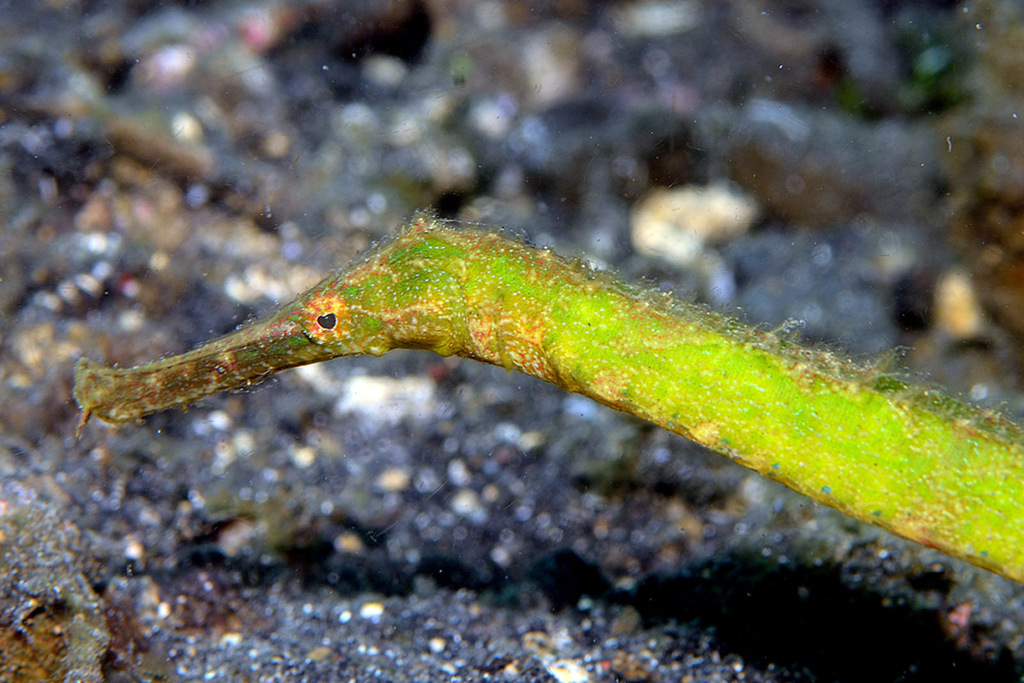
Double-end Pipehorse
Syngnathoides biaculeatus
The alligator pipefish or double-ended pipefish (Syngnathoides biaculeatus) is a species of fish in the family Syngnathidae and is the only species in the monotypic genus Syngnathoides. It is found in shallow water in the tropical and subtropical Indo-Pacific, its range extending from East Africa to northern Australia. This fish lives in habitats of seagrass and seaweed, and hides by positioning itself vertically with its head down amidst the similar-coloured fronds of vegetation. The elongated, well-camouflaged body can reach 29 cm (11 in) in length. It feeds by sucking up its prey.
From the article Alligator pipefish on Wikipedia (CC BY-SA), quoted section by section
Description
The alligator pipefish can grow to a length of about 29 cm (11 in) though a more typical length is 20 cm (8 in). The narrow head has the snout tipped by a pair of short tentacles and the body is elongated and tetrahedral. The dorsal fin has 38 to 48 soft rays and the anal fins have 4 soft rays. The tail is long and tapering. It is prehensile and lacks a tail fin, being used to anchor the fish to vegetation. The colour of this fish tends to match its surroundings and is usually some shade of green, brown, or grey. Females are often blotched and may have a white zigzag line running along the abdomen.
Range & habitat
The alligator pipefish occurs in tropical and subtropical parts of the Indian Ocean and Pacific Ocean. Its range extends from South Africa, the East Coast of Africa, and the Red Sea to India, Japan, Indonesia, the Philippines, New Guinea, Australia, and various Pacific Islands. In Australia its range extends from Geraldton in Western Australia around the coast of the Northern Territory and Queensland to Batemans Bay in New South Wales. It occurs in lagoons and on reef flats, in bays and estuaries, in seagrass meadows, and in floating masses of algae, usually at depths of less than 5 m (16 ft).
Wikipedia: “Distribution and habitat”
What it does
The alligator pipefish is an inefficient swimmer, moving by an undulating motion of its pectoral and dorsal fins. It feeds on zooplankton and small creatures which it sucks into its mouth. The diet includes amphipods, mysids, shrimps, other benthic invertebrates, and small fish. The alligator pipefish is sexually dimorphic with males being larger than females. Males become mature at a length of about 180 mm (7 in). Breeding takes place during the summer in Moreton Bay, Queensland but occurs at any time of year in Papua New Guinea. A female produces a batch of 60 to 200 eggs which are retained by the male in a brood pouch on his abdomen. Here they remain until they hatch. The male and female seem to have a monogamous relationship with all the developing eggs being at the same stage of development and presumably the product of a single female.
Wikipedia: “Behaviour”
Where it lives
Recorded sightings
—
geo-referenced records in GBIF, from museums, herbaria and field observers.
Drag the globe to turn it. Dots are where records exist, not a range map; darker means more records.
In the stacks
Searching the stacks…
Every page naming Syngnathoides biaculeatus in the Biodiversity Heritage Library →
This page is assembled live from iNaturalist, GBIF, Wikipedia, the Source Library and the Internet Archive. It is not yet part of the hand-edited codex. iNaturalist taxon 69834.