- Animals
- ›Arthropods
- ›Chelicerates
- ›Arachnids
- ›Spiders
- ›Typical Spiders
- ›Entelegyne Spiders
- ›Thomisoidea Spiders
- ›Crab Spiders
- ›Thomisinae
- ›Thomisini
- ›Thomisus
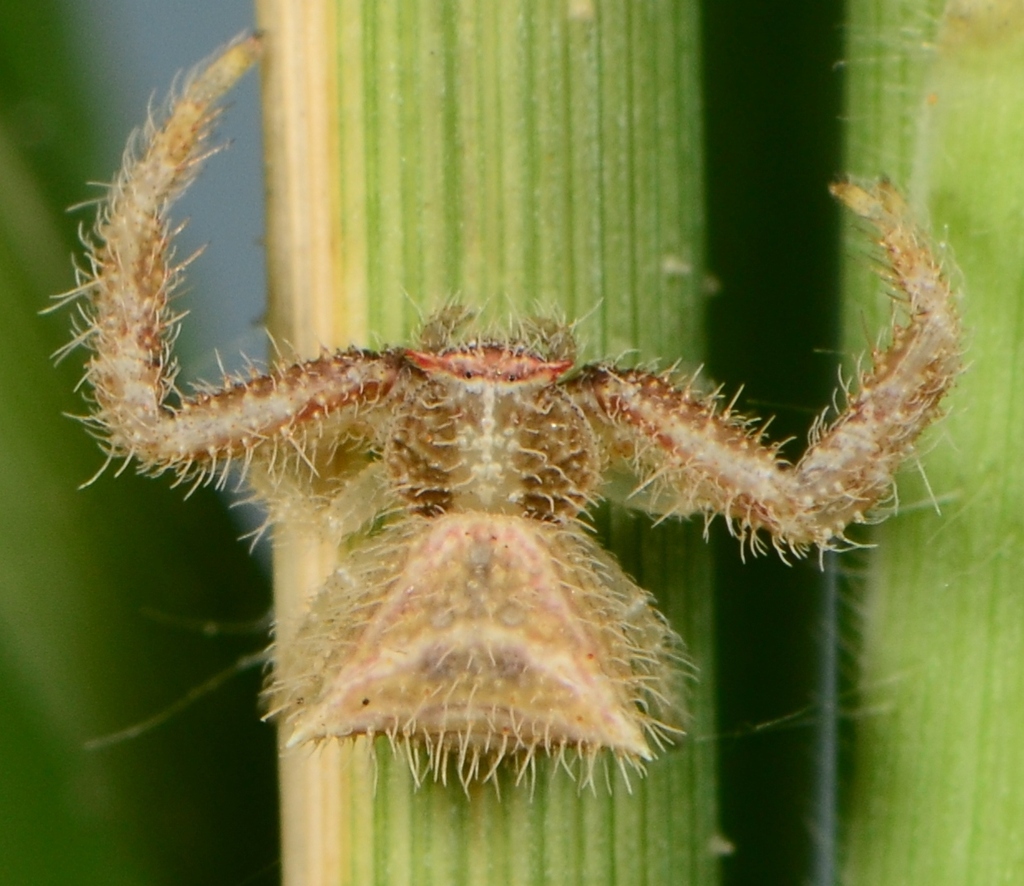
Thomisus spiculosus
Thomisus spiculosus is a species of spider of the genus Thomisus in the family Thomisidae. It is found in several countries in Africa.
From the article Thomisus spiculosus on Wikipedia (CC BY-SA), quoted section by section
Description
Thomisus spiculosus belongs to a group of crab spiders characterized by short, robust bodies with the first two pairs of legs being particularly stout. The lateral eyes are situated on distinct eye tubercles.
Female. The female is larger than the male, with a total length of 7.9–8.3 mm. The cephalothorax measures 3.6–3.8 mm in length and 3.5–4.0 mm in width. The body appears yellowish when preserved in alcohol, though living specimens display a pale green carapace and legs with a green-banded opisthosoma. The most distinctive feature is the dense covering of numerous long, spiniform setae across the body and legs, each arising from a small tubercle. Some setae and their bases are darker than others, creating a mottled appearance. The carapace is high and slightly wider than long, with both eye rows recurved and the anterior row more strongly curved than the posterior. The eye arrangement shows the anterior lateral eyes slightly larger than the anterior median eyes, with the posterior eyes nearly equal in size. The anterior median eyes are positioned closer to each other than to the anterior lateral eyes.
Male. Males are considerably smaller than females, measuring 3.6 mm in total length with a carapace length of 1.5 mm and width of 1.8 mm. The carapace is dark brown, becoming slightly darker around the edges, while the chelicerae are also dark brown. …
Range & habitat
Thomisus spiculosus has been recorded from Nigeria, Democratic Republic of the Congo, Tanzania, Zimbabwe, Mozambique, and South Africa. In South Africa, the species is distributed across several provinces including Gauteng, KwaZulu-Natal, Limpopo, and Mpumalanga.
Wikipedia: “Distribution”
What it does
Adults are active from September to December, with males specifically recorded during November and December. As predators, they feed on various insects including Lantana bugs. The species has been collected using beating and sweeping techniques from vegetation.
Wikipedia: “Behavior and ecology”
In human culture
The species name spiculosus derives from the Latin word meaning "pointed" or "bearing small spikes," referring to the numerous spiniform setae that cover the spider's body and give it a distinctly hairy appearance.
Wikipedia: “Etymology”
Where it lives
Recorded sightings
—
geo-referenced records in GBIF, from museums, herbaria and field observers.
Drag the globe to turn it. Dots are where records exist, not a range map; darker means more records.
In the stacks
Searching the stacks…
Every page naming Thomisus spiculosus in the Biodiversity Heritage Library →
This page is assembled live from iNaturalist, GBIF, Wikipedia, the Source Library and the Internet Archive. It is not yet part of the hand-edited codex. iNaturalist taxon 693351.