On eBird ↗
Trumpeter Swan
Live sightings near you, the range map, bar charts of when it is seen, and Macaulay Library photos and recordings.
Trumpeter Swan
Cygnus buccinator
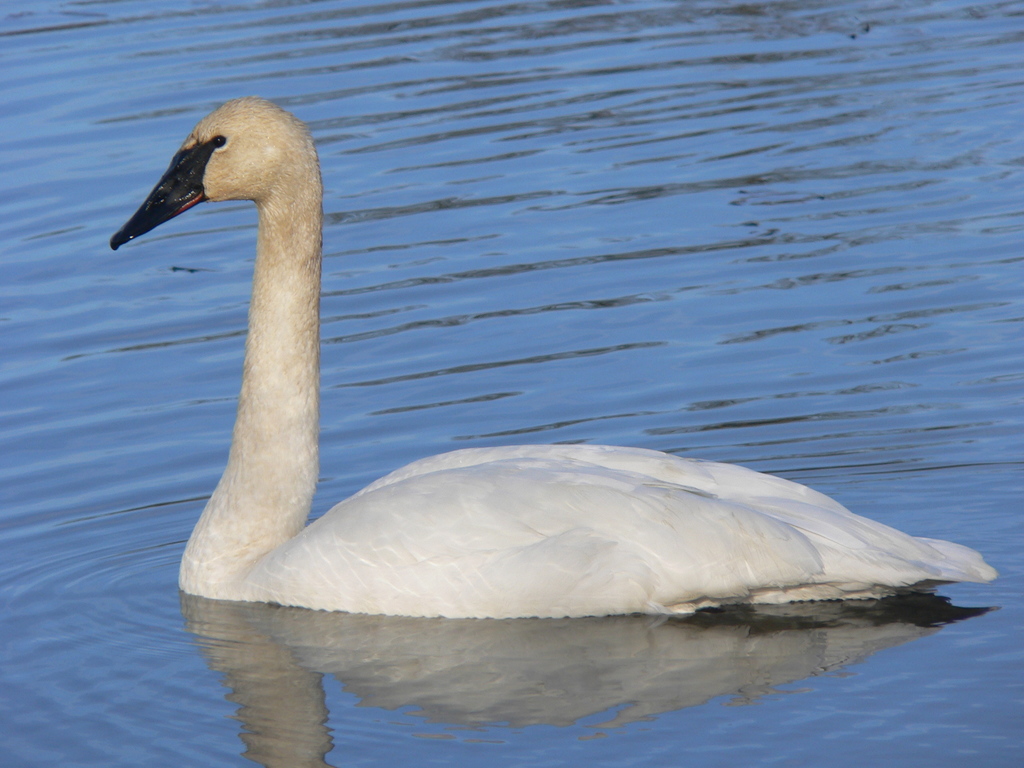
The trumpeter swan (Cygnus buccinator), or simply the trumpeter, is a species of swan found in North America. The heaviest living bird native to North America, it is also the largest extant species of waterfowl, with a wingspan of 185 to 304.8 cm (6 ft 2 in to 10 ft 2 in). It is the American counterpart and a close relative of the whooper swan (Cygnus cygnus) of Eurasia and has even been considered the same species by some authorities. By 1933, fewer than 70 wild individuals were known to exist; extinction seemed imminent until aerial surveys discovered a Pacific population of several thousand trumpeter swans around Alaska's Copper River. Careful reintroductions by wildlife agencies and the Trumpeter Swan Society gradually restored the North American wild population to over 46,000 birds by 2010.
From the article Trumpeter swan on Wikipedia (CC BY-SA), quoted section by section
Description
The trumpeter swan is the largest extant species of waterfowl, and both the heaviest and longest native bird of North America. Adults usually measure 138–165 cm (4 ft 6 in – 5 ft 5 in) long, though large males can exceed 180 cm (5 ft 11 in) in total length. The weight of adult birds is typically 7–13.6 kg (15–30 lb). Possibly due to seasonal variation based on food access and variability due to age, average weights in males have been reported to range from 10.9 to 12.7 kg (24 to 28 lb) and from 9.4 to 10.3 kg (21 to 23 lb) in females. It is one of the heaviest living animals capable of flight, and, in terms of average mass, the heaviest flying bird in the world. Alongside the mute swan (Cygnus olor), wild turkey (Meleagris gallopavo), great bustard (Otis tarda), Kori bustard (Ardeotis kori), Dalmatian pelican (Pelecanus crispus), and Andean condor (Vultur gryphus), it is one of a handful to weigh in excess of 10 kg (22 lb) between the sexes, and one survey of wintering trumpeters found it averaged second only to the condor in mean mass. The trumpeter swan's wingspan ranges from 185 to 304.8 cm (6 ft 0.8 in to 10 ft 0 in), with the wing chord measuring 60–68 cm (24–27 in). The largest known male trumpeter attained a length of 183 cm (6 ft 0 in), a wingspan of 3.1 m (10 ft 2 in) and a weight of 17.2 kg (38 lb). …
Range & habitat
Cooperative continental surveys of trumpeter swans have been performed regularly, beginning in 1968, repeated in 1975, and then conducted at 5-year intervals. The most recent survey of trumpeter swans occurred in 2015. The survey assesses trumpeter swan abundance and productivity throughout the entire breeding ranges of the three recognized North American populations: the Pacific Coast (PCP), Rocky Mountain (RMP), and Interior (IP) populations (see Figure). From 1968 to 2010 the population has increased from 3,722 to approximately 46,225 birds, in large part due to re-introductions to the species' historic range. The breeding habitat of trumpeter swans includes large and shallow ponds, undisturbed lakes, pristine wetlands, wide and slow rivers, and marshes in northwestern and central North America. The largest numbers of breeding pairs are found in Alaska. Trumpeter swans prefer nesting sites with enough surface water for them to have space to take off, as well as accessible and reliable food sources, shallow, unpolluted water, and little to no human disturbance. Natural populations migrate in V-shaped flocks to and from the Pacific coast and portions of the United States. …
Wikipedia: “Range and habitat”
What it does
These birds feed while swimming, sometimes up-ending or dabbling in reaching submerged food. The diet is almost entirely aquatic plants and occasionally insects. They will eat both the leaves and stems of submerged and emergent vegetation. They will also dig into muddy substrates underwater to extract roots and tubers. In winter, they may also eat grasses and grains in fields. They will often feed at night as well as by day. Feeding activity, and the birds' weights, often peak in the spring as they prepare for the breeding season. The young initially include insects, small fish, fish eggs and small crustaceans in their diet, providing additional protein, and change to a vegetation-based diet over the first few months.
Wikipedia: “Diet”
Listen
Looking for field recordings…
Where it lives
Recorded sightings
—
geo-referenced records in GBIF, from museums, herbaria and field observers.
Drag the globe to turn it. Dots are where records exist, not a range map; darker means more records.
In the stacks
Searching the stacks…
Every page naming Cygnus buccinator in the Biodiversity Heritage Library →
This page is assembled live from iNaturalist, GBIF, Wikipedia, the Source Library and the Internet Archive. It is not yet part of the hand-edited codex. iNaturalist taxon 6915.