On eBird ↗
Fulvous Whistling-Duck
Live sightings near you, the range map, bar charts of when it is seen, and Macaulay Library photos and recordings.
Fulvous Whistling-Duck
Dendrocygna bicolor
The fulvous whistling duck or fulvous tree duck (Dendrocygna bicolor) is a species of whistling duck that breeds across the world's tropical regions in much of Mexico and South America, the West Indies, the southern United States, sub-Saharan Africa and the Indian subcontinent. It has plumage that is mainly reddish brown, long legs and a long grey bill, and shows a distinctive white band across its black tail in flight. Like other members of its ancient lineage, it has a whistling call which is given in flight or on the ground. Its preferred habitat consists of wetlands with plentiful vegetation, including shallow lakes and paddy fields.
The nest, built from plant material and unlined, is placed among dense vegetation or in a tree hole. The typical clutch is around ten whitish eggs. The breeding adults, which pair for life, take turns to incubate, and the eggs hatch in 24–29 days. The downy grey ducklings leave the nest within a day or so of hatching, but the parents continue to protect them until they fledge around nine weeks later.
From the article Fulvous whistling duck on Wikipedia (CC BY-SA), quoted section by section
Description
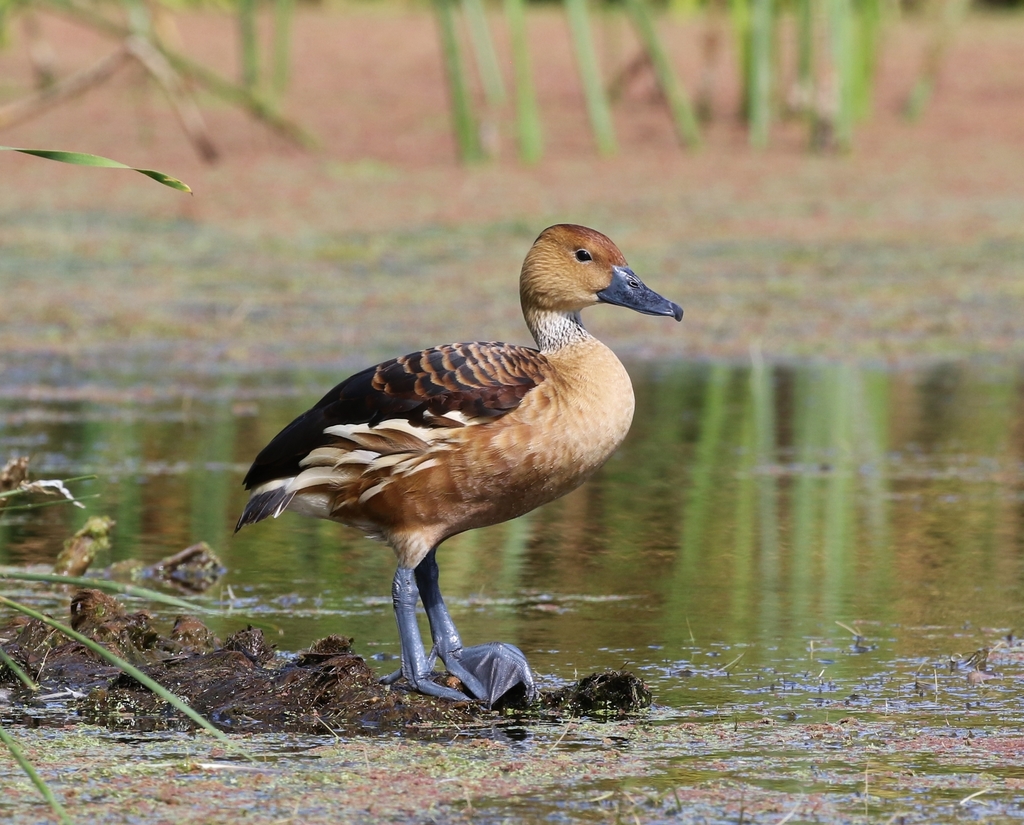
The fulvous whistling duck is 45–53 cm (18–21 in) long; the male weighs 748–1,050 g (26.4–37.0 oz), and the female averages marginally lighter at 712–1,000 g (25.1–35.3 oz). The wingspan ranges from 85 to 93 cm. It is a long-legged duck, mainly different shades of brown; head, neck and breast are particularly rich buff (fulvous) with a darker back. The mantle is more darker shade of brown with buff-tipped feathers, the flight feathers and tail are dark brown, and a dark brown to black stripe runs through the center of the crown down the back of the neck to the base of the mantle. It has whitish stripes on its flanks, a long grey bill and grey legs. In flight, the wings are brown above and black below, with no white markings, and a white crescent on the rump contrasts with the black tail. All plumages are fairly similar, but the female is slightly smaller and duller-plumaged than the male. The juvenile has paler underparts, and appears generally duller, especially on the flanks. There is a complete wing moult after breeding, and birds then seek the cover of dense wetland vegetation while they are flightless. Body feathers may be moulted throughout the year; each feather is replaced only once annually. These are noisy birds with a clear whistling kee-wee-ooo call given on the ground or in flight, frequently heard at night. Quarrelling birds also have a harsh repeated kee. …
Range & habitat
The fulvous whistling duck has a very large range extending across four continents. It breeds in lowland South America from northern Argentina to Colombia and then up to the southern US and the West Indies. It is found in a broad belt across sub-Saharan Africa and down the east of the continent to South Africa and Madagascar. The Indian subcontinent is the Asian stronghold. It undertakes seasonal movements in response to the availability of water and food. African birds move southwards in the southern summer to breed and return north in the winter, and Asian populations are highly nomadic due to the variability of rainfall. This species has strong colonising tendencies, having expanded its range in Mexico, the US and the West Indies in recent decades with northerly range expansions into California in late 19th century and rice-growing regions of the U.S. Gulf Coastal Plain in the early to mid-20th century, given its affinity for rice-growing areas. Breeding in the northern American region is restricted to the Gulf Coastal Plain of Texas and Louisiana and localities in southern California and south- and east-central Florida. …
Wikipedia: “Distribution and habitat”
What it does
This species is usually found in small groups, but substantial flocks can form at favoured sites. It walks well, without waddling, and normally feeds by upending, though it can dive if necessary. It does not often perch in trees, unlike other whistling ducks. It flies at low altitude with slow wingbeats and trailing feet, in loose flocks rather than tight formation. It feeds during the day and at night in fairly large flocks, often with other whistling duck species, but rests or sleeps in smaller groups in the middle of the day. They are noisy and display their aggression towards other individuals by throwing back their heads. Before taking off in alarm, they often shake their head sideways. Several arthropod parasites have been recorded on this duck, including chewing mites of the families Philopteridae and Menoponidae, feather mites and skin mites. Internal helminth parasites include roundworms, tapeworms and flukes. In a survey in Florida, all 30 ducks tested carried at least two helminth species; none had blood parasites. Only one duck had no mites or lice.
Breeding. Breeding coincides with the availability of water. In South America and South Africa, the main nesting period is December–February, in Nigeria it is July–December, and in North America mid-May–August. In India, the breeding season is from June to October but peaking in July and August. …
Wikipedia: “Behaviour”
Listen
Looking for field recordings…
Where it lives
Recorded sightings
—
geo-referenced records in GBIF, from museums, herbaria and field observers.
Drag the globe to turn it. Dots are where records exist, not a range map; darker means more records.
In the stacks
Searching the stacks…
Every page naming Dendrocygna bicolor in the Biodiversity Heritage Library →
This page is assembled live from iNaturalist, GBIF, Wikipedia, the Source Library and the Internet Archive. It is not yet part of the hand-edited codex. iNaturalist taxon 6899.