On eBird ↗
Black-bellied Whistling-Duck
Live sightings near you, the range map, bar charts of when it is seen, and Macaulay Library photos and recordings.
Black-bellied Whistling-Duck
Dendrocygna autumnalis
The black-bellied whistling duck (Dendrocygna autumnalis) or black-bellied tree duck, is a whistling duck that before 2000 bred mainly from the southernmost United States to south-central South America. It can be found year-round in much of the United States. It has been recorded in every eastern state and adjacent Canadian province. Since it is one of only two whistling duck species native to North America, it is occasionally just known as the "whistling duck" or "Mexican squealer" in the southern USA.
From the article Black-bellied whistling duck on Wikipedia (CC BY-SA), quoted section by section
Description
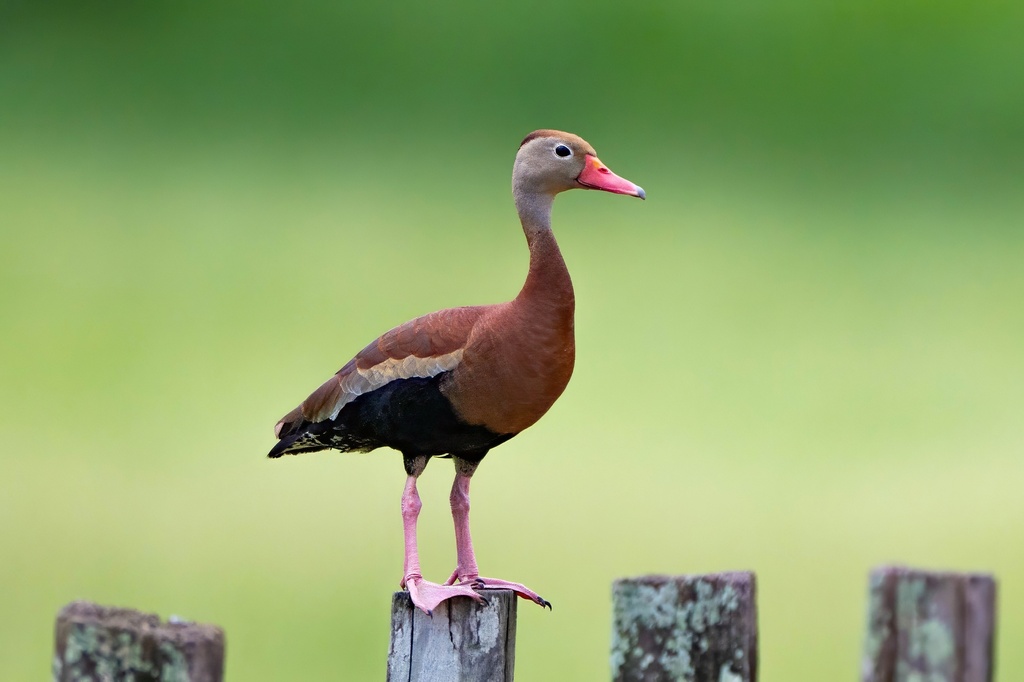
The black-bellied whistling duck is a mid-sized waterfowl species. Length ranges from 47 to 56 cm (19 to 22 in), body mass from 652 to 1,020 g (1.437 to 2.249 lb), and wingspan ranges from 76 to 94 cm (30 to 37 in). It has a long pink bill, long head and longish legs, pale gray head and mostly gray-brown plumage. The belly and tail are black, and the body plumage, back of the neck and cap are a rich chestnut brown. The face and upper neck are gray, and they sport a thin but distinct white eye-ring. The extensive white in the wings is obvious in flight, less so on the ground; it is formed by the secondary remiges while the primaries are black; the wing coverts are brown. Males and females look alike; juveniles are similar but have a gray bill and less contrasting belly. The wing bar is unique among whistling ducks. When on the ground, it may be hard to discern the light flanks present in many of these waterfowl. The fulvous whistling duck (D. bicolor) is the only sympatric whistling duck that shows such a whitish flank stripe, and it differs from the black-bellied by having dark wings and a lighter belly rather than the other way around. Juvenile D. autumnalis are quite similar to the young of the white-faced whistling duck (D. …
Range & habitat
The species is widely distributed in the American continent, to the north it includes the southern part of the United States (Texas, Arizona and Louisiana) and Mexico (mainly along the Pacific and Atlantic slopes, Yucatan Peninsula, southern Mexico and Baja California). Its distribution continues to Central and South America, including Venezuela, Colombia, Ecuador and Peru . The black-bellied whistling duck is generally not strongly migratory , although they are listed on the List of Birds protected by the Migratory Bird Treaty Act (MBTA). At the heart of their range, there is a tendency to travel in flocks over the winter months, though this behavior is not a true long-range migration but rather local dispersal. In the 21st century, small numbers have been observed nesting in the Midwestern U.S., including Ohio, Missouri, Illinois, Indiana, and Wisconsin; the species has also strayed to the eastern U.S. and Canada.
Wikipedia: “Distribution and habitat”
What it does
The black-bellied whistling duck is a common species that is "quite tame, even in the wild". It is highly gregarious, or social, forming large flocks when not breeding, and is largely resident apart from local movements. It usually nests in hollow trees (in South America many times in palm trees). The habitat is quite shallow freshwater ponds, lakes, and marshes, cultivated land or reservoirs with plentiful vegetation, where this duck feeds mainly at night on seeds and other plant food.
Breeding. The black-bellied whistling duck is quite unique among ducks in their strong monogamous pair-bond. Its pairs often stay together for many years, a trait more often associated with geese and swans. Both parents share all tasks associated with the raising of the young, from incubation to the rearing of ducklings. The ducks, primarily cavity nesters, prefer the confines of a hollow tree but will nest on the ground when necessary. …
Wikipedia: “Behavior and ecology”
Listen
Looking for field recordings…
Where it lives
Recorded sightings
—
geo-referenced records in GBIF, from museums, herbaria and field observers.
Drag the globe to turn it. Dots are where records exist, not a range map; darker means more records.
In the stacks
Searching the stacks…
Every page naming Dendrocygna autumnalis in the Biodiversity Heritage Library →
This page is assembled live from iNaturalist, GBIF, Wikipedia, the Source Library and the Internet Archive. It is not yet part of the hand-edited codex. iNaturalist taxon 6893.