- Animals
- ›Chordates
- ›Vertebrates
- ›Reptiles
- ›Snakes and Lizards
- ›Snakes
- ›Colubrid Snakes
- ›Colubrine Snakes
- ›Elaphe
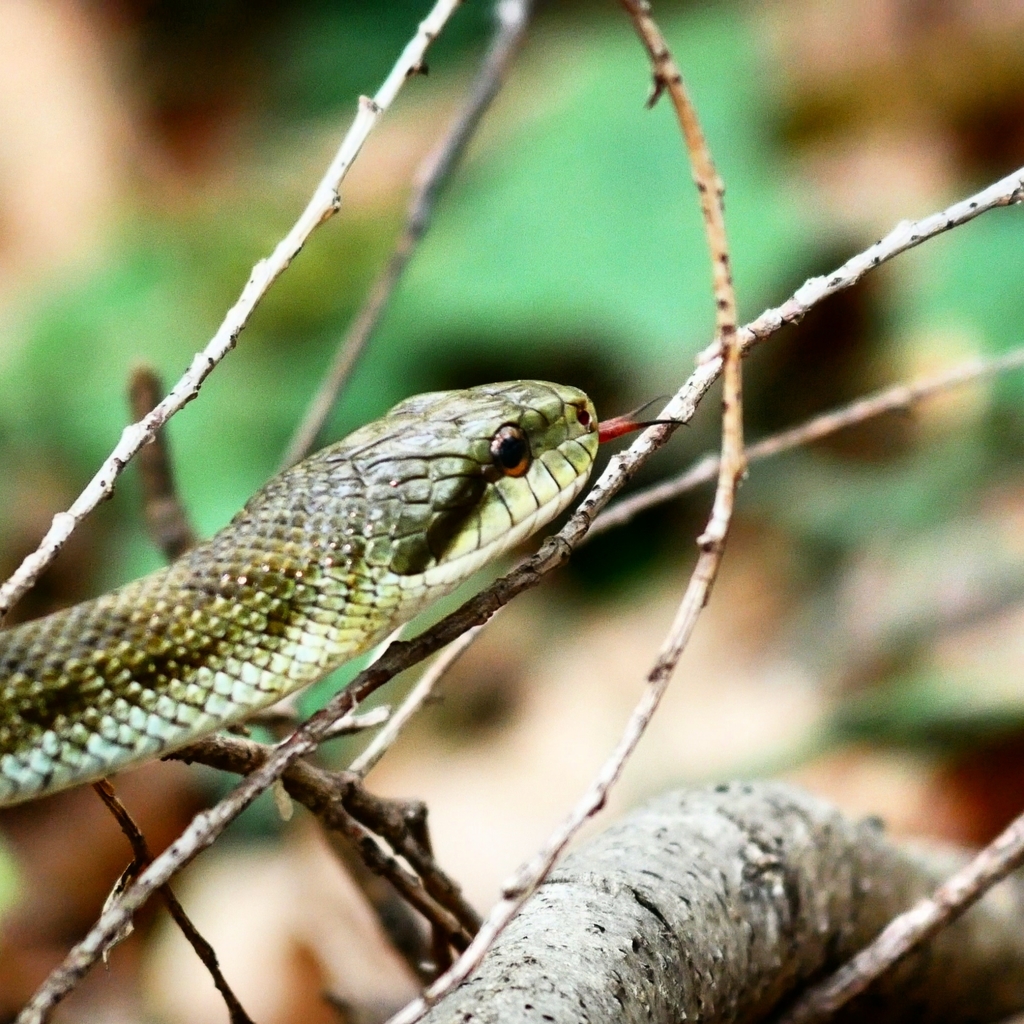
Japanese Ratsnake
Elaphe climacophora
The Japanese rat snake (Elaphe climacophora) is a medium-sized colubrid snake found throughout the Japanese archipelago (except the far South West) as well as on the Russian-administered Kunashir Island. In Japanese it is known as the aodaishō or "blue general". It is non-venomous and is hunted by eagles and tanukis.
The snakes brumate for three to four months, mate in spring and lay 7–20 eggs in early summer.
From the article Japanese rat snake on Wikipedia (CC BY-SA), quoted section by section
Description
Adults reach one to two meters in length and about five centimeters in girth. E. climacophora is the largest Japanese snake outside Okinawa. They are variable in color, ranging from pale yellow-green to dark blue-green. They can be identified as Asian rat snakes due to the dark streak behind each of their eyes. Juveniles have brown-stripe pattern that may be mimesis of the venomous mamushi. There is an established, albino population in the wild, with specimens especially numerous near Iwakuni, where they are called "Iwakuni white snakes" and revered as messengers of deities and deity-guardians of mountains and rivers. The albino population was protected in 1924 as a "national monument."
What it does
Japanese rat snakes eat a variety of small animals: rodents, frogs, lizards, shrews, or flies. They are also among the species of snake to have the ability to eat raw eggs. As semi-arboreal snakes, they often raid bird nests in the wild. They were favoured by farmers as effective rat control, though unpopular with chicken rearers.
Wikipedia: “Feeding”
Where it lives
Recorded sightings
—
geo-referenced records in GBIF, from museums, herbaria and field observers.
Drag the globe to turn it. Dots are where records exist, not a range map; darker means more records.
In the stacks
Searching the stacks…
Every page naming Elaphe climacophora in the Biodiversity Heritage Library →
This page is assembled live from iNaturalist, GBIF, Wikipedia, the Source Library and the Internet Archive. It is not yet part of the hand-edited codex. iNaturalist taxon 68339.