- Animals
- ›Chordates
- ›Vertebrates
- ›Reptiles
- ›Turtles and Tortoises
- ›Eurasian Pond, River, and Neotropical Wood Turtles
- ›Geoemydinae
- ›Cuora
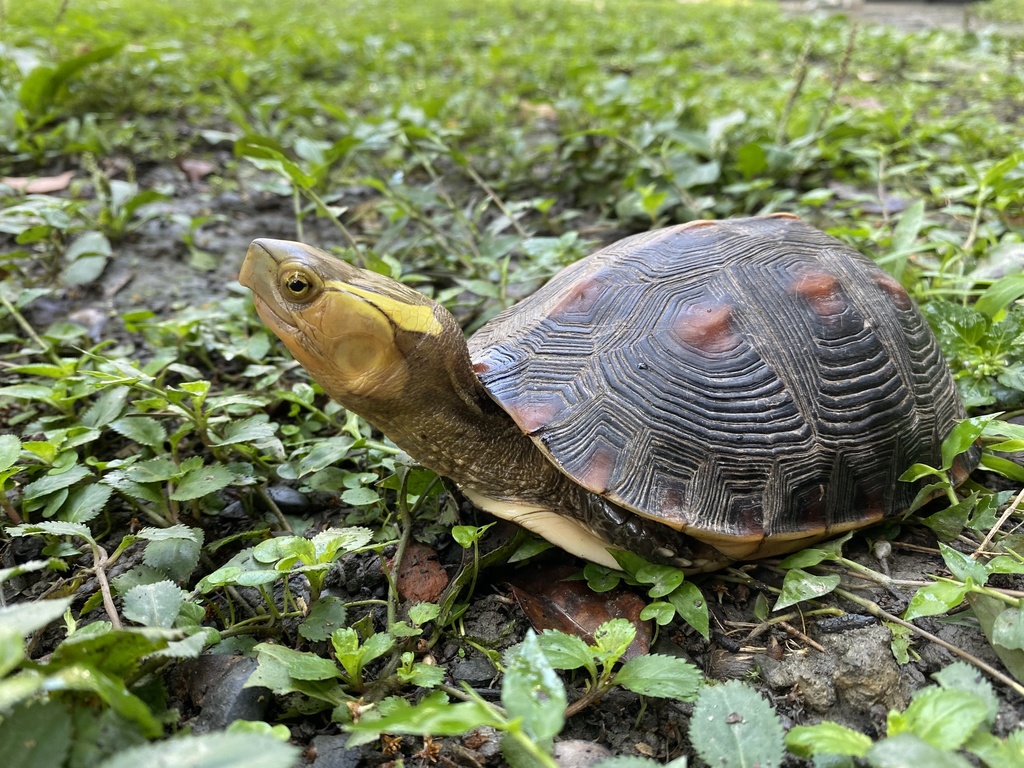
Chinese Box Turtle
Cuora flavomarginata
The Chinese box turtle (simplified Chinese: 食蛇龟; traditional Chinese: 食蛇龜; pinyin: shìshéguī; literally: "Snake-eating turtle"), also known as the Yellow-margined box turtle, or Golden-headed turtle, is a species of Asian box turtle. Taxonomically, it has been called Cistoclemmys flavomarginata, Cuora flavomarginata, and Cyclemys flavomarginata. The Integrated Taxonomic Information System uses Cuora flavomarginata.
From the article Chinese box turtle on Wikipedia (CC BY-SA), quoted section by section
Description
C. flavomarginata has a highly domed shell, the carapace and plastron of which are a dark brown with a cream-yellow stripe on the vertebral keel. The edge of the plastron is lightly pigmented due to the marginal scutes' and plastral scutes' lighter pigmentation near their edges. The skin on the limbs is brown, while the top of the head is pale green. Each side of the head has a yellow line extending from behind the eye backward. The skin beneath the head and between the limbs is a lighter pinkish color. The name box turtle refers to C. flavomarginata's ability to bring the plastron to the edges of the carapace. This is enabled by a hinge on the plastron and ligaments connecting the carapace and plastron, which allows for limited movement. The forefeet have five claws, while the rear have four. The external difference between male and female C. flavomarginata is slight. Males have a broader tail than females that is almost triangular in shape.
Wikipedia: “Anatomy”
Range & habitat
C. flavomarginata is found in Central China: Hunan, Henan, Anhui, Hubei, Chongqing, eastern Sichuan, Zhejiang & Jiangsu provinces (generally along the Yangtze drainage). It is also found in Taiwan and Japan, specifically the Ryukyu Islands, Ishigaki, and Iriomote.
Wikipedia: “Distribution”
What it does
C. flavomarginata is omnivorous, and will eat a large variety of foods. "Adults favor earthworms, frozen pinkies (defrosted), snails, slugs, and mealworms. They also eat dry trout chow and moistened dry cat food, canned cat food; fruits including strawberries, bananas, cantaloupe, and papaya; and vegetables including grated carrots, corn on the cob, and squash. Leafy greens are ignored. Invertebrates that the turtles hunt for include June bug (Phyllophaga) larvae and slugs being principal prey."
Wikipedia: “Trophic ecology”
In human culture
In 1863, John Edward Gray described the species as Cistoclemmys flavomarginata. It was later moved to Cyclemys, and then to Cuora. In the 2012 issue of the Turtle Taxonomy Working Group's Checklist, the species is listed as Cuora with two recognized subspecies. Two subspecies have been recognised:
Cuora flavomarginata flavomarginata Cuora flavomarginata evelynae This species has hybridized with Mauremys japonica in captivity and with female Ryukyu black-breasted leaf turtles both in captivity and in the wild.
Wikipedia: “Systematics and taxonomic history”
Where it lives
Recorded sightings
—
geo-referenced records in GBIF, from museums, herbaria and field observers.
Drag the globe to turn it. Dots are where records exist, not a range map; darker means more records.
In the stacks
Searching the stacks…
Every page naming Cuora flavomarginata in the Biodiversity Heritage Library →
This page is assembled live from iNaturalist, GBIF, Wikipedia, the Source Library and the Internet Archive. It is not yet part of the hand-edited codex. iNaturalist taxon 68335.