- Fungi Including Lichens
- ›Basidiomycete Fungi
- ›Higher Basidiomycetes
- ›Mushrooms, Bracket Fungi, Puffballs, and Allies
- ›Agaricomycetidae
- ›boletes and allies
- ›Sclerodermatineae
- ›Sclerodermataceae
- ›Calostoma
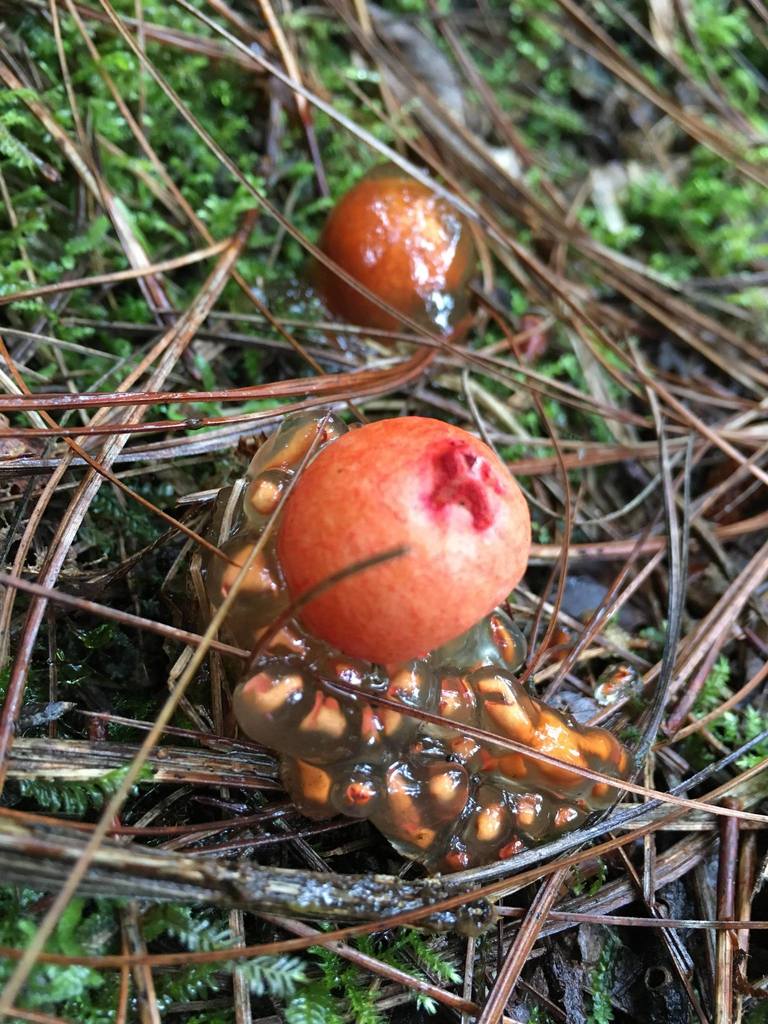
stalked puffball-in-aspic
Calostoma cinnabarinum
Calostoma cinnabarinum, commonly known as the red slimy-stalked puffball, stalked puffball-in-aspic, or gelatinous stalked-puffball, is a species of gasteroid fungus in the family Sclerodermataceae. It is the type species of the genus Calostoma. Despite its appearance and common name, C. cinnabarinum is not related to the true puffballs, members of Podaxis (also commonly called "stalked puffballs"), earthstars or stinkhorns. However, during its complex taxonomic history, it has variously been confused it with each of those groups, prior to the advent of molecular phylogenetics.
The fruit body has a distinctive color and overall appearance, featuring a layer of yellowish jelly surrounding a bright red, spherical head approximately 2 centimeters (0.8 in) in diameter atop a red or yellowish brown spongy stipe 1.5 to 4 cm (0.6 to 2 in) tall. The innermost layer of the head is the gleba, containing clear or slightly yellowish elliptical spores, measuring 14–20 micrometers (μm) long by 6–9 μm across. The spore surface features a pattern of small pits, producing a net-like appearance. It is distributed in the Americas and East Asia, where it grows on the ground in deciduous forests, forming mycorrhizal associations with oaks. Although eaten or used in folk medicine in some areas, it is typically considered inedible.
From the article Calostoma cinnabarinum on Wikipedia (CC BY-SA), quoted section by section
Description
The appearance of the fruit bodies has been compared to amphibian eggs or "small red tomato[es] surrounded by jelly". They consist of a bright red, globose head atop a net-like stipe, covered in a thick gelatinous layer. These fruit bodies are initially hypogeous, but emerge from the ground as the stipe continues to expand. The head is up to 2 cm (0.8 in) in diameter and typically nearly round, although in some populations, it is visibly oval and may be slightly smaller or larger. The internal structure of the head is complex, sometimes described as an exoperidium and endoperidium that each possess sublayers, and sometimes as distinct layers. The outermost is a yellowish, translucent coating of jelly-like material 4 to 9 millimetres (0.2 to 0.4 in) thick, somewhat similar to a gelatinous universal veil. Below this coating is a thin, cinnabar-red membrane. As the mushroom ages, these outer layers break down and fall away from the head. Pieces of the red membrane become embedded in the remaining gelatinous material, giving them the appearance of small red seeds. This process reveals the endoperidium, a tough, non-gelatinous layer that does not break apart. When first revealed, it has a powdery, bright red surface that weathers to orange or pale yellow as the powder wears away. Bright red apical ridges or rays form a peristome. …
Range & habitat
Widely distributed, C. cinnabarinum can be found from Massachusetts south to Florida in the United States. Its range extends at least as far west as Texas, with possible populations in the Southwest, but is most common in the Appalachian Mountains where it becomes more frequent with increasing elevation. It is also present in Eastern Mexico, where it grows in the subtropical cloud forests of Veracruz and Hidalgo. In Central America, it is known from Belize's Chiquibul National Park, the cloud forests of Baja Verapaz and El Quiché in Guatemala, and Panama. The species is also recorded in South America, from Colombia as far southeast as Brazil, where it is described as rare. It has also been collected from a disjunct population in Asia, where it has been recorded from seven provinces in mainland China, mostly in the southeast, including Taiwan, as well as from Indonesia, Japan, and Jirisan in South Korea. Calostoma cinnabarinum was thought to be saprotrophic, and has been described in this manner in both scholarly and popular discussions of the species. However, this classification was the result of its taxonomic history and comparisons with saprotrophic fungi that are not closely related. After its assignment to the Sclerodermatineae, a suborder whose members are ectomycorrhizal, its ecological role came into question. …
Wikipedia: “Distribution, habitat, and ecology”
At the table
As with all members of its genus, C. cinnabarinum is generally considered inedible by field guides. Because the fruit bodies begin development underground, they are too tough for consumption by the time they are visible, and their appearance may be considered unappetizing. A study of the cultural practices of mestizo descendants of the Otomi people in Tenango de Doria, Mexico, reported that immature specimens of C. cinnabarinum, known locally as yemitas, were frequently eaten raw in the past, especially by children. Consumption of the species was no longer commonplace, with only five of the 450 locals interviewed familiar with the practice. The gleba of C. cinnabarinum has been described as having a mild taste and, despite a local recollection to the contrary, is not sweet. C. cinnabarinum has also been used in traditional medicine. A 1986 ethnomycological study of native traditions in Veracruz identified this use of huang noono, which locals roasted, then consumed as a powder with mineral water to treat gastrointestinal distress. Unlike these Mexican traditions, Hunan folk beliefs hold that the mushroom is poisonous on account of its bright color.
Wikipedia: “Uses”
In human culture
The specific epithet cinnabarinum is derived from the Ancient Greek word kinnábari (κιννάβαρι), and refers to its "cinnabar-red" color, like that of dragon's blood. Its names in the English vernacular include "stalked puffball-in-aspic", "red slimy-stalked puffball", "aspic puffball", "gelatinous-stalked puffball", and "hot lips". In central Mexico, it is known as "orchid fungus" in both Spanish (hongo orquídea) and Nahuatl (huang noono).
Wikipedia: “Etymology”
Where it lives
Recorded sightings
—
geo-referenced records in GBIF, from museums, herbaria and field observers.
Drag the globe to turn it. Dots are where records exist, not a range map; darker means more records.
In the stacks
Searching the stacks…
Every page naming Calostoma cinnabarinum in the Biodiversity Heritage Library →
This page is assembled live from iNaturalist, GBIF, Wikipedia, the Source Library and the Internet Archive. It is not yet part of the hand-edited codex. iNaturalist taxon 68153.