- Plants
- ›Vascular Plants
- ›conifers
- ›conifers
- ›pine family
- ›firs, hemlocks, cedars, and allies
- ›Abies
- ›Nobilis
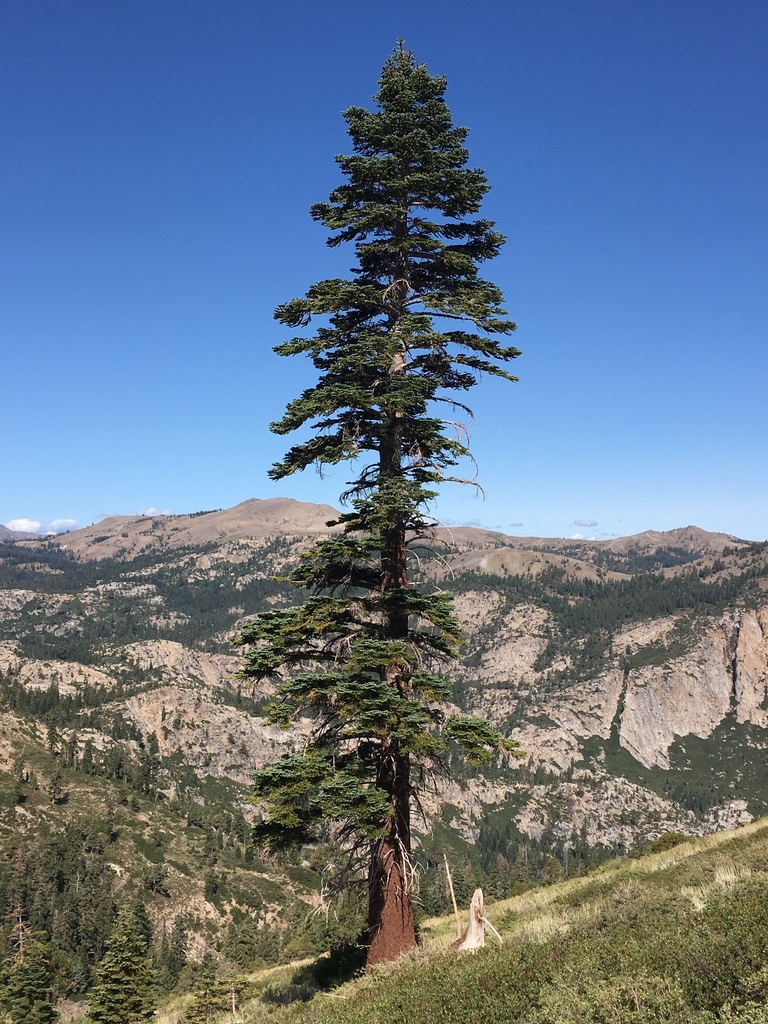
red fir
Abies magnifica
Abies magnifica, the red fir or silvertip fir, is a western North American fir, native to the mountains of southwest Oregon and California in the United States. It is a high elevation tree, typically occurring at 1,400–2,700 metres (4,600–8,900 ft) elevation, though only rarely reaching tree line. The name red fir derives from the bark color of old trees.
From the article Abies magnifica on Wikipedia (CC BY-SA), quoted section by section
Description
Abies magnifica is a large evergreen tree typically up to 40–60 metres (130–200 ft) tall and 2 m (6 ft 7 in) trunk diameter, rarely to 76.5 m (251 ft) tall and 3 m (9 ft 10 in) diameter, with a narrow conic crown. The bark on young trees is smooth, grey, and has resin blisters, becoming orange-red, rough and fissured on old trees. The leaves are needle-like, 2–3.5 centimetres (3⁄4–1+1⁄2 in) long, glaucous blue-green above and below with strong stomatal bands, and an acute tip. They are arranged spirally on the shoot, but twisted slightly S-shaped to be upcurved above the shoot. The cones are erect, 9–21 cm (3+1⁄2–8+1⁄4 in) long, yellow-green (occasionally purple), ripening brown and disintegrating to release the winged seeds in fall.
Related. Red fir is very closely related to Abies procera (noble fir), which replaces it further north in the Cascade Range. They are best distinguished by the leaves; noble fir leaves have a groove along the midrib on the upper side, while red fir does not show this. Red fir also tends to have the leaves less closely packed, with the shoot bark visible between the leaves, whereas the shoot is largely hidden in noble fir. Shasta red fir hybridizes with noble fir, with which it is both chemically and microscopically similar; some botanists treat the former as a natural hybrid between red and noble fir.
At the table
The wood is used for general structural purposes and paper manufacture. It is also a popular Christmas tree, with a 53-foot red fir from the Humboldt–Toiyabe National Forest being used as the 2025 Capitol Christmas Tree. Paiute peoples used the foliage of Shasta red fir (or perhaps noble fir) to treat coughs and colds.
Wikipedia: “Uses”
Where it lives
Recorded sightings
—
geo-referenced records in GBIF, from museums, herbaria and field observers.
Drag the globe to turn it. Dots are where records exist, not a range map; darker means more records.
In the stacks
Searching the stacks…
Every page naming Abies magnifica in the Biodiversity Heritage Library →
This page is assembled live from iNaturalist, GBIF, Wikipedia, the Source Library and the Internet Archive. It is not yet part of the hand-edited codex. iNaturalist taxon 68090.