- Animals
- ›Arthropods
- ›Chelicerates
- ›Arachnids
- ›Spiders
- ›Typical Spiders
- ›Entelegyne Spiders
- ›RTA Clade Spiders
- ›Oval calamistrum clade spiders
- ›Wolf Spiders and Allies
- ›Wolf Spiders
- ›Tricassinae
- ›Arctosa
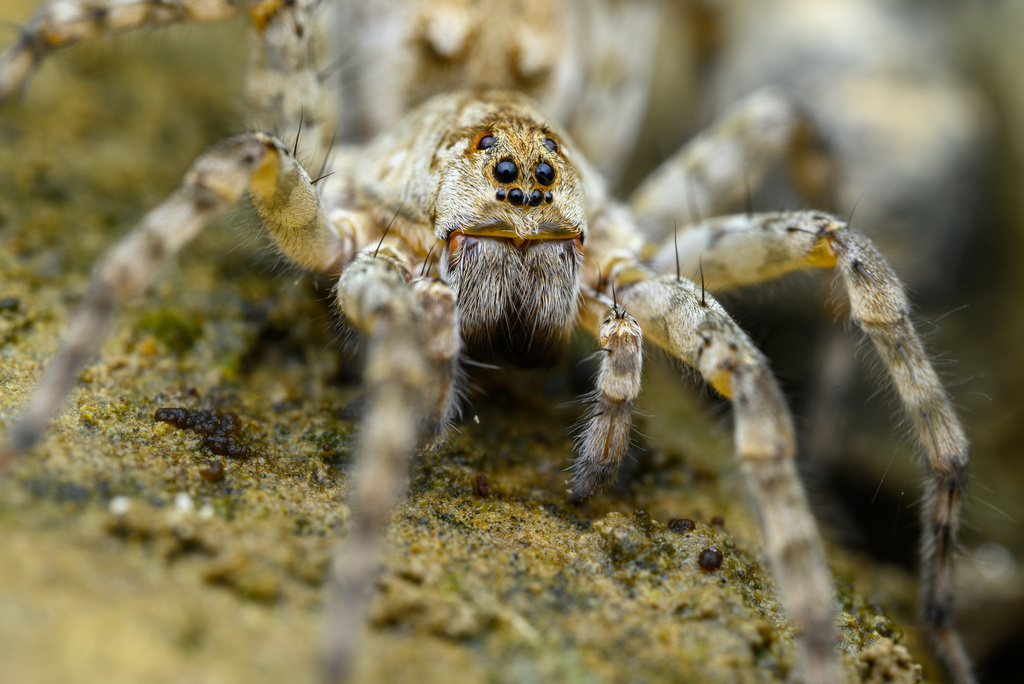
Shoreline Wolf Spider
Arctosa littoralis
Arctosa littoralis, the beach wolf spider, is a species of wolf spider in the family Lycosidae. It is found in North and Central America.
From the article Arctosa littoralis on Wikipedia (CC BY-SA), quoted section by section
Description
These spiders have mottled white, gray, or brown bodies that enable them to camouflage against sand. Females tend to be slightly larger, with an average body length (excluding legs) of 11.2 to 14.7 mm, compared to 9.6 to 12.8 mm for males.
Range & habitat
A. littoralis is found in sandy substrates within scrub habitats, grass-shrub associations, seashores, riverbanks, and lakes across North and Central America.
Wikipedia: “Habitat and distribution”
What it does
They are active during both daylight and nighttime hours. Females typically store their egg sacs under rocks or within burrows, which they can construct by bonding grains of sand together with their silk. Once they hatch, the spiderlings are carried on their mother's back until they molt and disperse. Like other wolf spiders, A. littoralis chases and attacks prey and does not spin webs.
Wikipedia: “Behavior”
Where it lives
Recorded sightings
—
geo-referenced records in GBIF, from museums, herbaria and field observers.
Drag the globe to turn it. Dots are where records exist, not a range map; darker means more records.
In the stacks
Searching the stacks…
Every page naming Arctosa littoralis in the Biodiversity Heritage Library →
This page is assembled live from iNaturalist, GBIF, Wikipedia, the Source Library and the Internet Archive. It is not yet part of the hand-edited codex. iNaturalist taxon 67712.