- Animals
- ›Arthropods
- ›Chelicerates
- ›Arachnids
- ›Spiders
- ›Typical Spiders
- ›Entelegyne Spiders
- ›Orbweavers and Allies
- ›Orbweavers
- ›Argiopinae
- ›Argiope
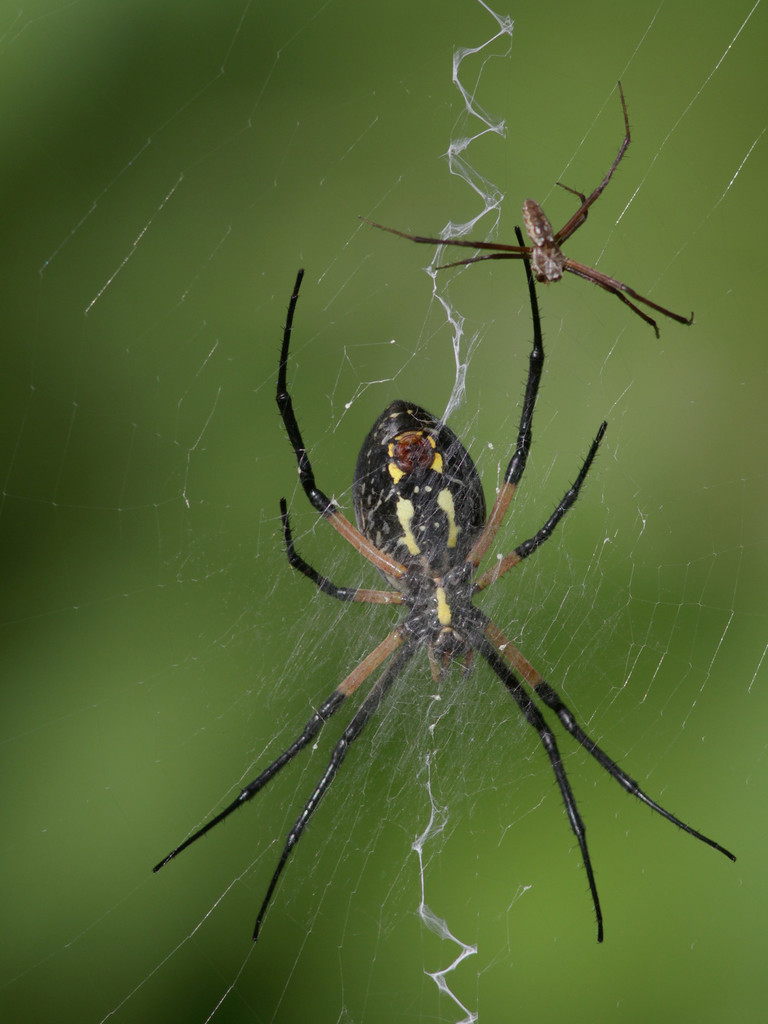
Yellow Garden Spider
Argiope aurantia
Argiope aurantia is a species of spider, commonly known as the yellow garden spider, black and yellow garden spider, golden garden spider, writing spider, zigzag spider, zipper spider, black and yellow argiope, corn spider, Steeler spider, or McKinley spider. The species was first described by Hippolyte Lucas in 1833. It is common in the contiguous United States, Hawaii, southern Canada, Mexico, and Central America. It has distinctive yellow and black markings on the abdomen and a mostly white cephalothorax. Its scientific Latin name translates to "gilded silver-face" (the genus name Argiope meaning "silver-face", while the specific epithet aurantia means "gilded"). The body length of males ranges from 5–9 mm (0.20–0.35 in); females range from 19–28 mm (0.75–1.10 in). The average female body mass is about 752.0 mg. These spiders may bite if disturbed or harassed, but the venom is harmless to non-allergic humans, roughly equivalent to a bumblebee sting in intensity.
From the article Argiope aurantia on Wikipedia (CC BY-SA), quoted section by section
Range & habitat
Yellow garden spiders often build webs in areas adjacent to open sunny fields where they stay concealed and protected from the wind. The spider can also be found along the eaves of houses and outbuildings or in any tall vegetation where they can securely stretch a web. Female Argiope aurantia spiders tend to be somewhat local, often staying in one place throughout much of their lifetime. The web of the yellow garden spider is distinctive: a circular shape up to 2 feet (60 cm) in diameter, with a dense zigzag of silk, known as a stabilimentum, in the center. The purpose of the stabilimentum is disputed. It is possible that it acts as camouflage for the spider lurking in the web's center, but it may also attract insect prey, or even warn birds of the presence of the otherwise difficult-to-see web. Only those spiders that are active during the day construct stabilimenta in their webs. To construct the web, several radial lines are stretched among four or five anchor points that can be more than three feet apart. The radial lines meet at a central point. The spider makes a frame with several more radial lines and then fills the center with a spiral of silk, leaving a 7.9–9.5 mm (0.31–0.37 in) gap between the spiral rings, starting with the innermost ring and moving outward in a clockwise motion. …
Wikipedia: “Habitat”
What it does
Yellow garden spiders breed twice a year. The males roam in search of a female, building a small web near or actually in the female's web, then court the female by plucking strands on her web. Often, when the male approaches the female, he has a safety drop line ready, in case she attacks him. The male uses the palpal bulbs on his pedipalps to transfer sperm to the female. After inserting the second palpal bulb, the male dies, and is sometimes then eaten by the female. The female lays her eggs at night on a sheet of silky material, then covers them with another layer of silk, then a protective brownish silk. She then uses her legs to form the sheet into a ball with an upturned neck. Egg sacs range from 5/8" to 1" in diameter. The location of the egg sac varies. She sometimes suspends the egg sac near her web or places it several feet from the web. Each spider produces from one to four sacs with perhaps over a thousand eggs inside each. Females produce clutches containing approximately 978 eggs. Each egg measures about 0.92 mm in diameter and weighs around 0.46 mg. In the spring, the young spiders exit the sac. They are so tiny that they look like dust gathered inside the silk mesh. Some of the spiderlings remain nearby, but others exude a strand of silk that gets caught by the breeze, carrying the spiderling to a more distant area.
Wikipedia: “Reproduction”
Toxicity
Argiope spiders are not aggressive. They might bite if grabbed, but other than for defense they do not attack large animals. Their venom often contains a library of polyamine toxins with potential as therapeutic medicinal agents. Notable among these is the argiotoxin ArgTX-636. A bite by Argiope aurantia is comparable to a bee sting, with redness and swelling. For a healthy adult, a bite is not considered an issue. Though these spiders are not aggressive, people who are very young, elderly, or who have compromised immune systems should exercise caution, just as they would around a beehive or a hornet nest.
Wikipedia: “Venom”
Where it lives
Recorded sightings
—
geo-referenced records in GBIF, from museums, herbaria and field observers.
Drag the globe to turn it. Dots are where records exist, not a range map; darker means more records.
In the stacks
Searching the stacks…
Every page naming Argiope aurantia in the Biodiversity Heritage Library →
This page is assembled live from iNaturalist, GBIF, Wikipedia, the Source Library and the Internet Archive. It is not yet part of the hand-edited codex. iNaturalist taxon 67707.