- Animals
- ›Arthropods
- ›Chelicerates
- ›Arachnids
- ›Spiders
- ›Typical Spiders
- ›Entelegyne Spiders
- ›Salticoid Spiders
- ›Jumping Spiders
- ›Typical Jumping Spiders
- ›Plexippini
- ›Plexippina
- ›Evarcha
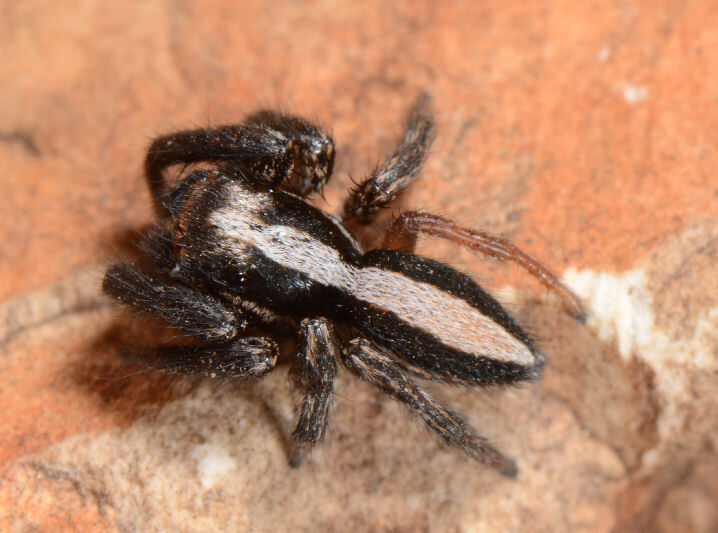
Evarcha vittula
Evarcha vittula, the White-banded Evarcha Jumping Spider, is a species of jumping spider in the genus Evarcha that lives in South Africa. The species was first described in 2011 by Charles Haddad and Wanda Wesołowska. The spider is small, with a carapace measuring between 2.4 and 3.2 mm (0.09 and 0.13 in) long and an abdomen between 2.5 and 3.6 mm (0.10 and 0.14 in) long. There is a delicate scutum on the abdomen. The spider is generally dark brown but there is an orange streak down the middle of the upper surface of both the abdomen and carapace. This streak helps distinguish the spider from others in the genus. It can also be identified by its copulatory organs. The male has a characteristic short straight embolus. The female has not been described.
From the article Evarcha vittula on Wikipedia (CC BY-SA), quoted section by section
Description
Evarcha vittula is small to medium-sized with looks that are typical for the genus. The male has a carapace that is between 2.4 and 3.2 mm (0.09 and 0.13 in) long and 1.8 and 2.0 mm (0.07 and 0.08 in) wide. It is a dark brown oval spider with an orange streak down the middle of the top and white hairs on the side. The eye field is black with fawn scales around the front eyes. The underside, or sternum, is light brown. The mouthparts are distinctive with black chelicerae, brown labium and brown maxillae that have lighter edges where they chew. The spider's abdomen is similar in size to the carapace, measuring 2.5 and 3.6 mm (0.10 and 0.14 in) long and 1.5 and 1.7 mm (0.06 and 0.07 in) wide. There is a delicate scutum on the front third of the abdomen. The underside is grey and has two narrow dark stripes. The spider has grey spinnerets. The dark brown legs have dense dark hairs and many spines. The pedipalps are brown. The spider has distinctive copulatory organs. There is a long straight projection from the palpal tibia called a tibial apophysis. The palpal bulb is rounded with a bulge sticking out of the middle and a very short embolus. The tibia has long hairs, with shorter hairs projecting from the palpal bulb itself. The female has not been described. The species can be distinguished from others in the genus by the striped pattern on its abdomen. …
Range & habitat
Evarcha spiders live across the world, although those found in North America may be accidental migrants. The genus is found in many parts of Africa. Evarcha vittula is endemic to South Africa. The male holotype for the species was found in the Erfenis Dam Nature Reserve in Free State in 2009. Examples have also been found across the province including in the Willem Pretorius Game Reserve. The first example seen outside the province was collected in 2010 in KwaZulu-Natal. It is likely to also live in the provinces of Gauteng, Northern Cape and North West. In comparison to other spiders in the genus, Evarcha vittula prefers to live in grass-dominated environments. It thrives in open grasslands with scattered trees, living under rocks and on grass tussocks woodlands. Some examples have been found amongst woodland of Rhus lancea trees. Others have been seen openly on the exposed surface of rocks.
Wikipedia: “Distribution and habitat”
Where it lives
Recorded sightings
—
geo-referenced records in GBIF, from museums, herbaria and field observers.
Drag the globe to turn it. Dots are where records exist, not a range map; darker means more records.
In the stacks
Searching the stacks…
Every page naming Evarcha vittula in the Biodiversity Heritage Library →
This page is assembled live from iNaturalist, GBIF, Wikipedia, the Source Library and the Internet Archive. It is not yet part of the hand-edited codex. iNaturalist taxon 666107.